




Give the classification of cobra with specific reason.
Answer
 Verified
574.5k+ views
Hint: The king cobra—one of the most venomous snakes on earth—can in a real sense "stand up" and look a completely mature individual in the eye. When stood up to, they can lift up to 33% of its body off the ground and still push ahead to assault.
Complete answer:
Classification of cobra:
Realm: Animalia
Phylum: Chordata
Class: Reptilian
Request: Squamae
Suborder: Serpents
Family: Lapidate
Since all cobras have a couple of proteroglyphous teeth used to infuse toxin from organs situated towards the back of the upper jaws, they are put in Lapidate alongside different venomous snakes.
King cobra Habitat and behavior: king cobras live principally in the tropical jungles and fields of India, southern China, and Southeast Asia, and their shading can change extraordinarily from district to area. They are agreeable in an assortment of living spaces, including woods, bamboo bushes, mangrove swamps, high-height prairies, and in rivers. This species takes care of primarily different snakes, venomous and nonvenomous.
They will likewise eat reptiles, eggs, and little warm blooded creatures. They are the main snakes on the planet that manufacture homes for their eggs, which they watch fiercely until the hatchlings rise.
Snake charmers: cobras might be most popular as the types of decision for the snake charmers of South Asia. In spite of the fact that cobras can hear, they are really hard of hearing to surrounding commotions, detecting ground vibrations. Snake beguiling is "frequently a pitiful con game in which a depleted cobra is put on edge, yet molded (with torment) not to strike the flute player," Smithsonian's National Zoo says.
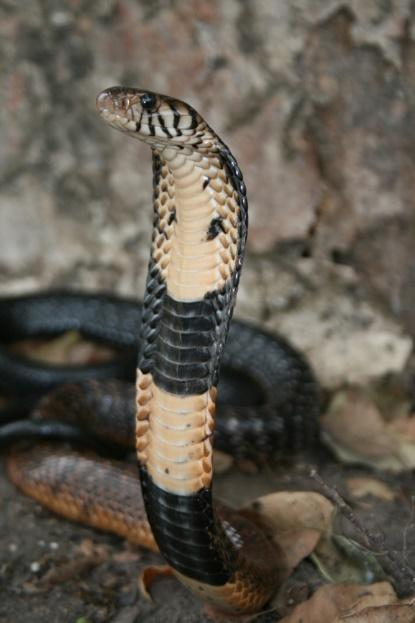
Note: In Vietnam, the cobra is a secure animal type. Ensured zones inside this current snake's geographic range probably give a few shields, and associations like the King Cobra Conservancy work to more readily comprehend the practices of the species so as to teach general society and secure the snake's environment.
Complete answer:
Classification of cobra:
Realm: Animalia
Phylum: Chordata
Class: Reptilian
Request: Squamae
Suborder: Serpents
Family: Lapidate
Since all cobras have a couple of proteroglyphous teeth used to infuse toxin from organs situated towards the back of the upper jaws, they are put in Lapidate alongside different venomous snakes.
King cobra Habitat and behavior: king cobras live principally in the tropical jungles and fields of India, southern China, and Southeast Asia, and their shading can change extraordinarily from district to area. They are agreeable in an assortment of living spaces, including woods, bamboo bushes, mangrove swamps, high-height prairies, and in rivers. This species takes care of primarily different snakes, venomous and nonvenomous.
They will likewise eat reptiles, eggs, and little warm blooded creatures. They are the main snakes on the planet that manufacture homes for their eggs, which they watch fiercely until the hatchlings rise.
Snake charmers: cobras might be most popular as the types of decision for the snake charmers of South Asia. In spite of the fact that cobras can hear, they are really hard of hearing to surrounding commotions, detecting ground vibrations. Snake beguiling is "frequently a pitiful con game in which a depleted cobra is put on edge, yet molded (with torment) not to strike the flute player," Smithsonian's National Zoo says.
Note: In Vietnam, the cobra is a secure animal type. Ensured zones inside this current snake's geographic range probably give a few shields, and associations like the King Cobra Conservancy work to more readily comprehend the practices of the species so as to teach general society and secure the snake's environment.
Recently Updated Pages
Master Class 11 Computer Science: Engaging Questions & Answers for Success

Master Class 11 Business Studies: Engaging Questions & Answers for Success
Master Class 11 Economics: Engaging Questions & Answers for Success
Master Class 11 English: Engaging Questions & Answers for Success
Master Class 11 Maths: Engaging Questions & Answers for Success
Master Class 11 Biology: Engaging Questions & Answers for Success
Trending doubts
One Metric ton is equal to kg A 10000 B 1000 C 100 class 11 physics CBSE
There are 720 permutations of the digits 1 2 3 4 5 class 11 maths CBSE
Discuss the various forms of bacteria class 11 biology CBSE
Draw a diagram of a plant cell and label at least eight class 11 biology CBSE
State the laws of reflection of light
Explain zero factorial class 11 maths CBSE