




Give IUPAC name of the following compounds:
(a) ${{C}}{{{H}}_3}{{C}}{{{H}}_2}{{C}}{{{H}}_2}{{OH}}$
(b) ${{HCOOH}}$
(c) ${{C}}{{{H}}_3}{{CH = CHC}}{{{H}}_3}$
Answer
 Verified
625.5k+ views
Hint: Organic chemical compounds are named based on IUPAC nomenclature. The International Union of Pure and Applied Chemistry is abbreviated as IUPAC. First we have to find the functional group present in each compound followed by the longest carbon chain or the parent chain.
Complete step by step answer:
Let’s focus on the given options.
(a) The structure of ${{C}}{{{H}}_3}{{C}}{{{H}}_2}{{C}}{{{H}}_2}{{OH}}$ is given below:

The molecular formula of this compound is ${{{C}}_3}{{{H}}_7}{{O}}$. There are three carbon atoms, seven hydrogen atoms and one oxygen atom. The functional group present in the molecule is the hydroxyl group. This is used to denote the alcohols. Thus a suffix of “ol” is used in the chemical name. “Prop” is used to denote the carbon number three. There is only a single bond. So “ane” is used. Hydroxyl group is placed at the first carbon when we count the number of carbon atoms from right to left. By combining these information, we get the IUPAC name as propan-1-ol.
(b) The structure of ${{HCOOH}}$ is given below:

This compound has a carbonyl carbon and a hydroxyl group. The functional group present in this molecule is carboxylic group. The molecular formula of this compound is ${{C}}{{{H}}_2}{{{O}}_2}$. “Meth” is used as a parent name since the compound has only one carbon atom. Carboxylic acid functional group is denoted with “oic acid” as a suffix in the IUPAC name. This compound also has a single bond, hence “ane” is used. So the IUPAC name is methanoic acid.
(c) The structure of ${{C}}{{{H}}_3}{{CH = CHC}}{{{H}}_3}$ is given below:
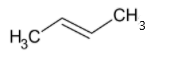
This compound is an example of alkene since it has a double bond between two carbon atoms. The molecular formula of this compound is ${{{C}}_4}{{{H}}_8}$. The double bond is placed between the second and third carbon atoms. For alkenes, “ene” is used as a suffix. “But” is used as a parent name since it contains four carbon atoms. So the IUPAC name is but-2-ene.
Note: When the substituent groups are more than one, then it must be named according to their alphabetical order. Moreover, when a substituent group has appeared two or more times, then it is named as di, tri and so on.
Complete step by step answer:
Let’s focus on the given options.
(a) The structure of ${{C}}{{{H}}_3}{{C}}{{{H}}_2}{{C}}{{{H}}_2}{{OH}}$ is given below:
The molecular formula of this compound is ${{{C}}_3}{{{H}}_7}{{O}}$. There are three carbon atoms, seven hydrogen atoms and one oxygen atom. The functional group present in the molecule is the hydroxyl group. This is used to denote the alcohols. Thus a suffix of “ol” is used in the chemical name. “Prop” is used to denote the carbon number three. There is only a single bond. So “ane” is used. Hydroxyl group is placed at the first carbon when we count the number of carbon atoms from right to left. By combining these information, we get the IUPAC name as propan-1-ol.
(b) The structure of ${{HCOOH}}$ is given below:
This compound has a carbonyl carbon and a hydroxyl group. The functional group present in this molecule is carboxylic group. The molecular formula of this compound is ${{C}}{{{H}}_2}{{{O}}_2}$. “Meth” is used as a parent name since the compound has only one carbon atom. Carboxylic acid functional group is denoted with “oic acid” as a suffix in the IUPAC name. This compound also has a single bond, hence “ane” is used. So the IUPAC name is methanoic acid.
(c) The structure of ${{C}}{{{H}}_3}{{CH = CHC}}{{{H}}_3}$ is given below:
This compound is an example of alkene since it has a double bond between two carbon atoms. The molecular formula of this compound is ${{{C}}_4}{{{H}}_8}$. The double bond is placed between the second and third carbon atoms. For alkenes, “ene” is used as a suffix. “But” is used as a parent name since it contains four carbon atoms. So the IUPAC name is but-2-ene.
Note: When the substituent groups are more than one, then it must be named according to their alphabetical order. Moreover, when a substituent group has appeared two or more times, then it is named as di, tri and so on.
Recently Updated Pages
Which will be the least stable resonating structure class 11 chemistry CBSE

How many 5 digit telephone numbers can be construc-class-11-maths-CBSE
How do you find the angle of the resultant vector class 11 physics CBSE
Draw labelled diagram of the following i Gram seed class 11 biology CBSE
1 Quintal is equal to a 110 kg b 10 kg c 100kg d 1000 class 11 physics CBSE
What is the need and importance of classification class 11 biology CBSE
Trending doubts
One Metric ton is equal to kg A 10000 B 1000 C 100 class 11 physics CBSE
Find the value of the expression given below sin 30circ class 11 maths CBSE
Draw a diagram of nephron and explain its structur class 11 biology CBSE
10 examples of friction in our daily life
Proton was discovered by A Thomson B Rutherford C Chadwick class 11 chemistry CBSE
The teeth used for biting and cutting food are called class 11 biology CBSE