




Give examples of Gamosepalous, Polysepalous, Gamopetalous and Polypetalous based on Calyx and Corolla respectively.
Answer
 Verified
569.7k+ views
Hint: Calyx and Corolla are the important floral whorls of the flower. The Calyx is the utmost whorl which comprises green fused or separate sepals. The Corolla is the second important whorl which is the petals. The Calyx and the Corolla are the non-reproductive parts of the flower.
Complete answer:
The angiosperm plants contain flowers. The group of sepals are known as Calyx. They are mostly green in colour. The main function of the Calyx is to protect the flower bud and also to hold the petals. It does not play any role in reproduction.
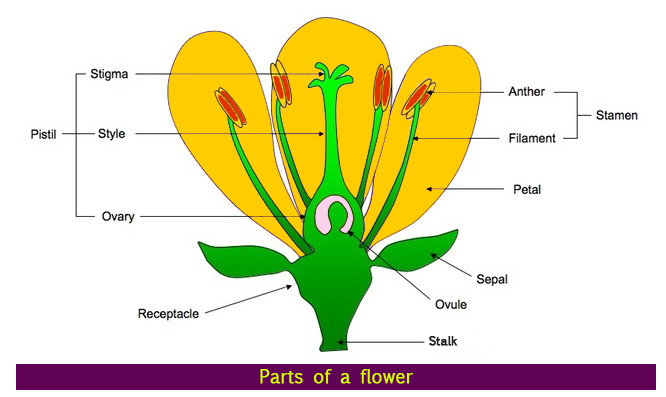
Parts of the flower are shown in the figure below:
The sepals are of two types based on the arrangement-
i) Gamosepalous: The flowers which have fused sepals are known as gamosepalous.
Examples: Hibiscus or China rose.
ii) Polysepalous: The flowers in which the sepals are free.
Example: Rose.
The group of petals are known as the Corolla. The function of the petals is to protect the reproductive whorls or the flower. The petals are mostly coloured and attractive so that they can attract the pollinators like bees for bringing about pollination.
Based on the arrangement the petals are of two types-
i) Gamopetalous: The flowers in which the petals are fused or united are known as gamopetalous flowers.
Example: Elderberry.
ii) Polypetalous: The flowers in which the petals are free.
Example: Rose.
Note: The arrangement of sepals and petals are the characteristic identifying feature of a particular family. The other two important reproductive whorls of flower are androecium( male reproductive) which comprises stamens and the female reproductive gynoecium which comprises stigma, style and ovary.
Complete answer:
The angiosperm plants contain flowers. The group of sepals are known as Calyx. They are mostly green in colour. The main function of the Calyx is to protect the flower bud and also to hold the petals. It does not play any role in reproduction.
Parts of the flower are shown in the figure below:
The sepals are of two types based on the arrangement-
i) Gamosepalous: The flowers which have fused sepals are known as gamosepalous.
Examples: Hibiscus or China rose.
ii) Polysepalous: The flowers in which the sepals are free.
Example: Rose.
The group of petals are known as the Corolla. The function of the petals is to protect the reproductive whorls or the flower. The petals are mostly coloured and attractive so that they can attract the pollinators like bees for bringing about pollination.
Based on the arrangement the petals are of two types-
i) Gamopetalous: The flowers in which the petals are fused or united are known as gamopetalous flowers.
Example: Elderberry.
ii) Polypetalous: The flowers in which the petals are free.
Example: Rose.
Note: The arrangement of sepals and petals are the characteristic identifying feature of a particular family. The other two important reproductive whorls of flower are androecium( male reproductive) which comprises stamens and the female reproductive gynoecium which comprises stigma, style and ovary.
Recently Updated Pages
Which will be the least stable resonating structure class 11 chemistry CBSE

How many 5 digit telephone numbers can be construc-class-11-maths-CBSE
How do you find the angle of the resultant vector class 11 physics CBSE
Draw labelled diagram of the following i Gram seed class 11 biology CBSE
1 Quintal is equal to a 110 kg b 10 kg c 100kg d 1000 class 11 physics CBSE
What is the need and importance of classification class 11 biology CBSE
Trending doubts
Find the value of the expression given below sin 30circ class 11 maths CBSE
One Metric ton is equal to kg A 10000 B 1000 C 100 class 11 physics CBSE
10 examples of friction in our daily life
Draw a diagram of a plant cell and label at least eight class 11 biology CBSE
Difference between physical and chemical change class 11 chemistry CBSE
Proton was discovered by A Thomson B Rutherford C Chadwick class 11 chemistry CBSE