



Give an account of the composition of the atmosphere. Also discuss the importance of the components.
Answer
 Verified
539.4k+ views
Hint: Earth’s atmosphere is composed of several gases such as nitrogen ,oxygen , argon and other gases. These gases are used by different organisms residing on the earth.
Complete answer: Nitrogen (approximately 78 percent), oxygen (about 21 percent), argon (about 0.9 percent), carbon dioxide (0.04$\%$), and other gases in tiny amounts make up the Earth's atmosphere. Most species utilise oxygen for respiration; bacteria and lightning fix nitrogen to make ammonia, which is needed in the production of nucleotides and amino acids; and plants, algae, and cyanobacteria utilise carbon dioxide for photosynthesis. Living creatures are protected by the atmosphere from genetic harm caused by solar UV radiation, solar wind, and cosmic rays. The present makeup of the Earth's atmosphere is the result of billions of years of living beings biochemically altering the paleo atmosphere.
Nitrogen and oxygen make up the majority of the atmosphere. They produce nearly all of the clean, dry air in the world. Nitrogen makes up 78$\%$ of the mixture, while oxygen makes up 21$\%$. Aside from these two primary gases, the atmosphere contains a variety of additional gases. Carbon dioxide, argon, and other gases make up 1$\%$ of the total volume. The breath of life is oxygen, while nitrogen aids in the development of living creatures. The earth's heat was absorbed by carbon dioxide. It keeps the world warm in this way. It's also necessary for plant development.
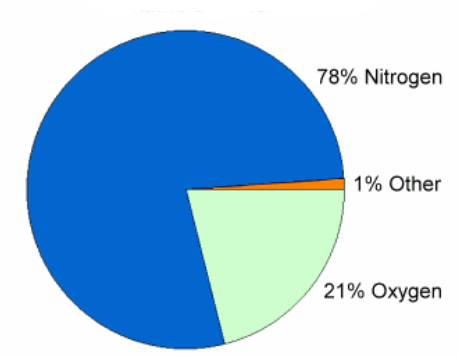
ORANGE - NITROGEN
VIOLET - OXYGEN
ASH - ARGON
BLACK - OTHER GAS
The chemistry and temperature of the local solar nebula during planetary formation, as well as the subsequent escape of internal gases, influence a planet's initial atmospheric makeup. The planets' atmospheres began as a revolving disc of gases that contracted into a series of spaced rings before condensing to create the planets. The atmospheres of the planets were then altered throughout time by a variety of complicated mechanisms, resulting in a variety of results.
Note:
The outer zone of a star, which often includes the section above the opaque photosphere, is known as the stellar atmosphere. Compound molecules may exist in the outer atmospheres of stars with sufficiently low temperatures.
Complete answer: Nitrogen (approximately 78 percent), oxygen (about 21 percent), argon (about 0.9 percent), carbon dioxide (0.04$\%$), and other gases in tiny amounts make up the Earth's atmosphere. Most species utilise oxygen for respiration; bacteria and lightning fix nitrogen to make ammonia, which is needed in the production of nucleotides and amino acids; and plants, algae, and cyanobacteria utilise carbon dioxide for photosynthesis. Living creatures are protected by the atmosphere from genetic harm caused by solar UV radiation, solar wind, and cosmic rays. The present makeup of the Earth's atmosphere is the result of billions of years of living beings biochemically altering the paleo atmosphere.
Nitrogen and oxygen make up the majority of the atmosphere. They produce nearly all of the clean, dry air in the world. Nitrogen makes up 78$\%$ of the mixture, while oxygen makes up 21$\%$. Aside from these two primary gases, the atmosphere contains a variety of additional gases. Carbon dioxide, argon, and other gases make up 1$\%$ of the total volume. The breath of life is oxygen, while nitrogen aids in the development of living creatures. The earth's heat was absorbed by carbon dioxide. It keeps the world warm in this way. It's also necessary for plant development.
ORANGE - NITROGEN
VIOLET - OXYGEN
ASH - ARGON
BLACK - OTHER GAS
The chemistry and temperature of the local solar nebula during planetary formation, as well as the subsequent escape of internal gases, influence a planet's initial atmospheric makeup. The planets' atmospheres began as a revolving disc of gases that contracted into a series of spaced rings before condensing to create the planets. The atmospheres of the planets were then altered throughout time by a variety of complicated mechanisms, resulting in a variety of results.
Note:
The outer zone of a star, which often includes the section above the opaque photosphere, is known as the stellar atmosphere. Compound molecules may exist in the outer atmospheres of stars with sufficiently low temperatures.
Recently Updated Pages
Master Class 11 English: Engaging Questions & Answers for Success

Master Class 11 Social Science: Engaging Questions & Answers for Success
Master Class 11 Maths: Engaging Questions & Answers for Success
Master Class 11 Biology: Engaging Questions & Answers for Success
Master Class 11 Physics: Engaging Questions & Answers for Success
Master Class 11 Chemistry: Engaging Questions & Answers for Success
Trending doubts
In Indian rupees 1 trillion is equal to how many c class 8 maths CBSE
What is BLO What is the full form of BLO class 8 social science CBSE
What helps Frog to breathe underwater class 8 biology CBSE
Citizens of India can vote at the age of A 18 years class 8 social science CBSE
Which of the following leader has given the term insensate class 8 social science CBSE
Name the states through which the Tropic of Cancer class 8 social science CBSE