




Give a brief description of three parts of the stomach.
Answer
 Verified
401.1k+ views
Hint: The stomach constitutes an important part of the digestive system. It produces various enzymes that help in the breakdown of food to facilitate the absorption of nutrients.
Complete step-by-step answer:
The stomach is a J-shaped organ that produces acids and enzymes for the digestion of food. It is situated between the oesophagus and the duodenal region of the small intestine. It is located in the upper quadrant of the abdomen.
It functions to store food temporarily, consists of specialised cells that secrete enzymes for digestion, and contracts and relaxes mechanically to break down food.
The stomach can be divided into five separate sections- cardia, fundus, body, antrum, and pylorus.
Cardia: It is the top portion of the stomach. It houses the cardiac sphincter, which prevents the regurgitation of food back into the oesophagus.
Fundus: It is located next to the cardia situated below the diaphragm. It is the upper curved part of the stomach.
Corpus/Body: It is the major central region of the stomach. It helps in the mechanical churning and breakdown of food.
Antrum: It is located below the body of the stomach. It temporarily holds the food before sending it to the small intestine.
Pylorus: It is the lowermost region. It houses the pyloric sphincter. This tissue controls the movement of the stomach content into the small intestine.
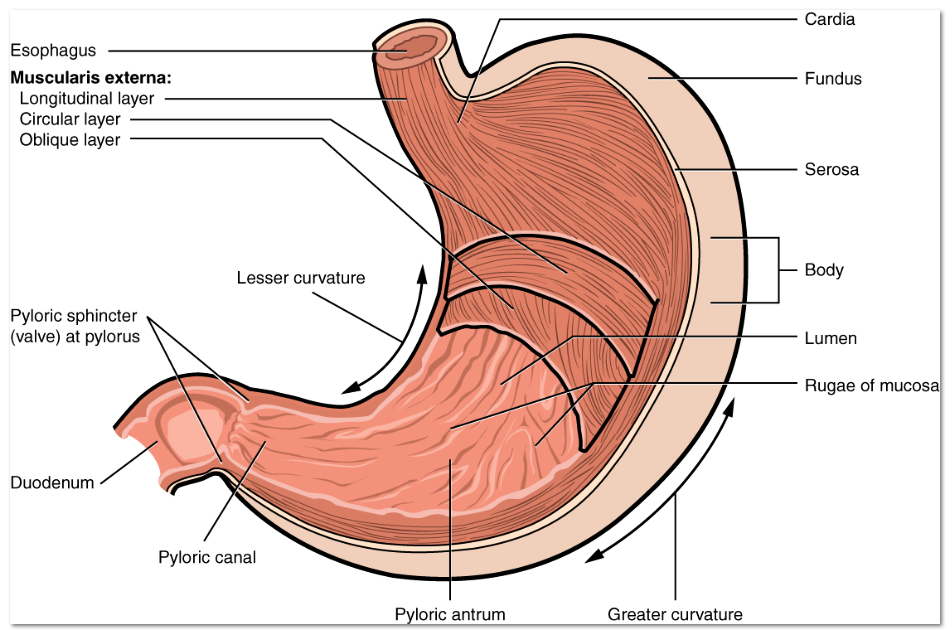
Image: Parts of the stomach
Note: The stomach is supplied with arteries from the celiac trunk of the first major visceral branch from the abdominal aorta. The nerves of the sympathetic and parasympathetic divisions of the autonomic nervous system innervate the stomach. The 10th cranial or the vagus nerve of the parasympathetic nerve fibres is involved.
Complete step-by-step answer:
The stomach is a J-shaped organ that produces acids and enzymes for the digestion of food. It is situated between the oesophagus and the duodenal region of the small intestine. It is located in the upper quadrant of the abdomen.
It functions to store food temporarily, consists of specialised cells that secrete enzymes for digestion, and contracts and relaxes mechanically to break down food.
The stomach can be divided into five separate sections- cardia, fundus, body, antrum, and pylorus.
Cardia: It is the top portion of the stomach. It houses the cardiac sphincter, which prevents the regurgitation of food back into the oesophagus.
Fundus: It is located next to the cardia situated below the diaphragm. It is the upper curved part of the stomach.
Corpus/Body: It is the major central region of the stomach. It helps in the mechanical churning and breakdown of food.
Antrum: It is located below the body of the stomach. It temporarily holds the food before sending it to the small intestine.
Pylorus: It is the lowermost region. It houses the pyloric sphincter. This tissue controls the movement of the stomach content into the small intestine.
Image: Parts of the stomach
Note: The stomach is supplied with arteries from the celiac trunk of the first major visceral branch from the abdominal aorta. The nerves of the sympathetic and parasympathetic divisions of the autonomic nervous system innervate the stomach. The 10th cranial or the vagus nerve of the parasympathetic nerve fibres is involved.
Recently Updated Pages
Master Class 9 Social Science: Engaging Questions & Answers for Success

Master Class 9 Science: Engaging Questions & Answers for Success
Master Class 9 Maths: Engaging Questions & Answers for Success
Master Class 9 General Knowledge: Engaging Questions & Answers for Success
Class 9 Question and Answer - Your Ultimate Solutions Guide
Master Class 8 Social Science: Engaging Questions & Answers for Success
Trending doubts
The common characteristics between tomato and potato class 11 biology NEET_UG
What is the full form of PNG A Petrol Natural Gas B class 10 chemistry CBSE
What are gulf countries and why they are called Gulf class 8 social science CBSE
Which are the Top 10 Largest Countries of the World?
One Metric ton is equal to kg A 10000 B 1000 C 100 class 11 physics CBSE
Explain the Treaty of Vienna of 1815 class 10 social science CBSE