



Give a brief account of the countercurrent mechanism.
Answer
 Verified
592.8k+ views
Hint: The exchange of a substance between the two fluids flowing in opposite directions is termed as counter-current flow. In the kidney, the position and proximity of limbs of Henle's loop and vasa recta will perform this mechanism.
Complete answer:
Nephrons in the kidney produce urine and also concentrate or dilute it according to the diet or environment. The countercurrent mechanism helps to concentrate the filtrate which occurs in the loop of Henle and vasa recta in the medulla region of the kidney. The flow of fluids in opposite directions is maintained by their flow in the two loops- ascending and descending limbs of the loop of Henle and vasa recta. The medullary concentration gradient caused by urea and sodium also plays a pivotal role in the countercurrent mechanism.
From the structure of urinary tubules, it is seen that the descending, ascending, and collecting tubules are very close to each other. The flow in the ascending tubule runs opposite to that in the descending and collecting tubule. Sodium and other ions are transported out of the filtrate in the proximal convoluted tubule(PCT ) where water also moves out. By the time urine reaches the loop of Henle, about 80% of total filtrate is out of the tubule. The loop of Henle will absorb a lot of sodium and make the urine concentrated or hyperosmolar.
As the ascending limb of Henle’s loop is impermeable to water and active transport of sodium takes place, the filtrate will lose sodium by active transport, making it less concentrated. When the filtrate reaches the distal convoluted tubule (DCT), it is hypotonic. DCT will reabsorb water making the filtrate isotonic. As the fluid( or filtrate) passes through the collecting tubule in the medullary region, it will lose water and becomes concentrated.
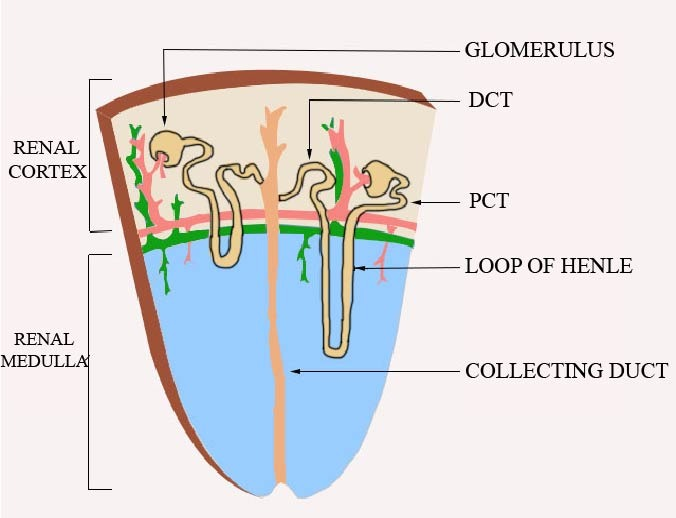
Note: The countercurrent mechanism is also maintained by the vasa recta. In vasa recta, the flow of blood runs counter to the flow of urine. As the blood flows through the medulla, water diffuses out and sodium diffuses in. whereas, reverse movement takes place in the cortex leaving most of the sodium to remain in the medullary interstitial fluid circulation. This maintains the osmolarity gradient from the outer cortex to the inner medulla. This gradient is one of the primary forces behind the existence of the countercurrent mechanism.
Complete answer:
Nephrons in the kidney produce urine and also concentrate or dilute it according to the diet or environment. The countercurrent mechanism helps to concentrate the filtrate which occurs in the loop of Henle and vasa recta in the medulla region of the kidney. The flow of fluids in opposite directions is maintained by their flow in the two loops- ascending and descending limbs of the loop of Henle and vasa recta. The medullary concentration gradient caused by urea and sodium also plays a pivotal role in the countercurrent mechanism.
From the structure of urinary tubules, it is seen that the descending, ascending, and collecting tubules are very close to each other. The flow in the ascending tubule runs opposite to that in the descending and collecting tubule. Sodium and other ions are transported out of the filtrate in the proximal convoluted tubule(PCT ) where water also moves out. By the time urine reaches the loop of Henle, about 80% of total filtrate is out of the tubule. The loop of Henle will absorb a lot of sodium and make the urine concentrated or hyperosmolar.
As the ascending limb of Henle’s loop is impermeable to water and active transport of sodium takes place, the filtrate will lose sodium by active transport, making it less concentrated. When the filtrate reaches the distal convoluted tubule (DCT), it is hypotonic. DCT will reabsorb water making the filtrate isotonic. As the fluid( or filtrate) passes through the collecting tubule in the medullary region, it will lose water and becomes concentrated.
Note: The countercurrent mechanism is also maintained by the vasa recta. In vasa recta, the flow of blood runs counter to the flow of urine. As the blood flows through the medulla, water diffuses out and sodium diffuses in. whereas, reverse movement takes place in the cortex leaving most of the sodium to remain in the medullary interstitial fluid circulation. This maintains the osmolarity gradient from the outer cortex to the inner medulla. This gradient is one of the primary forces behind the existence of the countercurrent mechanism.
Recently Updated Pages
If x a + bt + ct2 where x is in meters and t is in class 11 physics CBSE

A car covers the first half distance between two places class 11 physics CBSE
The resultant of two vectors overrightarrow P and overrightarrow class 11 physics CBSE
Find the value of cos 135 class 11 maths CBSE
A mass M is held in place by an applied force F and class 11 physics CBSE
A solution of glucose in water is labelled as 10 dfracwv class 11 chemistry CBSE
Trending doubts
One Metric ton is equal to kg A 10000 B 1000 C 100 class 11 physics CBSE
Find the value of the expression given below sin 30circ class 11 maths CBSE
What do you mean by retardation What is its SI uni class 11 physics CBSE
Draw a diagram of nephron and explain its structur class 11 biology CBSE
10 examples of friction in our daily life
Difference between physical and chemical change class 11 chemistry CBSE