




Ginger is a ______.
a) Rhizome
b) Tuber
c) Bulb
d) Corm
Answer
 Verified
582k+ views
Hint: Since plants cannot move from one place to another in an unfavourable environment, they modify their body parts such as leaves, stems and roots to store nutrients and meet the unfavourable environmental conditions.
Complete answer:
Ginger is a modified stem. It has several nodes and internodes that give rise to leaves. As it bears all the nutrient content of the planet body so is consumed by humans as a crop. This modified stem pattern of Ginger is called Rhizome. They grow perpendicularly either on or under the ground. However, these plants have thread-like roots arising from the stem. Therefore, we can say that option A is the correct option.
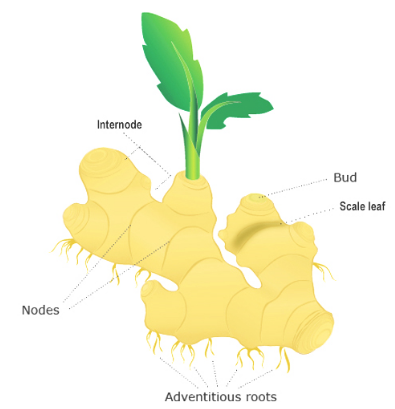
Tuber is another form of modified stem. It also bears several nodes and internodes that later give rise to scaly leaves. These leaves have a bud that has potential to grow into a new plant individual. This type of stem is common to potatoes. As Ginger bears bidets but not buds so cannot be termed as Tuber. Therefore, option B is an incorrect option.
Bulb is another form of modified stem which is typically found in perennial monocotyledons. It is oval in shape and has underground buds. However, a small sized typical stalk is also present that bears flowers and leaves. Since, this kind of stem modification is not found in ginger therefore, it is an incorrect option.
Corm is also one of the patterns of stem modification. It is a combination of bulb and tuber which is short, vertical and swollen in structure. It is present underground. However, it has some green stalk body above the ground that bears flowers and leaves like tubers and is oval in structure and like a bulb. As this kind of stem modification is different from ginger thus, option D is also an incorrect option.
Note:
A plant body can be divided into three parts, that is, stem, leaves and roots. Stem and leaves are typically present above the ground and roots are present under the ground. Any one of these plant parts gets modified to store nutrients from a crop or vegetable. However, new branches arise from nodes or internodes (area between two nodes) on the stalk surface. In a ginger plant, scaly and non-green leaves arise from these nodes. It is an underground crop.
Complete answer:
Ginger is a modified stem. It has several nodes and internodes that give rise to leaves. As it bears all the nutrient content of the planet body so is consumed by humans as a crop. This modified stem pattern of Ginger is called Rhizome. They grow perpendicularly either on or under the ground. However, these plants have thread-like roots arising from the stem. Therefore, we can say that option A is the correct option.
Tuber is another form of modified stem. It also bears several nodes and internodes that later give rise to scaly leaves. These leaves have a bud that has potential to grow into a new plant individual. This type of stem is common to potatoes. As Ginger bears bidets but not buds so cannot be termed as Tuber. Therefore, option B is an incorrect option.
Bulb is another form of modified stem which is typically found in perennial monocotyledons. It is oval in shape and has underground buds. However, a small sized typical stalk is also present that bears flowers and leaves. Since, this kind of stem modification is not found in ginger therefore, it is an incorrect option.
Corm is also one of the patterns of stem modification. It is a combination of bulb and tuber which is short, vertical and swollen in structure. It is present underground. However, it has some green stalk body above the ground that bears flowers and leaves like tubers and is oval in structure and like a bulb. As this kind of stem modification is different from ginger thus, option D is also an incorrect option.
Note:
A plant body can be divided into three parts, that is, stem, leaves and roots. Stem and leaves are typically present above the ground and roots are present under the ground. Any one of these plant parts gets modified to store nutrients from a crop or vegetable. However, new branches arise from nodes or internodes (area between two nodes) on the stalk surface. In a ginger plant, scaly and non-green leaves arise from these nodes. It is an underground crop.
Recently Updated Pages
Lysosomes are known as suicidal bags of cell why class 11 biology CBSE

Father s age is three times the sum of the ages of-class-11-maths-CBSE
Give a comparative account of the classes of kingdom class 11 biology CBSE
The ceiling of a long hall is 25m high What is the class 11 physics CBSE
Proton was discovered by A Thomson B Rutherford C Chadwick class 11 chemistry CBSE
Name the Largest and the Smallest Cell in the Human Body ?
Trending doubts
Difference Between Prokaryotic Cells and Eukaryotic Cells
Find the value of the expression given below sin 30circ class 11 maths CBSE
One Metric ton is equal to kg A 10000 B 1000 C 100 class 11 physics CBSE
Two of the body parts which do not appear in MRI are class 11 biology CBSE
10 examples of friction in our daily life
Draw a diagram of nephron and explain its structur class 11 biology CBSE