




Germination is epigeal in -
(a)Zea mays
(b)Helianthus
(c)Mangifera
(d)Pisum
Answer
 Verified
633.6k+ views
Hint: The term ‘epi’ means below something. And since we are understanding about germination, there are plants that may germinate above or below the ground surface. Germination can occur above or below ground depending on the type of the plant seed.
Complete answer:
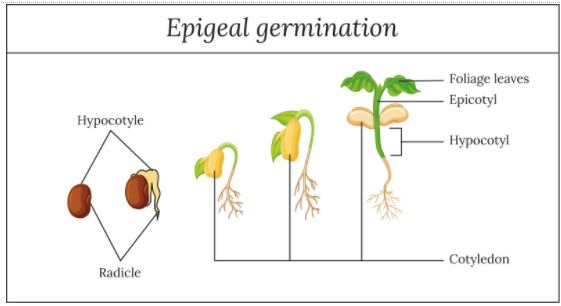
- Epigeal germination is the type where the cotyledons are above the soil surface as the hypocotyl elongates very rapidly. The epicotyl remains unchanged in length.
- Examples of epigeal germination are cotton, sunflower, castor, and bean (or common bean).
- As epigeal germination plants are more vulnerable to grazing and weather conditions, the plants produce a large number of seeds as an evolutionary strategy.
Additional Information: - Hypogeal germination is the type where the cotyledons stay below the ground, the epicotyl above the cotyledon grows, while the hypocotyl below the cotyledon remains the same in length.
- Examples of hypogeal germination include pea, mango, maize, and lily.
- Here, the plumule pushes the cotyledons out of the soil.
- The cotyledons are fleshy and as they stay below ground, they develop a survival strategy that they are resistant to cold temperatures or grazing.
- Hypogeal germination also occurs in plants where low nutrient soils and low sunlight conditions are favored. They are also resistant to flooding.
- Plants with hypogeal germination grow relatively slower while those with epigeal germination grow faster. This is also dependent on their resistance to flooding. Since epigeal plants are not resistant to flooding, rapid growth allows them to develop before the area is flooded again.
So, the correct answer is ‘Helianthus’.
Note: - Two species in the same genus can show different types of germination. For example, the runner bean or the Phaseolus coccineus shows hypogeal germination while the common bean Phaseolus vulgaris shows epigeal germination.
Complete answer:
- Epigeal germination is the type where the cotyledons are above the soil surface as the hypocotyl elongates very rapidly. The epicotyl remains unchanged in length.
- Examples of epigeal germination are cotton, sunflower, castor, and bean (or common bean).
- As epigeal germination plants are more vulnerable to grazing and weather conditions, the plants produce a large number of seeds as an evolutionary strategy.
Additional Information: - Hypogeal germination is the type where the cotyledons stay below the ground, the epicotyl above the cotyledon grows, while the hypocotyl below the cotyledon remains the same in length.
- Examples of hypogeal germination include pea, mango, maize, and lily.
- Here, the plumule pushes the cotyledons out of the soil.
- The cotyledons are fleshy and as they stay below ground, they develop a survival strategy that they are resistant to cold temperatures or grazing.
- Hypogeal germination also occurs in plants where low nutrient soils and low sunlight conditions are favored. They are also resistant to flooding.
- Plants with hypogeal germination grow relatively slower while those with epigeal germination grow faster. This is also dependent on their resistance to flooding. Since epigeal plants are not resistant to flooding, rapid growth allows them to develop before the area is flooded again.
So, the correct answer is ‘Helianthus’.
Note: - Two species in the same genus can show different types of germination. For example, the runner bean or the Phaseolus coccineus shows hypogeal germination while the common bean Phaseolus vulgaris shows epigeal germination.
Recently Updated Pages
Basicity of sulphurous acid and sulphuric acid are

Master Class 11 English: Engaging Questions & Answers for Success
Master Class 11 Physics: Engaging Questions & Answers for Success
Master Class 11 Computer Science: Engaging Questions & Answers for Success
Master Class 11 Chemistry: Engaging Questions & Answers for Success
Master Class 11 Social Science: Engaging Questions & Answers for Success
Trending doubts
Difference Between Prokaryotic Cells and Eukaryotic Cells
One Metric ton is equal to kg A 10000 B 1000 C 100 class 11 physics CBSE
Two of the body parts which do not appear in MRI are class 11 biology CBSE
Draw a diagram of nephron and explain its structur class 11 biology CBSE
10 examples of friction in our daily life
Proton was discovered by A Thomson B Rutherford C Chadwick class 11 chemistry CBSE