




What is Germination, explain with a diagram?
Answer
 Verified
570.3k+ views
Hint: The process of an organism growing from a seed or spore is known as germination. The term refers to the growth of a seedling from an angiosperm or gymnosperm seed, the growth of sprout from a spore, such as fungi, ferns, or bacteria, and the growth of the pollen tube from a seed plant's pollen grain.
Complete answer:
Germination is a fundamental process that all higher plants go through. A seed is allowed to mature, germinate, and produce new plantlets during this process. The entire germination process in seeds takes place in the presence of certain favorable conditions, such as air, water, light, and temperature.
Process of Germination in Seeds:
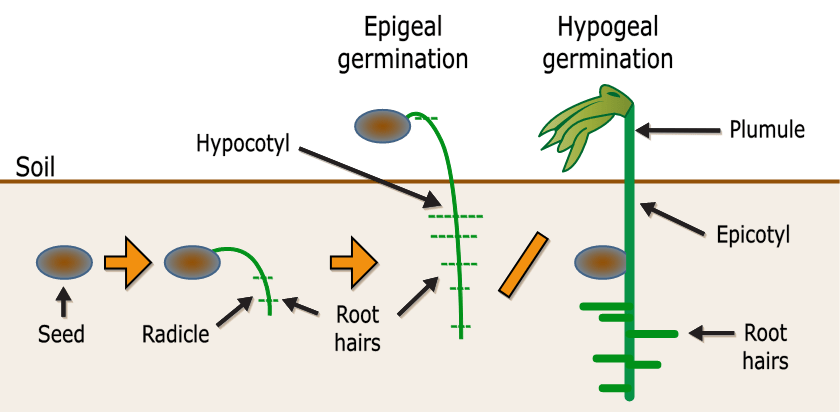
The seeds rapidly absorb water during the early stages of germination, resulting in swelling and softening of the seed coat at an optimal temperature. Imbibition is the name for this stage. The activation of enzymes kicks off the growth process. The seed's internal physiology is activated, and it begins to respire, produce proteins, and metabolize the stored food. This is the lag phase of the process.
Radicles emerge from the seed coat and form a primary root. The seed begins to absorb water from the ground. The shoot begins to grow upwards after the radicle and plumule emerge.
The seedling is formed when the seed cell becomes metabolically active, elongates, and divides in the final stage of seed germination.
Note:
Seed Germination Affecting Factors:
Seed germination is influenced by several major factors. These are some of them:
Water: Seed germination is affected by a lack of or additional supply of water.
The temperature has an impact on the seed's growth rate as well as its metabolism.
Oxygen: As seeds germinate, they take in a lot of oxygen and release the energy they need to grow. As a result, a lack of oxygen affects seed germination.
Dormancy of Seeds: This is a condition in which seeds are unable to germinate, even when the conditions are ideal.
Complete answer:
Germination is a fundamental process that all higher plants go through. A seed is allowed to mature, germinate, and produce new plantlets during this process. The entire germination process in seeds takes place in the presence of certain favorable conditions, such as air, water, light, and temperature.
Process of Germination in Seeds:
The seeds rapidly absorb water during the early stages of germination, resulting in swelling and softening of the seed coat at an optimal temperature. Imbibition is the name for this stage. The activation of enzymes kicks off the growth process. The seed's internal physiology is activated, and it begins to respire, produce proteins, and metabolize the stored food. This is the lag phase of the process.
Radicles emerge from the seed coat and form a primary root. The seed begins to absorb water from the ground. The shoot begins to grow upwards after the radicle and plumule emerge.
The seedling is formed when the seed cell becomes metabolically active, elongates, and divides in the final stage of seed germination.
Note:
Seed Germination Affecting Factors:
Seed germination is influenced by several major factors. These are some of them:
Water: Seed germination is affected by a lack of or additional supply of water.
The temperature has an impact on the seed's growth rate as well as its metabolism.
Oxygen: As seeds germinate, they take in a lot of oxygen and release the energy they need to grow. As a result, a lack of oxygen affects seed germination.
Dormancy of Seeds: This is a condition in which seeds are unable to germinate, even when the conditions are ideal.
Recently Updated Pages
If x a + bt + ct2 where x is in meters and t is in class 11 physics CBSE

A car covers the first half distance between two places class 11 physics CBSE
The resultant of two vectors overrightarrow P and overrightarrow class 11 physics CBSE
Find the value of cos 135 class 11 maths CBSE
A mass M is held in place by an applied force F and class 11 physics CBSE
A solution of glucose in water is labelled as 10 dfracwv class 11 chemistry CBSE
Trending doubts
One Metric ton is equal to kg A 10000 B 1000 C 100 class 11 physics CBSE
Find the value of the expression given below sin 30circ class 11 maths CBSE
Draw a diagram of nephron and explain its structur class 11 biology CBSE
10 examples of friction in our daily life
Proton was discovered by A Thomson B Rutherford C Chadwick class 11 chemistry CBSE
Bond order ofO2 O2+ O2 and O22 is in order A O2 langle class 11 chemistry CBSE