




What is the geometry and hybridization of $ P{F_6}^ - $ . What orbitals are used to hybridize?
Answer
 Verified
562.2k+ views
Hint: Phosphorus is the central atom in the compound $ P{F_6}^ - $ . There are only five electrons in the outermost shell of the phosphorus atom and the negative charge is placed on the more electronegative atom which is fluorine in this case.
Complete answer:
The ground state electronic configuration of the central phosphorus atom in $ P{F_6}^ - $ is such that there are five electrons in the outermost shell. Two of these electrons are paired and present in the s-orbital. To exhibit a covalency of five or above, the electrons need to be unpaired using the vacant d-orbitals.
The negative charge goes on the fluorine atom as it is more electronegative than phosphorus. Each fluorine atom shares one electron and pairs with the unpaired electron present in the atomic orbitals of phosphorus. The fluoride ion contains eight electrons and simply donates a pair of electrons in the vacant d-orbital of the phosphorus atom. As a result, six atomic orbitals of phosphorus are involved in the formation of $ P{F_6}^ - $ .
The six atomic orbitals undergo mixing to give six equivalent hybrid orbitals with better overlap, lesser energy and more directional character. These six hybrid orbitals arrange themselves in such a manner to create six equivalent positions for all fluorine atoms. The hybrid orbitals are therefore equal in length and mutually perpendicular to each other. Such a geometry is called an octahedral geometry.
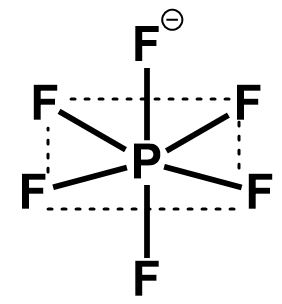
$ \Rightarrow $ The six atomic orbitals on phosphorus that undergo hybridization are $ s,{p_x},{p_y},{p_z},{d_{{z^2}}}{\text{ and }}{d_{{x^2} - {y^2}}} $ . Thus the hybridization of $ P{F_6}^ - $ is $ s{p_3}{d_2} $ and the geometry is octahedral.
Note:
The structure of $ P{F_6}^ - $ can be compared to $ S{F_6} $ which has an equal number of electrons and undergoes similar hybridization to give an octahedral geometry. The orbitals present in the $ z$ - plane are used to form axial orbitals and the remaining orbital forms a square planar geometry in the $ x - y $ plane.
Complete answer:
The ground state electronic configuration of the central phosphorus atom in $ P{F_6}^ - $ is such that there are five electrons in the outermost shell. Two of these electrons are paired and present in the s-orbital. To exhibit a covalency of five or above, the electrons need to be unpaired using the vacant d-orbitals.
The negative charge goes on the fluorine atom as it is more electronegative than phosphorus. Each fluorine atom shares one electron and pairs with the unpaired electron present in the atomic orbitals of phosphorus. The fluoride ion contains eight electrons and simply donates a pair of electrons in the vacant d-orbital of the phosphorus atom. As a result, six atomic orbitals of phosphorus are involved in the formation of $ P{F_6}^ - $ .
The six atomic orbitals undergo mixing to give six equivalent hybrid orbitals with better overlap, lesser energy and more directional character. These six hybrid orbitals arrange themselves in such a manner to create six equivalent positions for all fluorine atoms. The hybrid orbitals are therefore equal in length and mutually perpendicular to each other. Such a geometry is called an octahedral geometry.
$ \Rightarrow $ The six atomic orbitals on phosphorus that undergo hybridization are $ s,{p_x},{p_y},{p_z},{d_{{z^2}}}{\text{ and }}{d_{{x^2} - {y^2}}} $ . Thus the hybridization of $ P{F_6}^ - $ is $ s{p_3}{d_2} $ and the geometry is octahedral.
Note:
The structure of $ P{F_6}^ - $ can be compared to $ S{F_6} $ which has an equal number of electrons and undergoes similar hybridization to give an octahedral geometry. The orbitals present in the $ z$ - plane are used to form axial orbitals and the remaining orbital forms a square planar geometry in the $ x - y $ plane.
Recently Updated Pages
If x a + bt + ct2 where x is in meters and t is in class 11 physics CBSE

A car covers the first half distance between two places class 11 physics CBSE
The resultant of two vectors overrightarrow P and overrightarrow class 11 physics CBSE
Find the value of cos 135 class 11 maths CBSE
A mass M is held in place by an applied force F and class 11 physics CBSE
A solution of glucose in water is labelled as 10 dfracwv class 11 chemistry CBSE
Trending doubts
One Metric ton is equal to kg A 10000 B 1000 C 100 class 11 physics CBSE
Find the value of the expression given below sin 30circ class 11 maths CBSE
What do you mean by retardation What is its SI uni class 11 physics CBSE
Draw a diagram of nephron and explain its structur class 11 biology CBSE
10 examples of friction in our daily life
Difference between physical and chemical change class 11 chemistry CBSE