




What is the general formula of a carboxylic acid?
Answer
 Verified
584.1k+ views
Hint: Carboxylic acid is a homologous series of compounds that contain a carboxyl functional group (-COOH) attached to a hydrocarbon chain. These compounds are acidic in nature and the general formula for this homologous series is - ${{\text{C}}_{\text{n}}}{{\text{H}}_{\text{2n+1}}}\text{COOH}$.
Complete answer:
A homologous series a series of chemical compounds that are having the same functional group and similar chemical properties and the successive members differ by a $-\text{C}{{\text{H}}_{2}}$ group.
Carboxylic acids also form a homologous series and like all homologous series, the carboxylic acids have a general formula and common properties that are listed below:
-The general formula for the carboxylic acids is ${{\text{C}}_{\text{n}}}{{\text{H}}_{\text{2n+1}}}\text{COOH}$.
-Compounds show a gradual variation in physical properties, such as boiling points.
-All have similar chemical properties
The functional group in the carboxylic acids is the carboxyl group, –COOH. The carboxyl group is made up of a hydroxyl group (-OH) bonded to a carbonyl group (-C=O). The structure is given below:
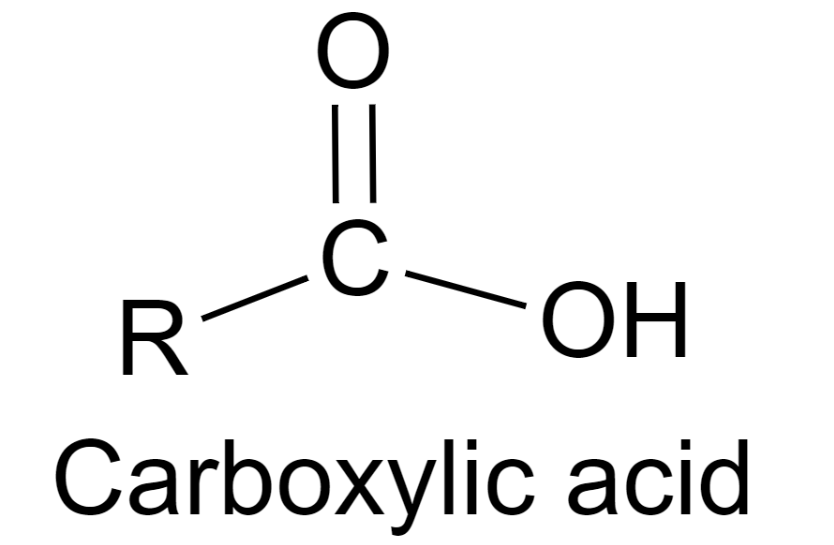
Due to this functional group, carboxylic acids possess acidic characters and typical properties such as they react with bases to form salt and water and with metals, they form salt and hydrogen.
Carboxylic acids are more acidic than other organic compounds but less acidic than mineral acids such as hydrochloric acid (HCl).
Additional information:
Carboxylic acids occur widely in nature. Lactic acid found in sour milk products and citric acid found in citrus fruits is carboxylic acids.
Note:
Compounds formed by the replacement of the hydroxyl group (-OH) of the carboxylic acids by certain other groups are known as carboxylic acid derivatives. This class of carboxylic acid derivatives includes many important compounds such as acyl halides, esters, acid anhydrides, and amides.
Complete answer:
A homologous series a series of chemical compounds that are having the same functional group and similar chemical properties and the successive members differ by a $-\text{C}{{\text{H}}_{2}}$ group.
Carboxylic acids also form a homologous series and like all homologous series, the carboxylic acids have a general formula and common properties that are listed below:
-The general formula for the carboxylic acids is ${{\text{C}}_{\text{n}}}{{\text{H}}_{\text{2n+1}}}\text{COOH}$.
-Compounds show a gradual variation in physical properties, such as boiling points.
-All have similar chemical properties
The functional group in the carboxylic acids is the carboxyl group, –COOH. The carboxyl group is made up of a hydroxyl group (-OH) bonded to a carbonyl group (-C=O). The structure is given below:
Due to this functional group, carboxylic acids possess acidic characters and typical properties such as they react with bases to form salt and water and with metals, they form salt and hydrogen.
Carboxylic acids are more acidic than other organic compounds but less acidic than mineral acids such as hydrochloric acid (HCl).
Additional information:
Carboxylic acids occur widely in nature. Lactic acid found in sour milk products and citric acid found in citrus fruits is carboxylic acids.
Note:
Compounds formed by the replacement of the hydroxyl group (-OH) of the carboxylic acids by certain other groups are known as carboxylic acid derivatives. This class of carboxylic acid derivatives includes many important compounds such as acyl halides, esters, acid anhydrides, and amides.
Recently Updated Pages
Which will be the least stable resonating structure class 11 chemistry CBSE

How many 5 digit telephone numbers can be construc-class-11-maths-CBSE
How do you find the angle of the resultant vector class 11 physics CBSE
Draw labelled diagram of the following i Gram seed class 11 biology CBSE
What is the need and importance of classification class 11 biology CBSE
The way in which the sparrows expressed their sorrow class 11 english CBSE
Trending doubts
One Metric ton is equal to kg A 10000 B 1000 C 100 class 11 physics CBSE
Find the value of the expression given below sin 30circ class 11 maths CBSE
1 Quintal is equal to a 110 kg b 10 kg c 100kg d 1000 class 11 physics CBSE
Draw a diagram of nephron and explain its structur class 11 biology CBSE
10 examples of friction in our daily life
Proton was discovered by A Thomson B Rutherford C Chadwick class 11 chemistry CBSE