




Gemma for vegetative reproduction occurs in
(a)Funaria
(b)Fern
(c)Marchantia
(d)Riccia
Answer
 Verified
606.3k+ views
Hint: It shows separation into two layers: an upper photosynthetic layer with an all-around characterized upper epidermis with pores and a lower stockpiling layer. The blend of barrel-molded pores and in this manner the round state of the gemma cups are analytic of the genus.
Complete answer:
Gemmae likewise happen on the protonemal parts of some Funaria species.
Additional Information: Marchantia can reproduce both sexually and asexually. Sexual reproduction includes sperm from antheridia on the male plant preparing an ovum (egg cell) inside the archegonium of a female plant. The antheridia and archegonia are borne on top gametophyte stalks called antheridiophores and archegoniophores, separately. These are borne on isolated thalli; henceforth, the plants are dioecious.
Once fertilized, the ovum is called a zygote and develops into a little sporophyte plant, which remains attached to the larger gametophyte plant. The sporophyte produces spores that develop into free-living male and female gametophyte plants.
Asexual reproduction happens by methods for gemmae, discoid bunches of cells that are hereditarily similar to the parent and contained in cup-like structures on the plant
These are dispersed when rain splashes into the cups and becomes new plants. Asexual reproduction also can occur when older parts of the plant die and therefore the surviving newer branches become separate plants.
So the correct answer is ‘Marchantia’.
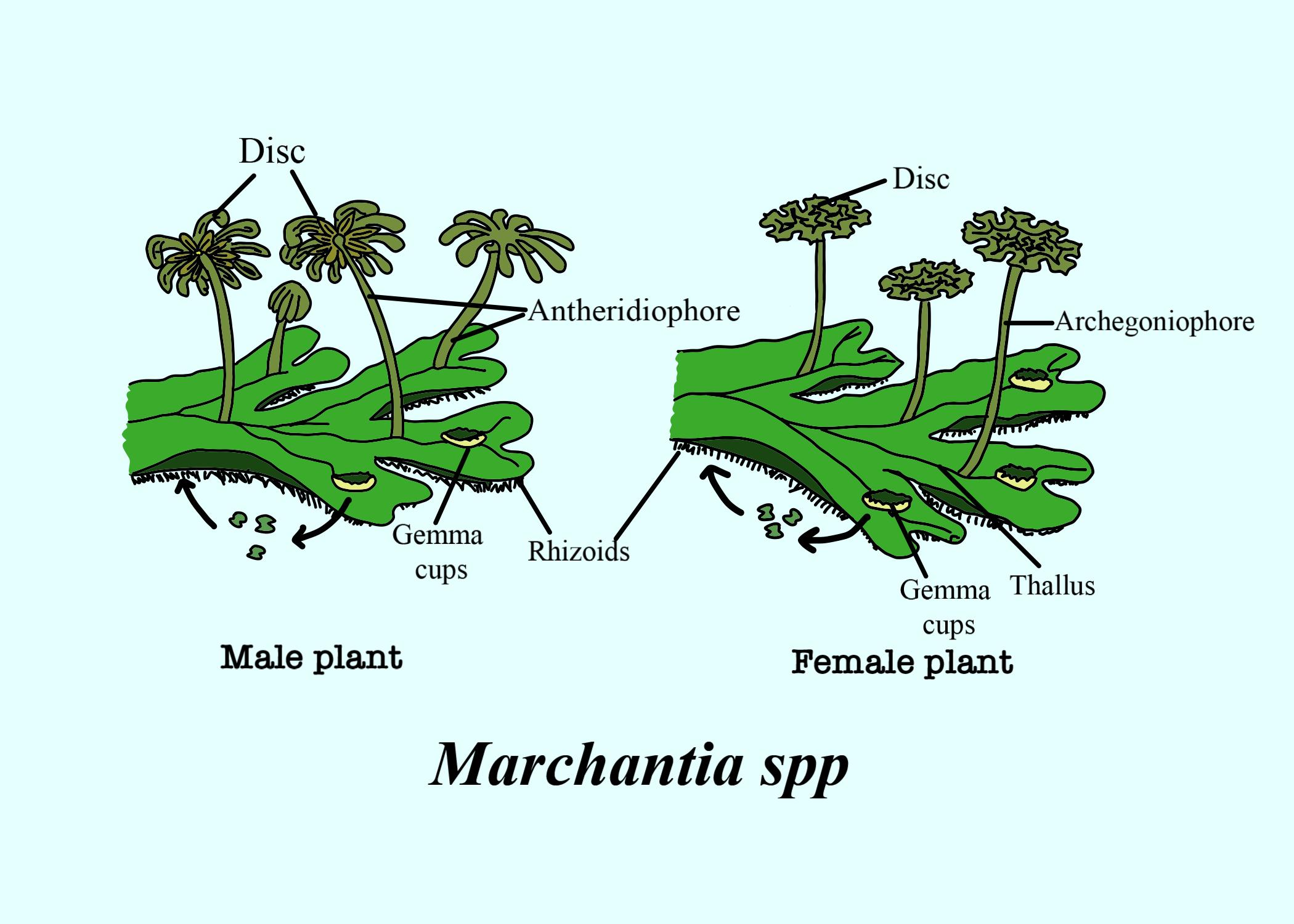
Note: In Marchantia and Lunularia the gemmae are delivered in gemma cups arranged on the dorsal surface of the gametophyte. Numerous gemmae are found in every gemma cup. On being segregated from the cup, every gemma offers to ascend to a plant. The gemma cups are round in Marchantia and bow molded-in Lunularia.
Complete answer:
Gemmae likewise happen on the protonemal parts of some Funaria species.
Additional Information: Marchantia can reproduce both sexually and asexually. Sexual reproduction includes sperm from antheridia on the male plant preparing an ovum (egg cell) inside the archegonium of a female plant. The antheridia and archegonia are borne on top gametophyte stalks called antheridiophores and archegoniophores, separately. These are borne on isolated thalli; henceforth, the plants are dioecious.
Once fertilized, the ovum is called a zygote and develops into a little sporophyte plant, which remains attached to the larger gametophyte plant. The sporophyte produces spores that develop into free-living male and female gametophyte plants.
Asexual reproduction happens by methods for gemmae, discoid bunches of cells that are hereditarily similar to the parent and contained in cup-like structures on the plant
These are dispersed when rain splashes into the cups and becomes new plants. Asexual reproduction also can occur when older parts of the plant die and therefore the surviving newer branches become separate plants.
So the correct answer is ‘Marchantia’.
Note: In Marchantia and Lunularia the gemmae are delivered in gemma cups arranged on the dorsal surface of the gametophyte. Numerous gemmae are found in every gemma cup. On being segregated from the cup, every gemma offers to ascend to a plant. The gemma cups are round in Marchantia and bow molded-in Lunularia.
Recently Updated Pages
Master Class 12 Business Studies: Engaging Questions & Answers for Success

Master Class 12 Chemistry: Engaging Questions & Answers for Success
Master Class 12 Biology: Engaging Questions & Answers for Success
Class 12 Question and Answer - Your Ultimate Solutions Guide
Master Class 11 English: Engaging Questions & Answers for Success
Master Class 11 Social Science: Engaging Questions & Answers for Success
Trending doubts
Which are the Top 10 Largest Countries of the World?
Draw a labelled sketch of the human eye class 12 physics CBSE
Differentiate between homogeneous and heterogeneous class 12 chemistry CBSE
Why is the cell called the structural and functional class 12 biology CBSE
When was the first election held in India a 194748 class 12 sst CBSE
Draw ray diagrams each showing i myopic eye and ii class 12 physics CBSE