




Fusion of male gamete and female gamete is termed as
(a) Reproduction
(b) Vegetative propagation
(c ) Fertilization
(d) Respiration
Answer
 Verified
654.3k+ views
Hint: When male and female gametes fuse, they form a cell which is a crucial link that ensures the progression of a particular species from one generation to another.
Complete answer:
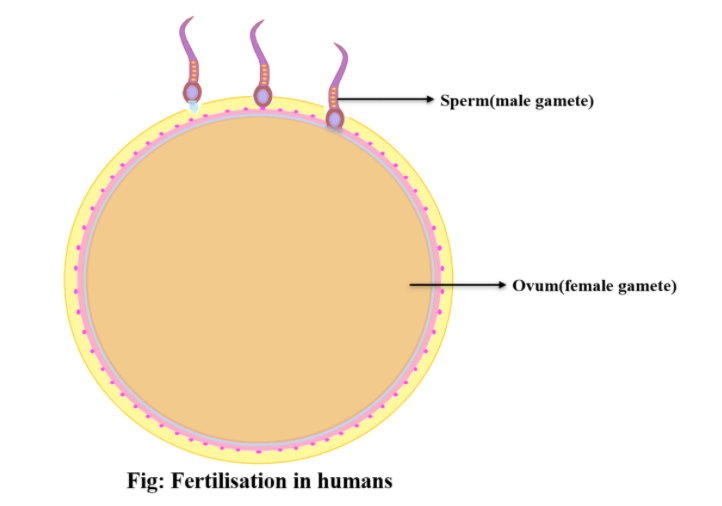
The process of fusion of a male gamete (or sperms) with a female gamete(ovum) is called fertilization. The two haploid nuclei each from either parent fuses to form a diploid zygote which is universal in all sexually reproducing organisms.
Additional Information:
Gametes are haploid but the parent body can be both haploid or diploid. A haploid parent produces gamete by mitotic division e.g. lower organisms such as monera, fungi, algae, and bryophytes, while a diploid parent body produces gametes by meiotic division i.s. reductional division e.g. pteridophytes, gymnosperms, angiosperms and most of the animals (including humans).
After the formation of gametes, they need to be physically brought together to induce fusion. The female gamete is stationary in most organisms while male gamete is motile. But in some fungi and algae, both the gametes are motile and thus need a medium for their transfer. In seed-producing plants, both the gametes are non-motile. Pollen grains are the carriers of male gamete while ovule is the carrier of female gamete.
Vegetative propagation is an asexual method of reproduction in plants wherein a new plant is produced from its vegetative parts such as roots, stems, etc.
Respiration is a process of production of ATP (energy)by oxidation of complex organic substances.
So, the correct answer is ‘Fertilization’.
Note: Based on the location where the fertilization takes place, it is of two types – Internal and external fertilization. External fertilization occurs when the fusion of gametes occurs in the external medium (water) i.e. outside the body of the organism. Internal fertilization occurs when the union of gametes takes place inside the body of the organism.
Complete answer:
The process of fusion of a male gamete (or sperms) with a female gamete(ovum) is called fertilization. The two haploid nuclei each from either parent fuses to form a diploid zygote which is universal in all sexually reproducing organisms.
Additional Information:
Gametes are haploid but the parent body can be both haploid or diploid. A haploid parent produces gamete by mitotic division e.g. lower organisms such as monera, fungi, algae, and bryophytes, while a diploid parent body produces gametes by meiotic division i.s. reductional division e.g. pteridophytes, gymnosperms, angiosperms and most of the animals (including humans).
After the formation of gametes, they need to be physically brought together to induce fusion. The female gamete is stationary in most organisms while male gamete is motile. But in some fungi and algae, both the gametes are motile and thus need a medium for their transfer. In seed-producing plants, both the gametes are non-motile. Pollen grains are the carriers of male gamete while ovule is the carrier of female gamete.
Vegetative propagation is an asexual method of reproduction in plants wherein a new plant is produced from its vegetative parts such as roots, stems, etc.
Respiration is a process of production of ATP (energy)by oxidation of complex organic substances.
So, the correct answer is ‘Fertilization’.
Note: Based on the location where the fertilization takes place, it is of two types – Internal and external fertilization. External fertilization occurs when the fusion of gametes occurs in the external medium (water) i.e. outside the body of the organism. Internal fertilization occurs when the union of gametes takes place inside the body of the organism.
Recently Updated Pages
Master Class 12 Economics: Engaging Questions & Answers for Success

Master Class 12 Social Science: Engaging Questions & Answers for Success
Master Class 12 English: Engaging Questions & Answers for Success
Master Class 12 Maths: Engaging Questions & Answers for Success
Master Class 12 Physics: Engaging Questions & Answers for Success
Master Class 12 Biology: Engaging Questions & Answers for Success
Trending doubts
Draw a labelled sketch of the human eye class 12 physics CBSE
Which are the Top 10 Largest Countries of the World?
Draw ray diagrams each showing i myopic eye and ii class 12 physics CBSE
Which is the correct genotypic ratio of mendel dihybrid class 12 biology CBSE
Differentiate between homogeneous and heterogeneous class 12 chemistry CBSE
Which animal never drinks water in its entire life class 12 biology CBSE