




What is the function of the rough endoplasmic reticulum? What structure of the rough ER is necessary for this function?
Answer
 Verified
520.2k+ views
Hint: The endoplasmic reticulum is a network of membranes that transports proteins and other substances within a cell. Ribosomes are organelles that build proteins. The ribosomes that assemble proteins that will be part of the cell membrane or exported from the cell connect to the endoplasmic reticulum, giving it a rough look.
Complete answer:
Protein synthesis is aided by ribosomes on the RER.
Protein synthesis takes place in the rough endoplasmic reticulum. Ribosomes on the surface of the ER give it a rough appearance. The proteins that have been produced are secreted to various locations.
Ribosomes are the actual sites of protein synthesis. Ribosomes complete the polymerization of lengthy polypeptide chains.
The endoplasmic reticulum can be smooth or rough, and its main job is to make proteins that help the rest of the cell function. Ribosomes, which are small, spherical organelles that make those proteins, are found in the rough endoplasmic reticulum. When proteins are produced incorrectly, they can sometimes linger in the endoplasmic reticulum.
They're held, and the endoplasmic reticulum enlarges because it's constipated in some ways, and the proteins don't get to where they're supposed to go. The smooth endoplasmic reticulum, on the other hand, is devoid of ribosomes.
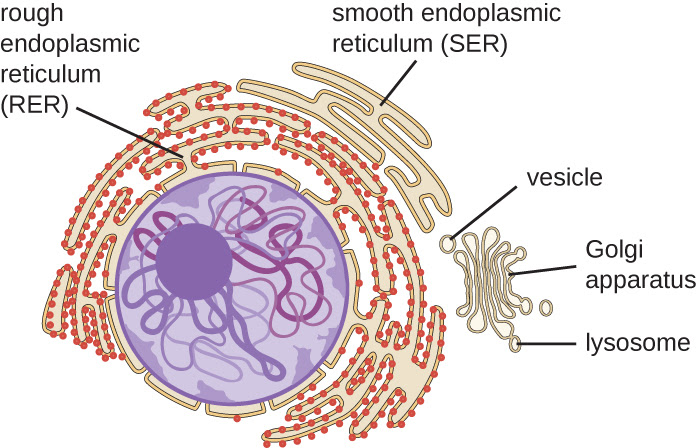
The smooth endoplasmic reticulum also creates other compounds that the cell needs. The endoplasmic reticulum is a workhorse organelle that produces proteins and chemicals required by the rest of the cell.
Note:
The rough endoplasmic reticulum (rough ER) is a subgroup of the endoplasmic reticulum and is part of the cell's endomembrane system (ER). This organelle is principally responsible for the synthesis, folding, and modification of proteins, particularly those that must be supplied to other organelles within the cell or secreted.
Complete answer:
Protein synthesis is aided by ribosomes on the RER.
Protein synthesis takes place in the rough endoplasmic reticulum. Ribosomes on the surface of the ER give it a rough appearance. The proteins that have been produced are secreted to various locations.
Ribosomes are the actual sites of protein synthesis. Ribosomes complete the polymerization of lengthy polypeptide chains.
The endoplasmic reticulum can be smooth or rough, and its main job is to make proteins that help the rest of the cell function. Ribosomes, which are small, spherical organelles that make those proteins, are found in the rough endoplasmic reticulum. When proteins are produced incorrectly, they can sometimes linger in the endoplasmic reticulum.
They're held, and the endoplasmic reticulum enlarges because it's constipated in some ways, and the proteins don't get to where they're supposed to go. The smooth endoplasmic reticulum, on the other hand, is devoid of ribosomes.
The smooth endoplasmic reticulum also creates other compounds that the cell needs. The endoplasmic reticulum is a workhorse organelle that produces proteins and chemicals required by the rest of the cell.
Note:
The rough endoplasmic reticulum (rough ER) is a subgroup of the endoplasmic reticulum and is part of the cell's endomembrane system (ER). This organelle is principally responsible for the synthesis, folding, and modification of proteins, particularly those that must be supplied to other organelles within the cell or secreted.
Recently Updated Pages
Master Class 11 English: Engaging Questions & Answers for Success

Master Class 11 Social Science: Engaging Questions & Answers for Success
Master Class 11 Maths: Engaging Questions & Answers for Success
Master Class 11 Biology: Engaging Questions & Answers for Success
Master Class 11 Physics: Engaging Questions & Answers for Success
Master Class 11 Chemistry: Engaging Questions & Answers for Success
Trending doubts
One Metric ton is equal to kg A 10000 B 1000 C 100 class 11 physics CBSE
Difference Between Prokaryotic Cells and Eukaryotic Cells
Find the value of the expression given below sin 30circ class 11 maths CBSE
Difference between physical and chemical change class 11 chemistry CBSE
Two of the body parts which do not appear in MRI are class 11 biology CBSE
Draw a diagram of a plant cell and label at least eight class 11 biology CBSE