




Function of Centrosome is
(a) Initiation of cell division
(b) Inhibition of cell division
(c) Termination of cell division
(d) To perform cytokinesis
Answer
 Verified
638.4k+ views
Hint: The microtubules attached to the kinetochore of the chromosome helps to pull the two sister chromatids apart for their division.
Complete answer:
The main function of the centrosome is the initiation of cell division.
Additional Information:
1. The word centrosome originated from the Latin word ‘centrum' meaning center and the Greek word ‘soma' meaning body.
2. Edouard Van Beneden is credited with the discovery of centrosomes in 1883. Later, it was named by Theodor Boveri in 1888.
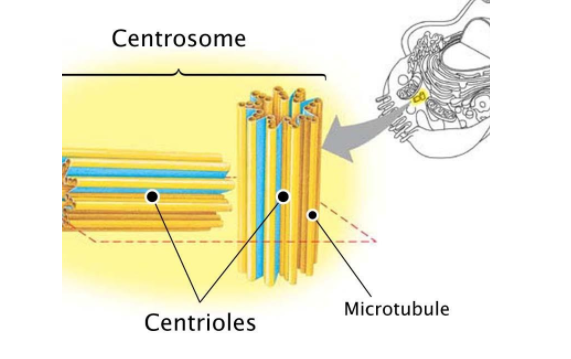
3. The centrosome is a cell organelle consisting of two centrioles aligned at an angle of 90° to each other. They remain surrounded by an amorphous, clear fluid known as PCM (pericentriolar material). It is also known as MTOC i.e. Microtubule Organising Centre of the animal cell.
4. They maintain the number of chromosomes during each cell division. During prophase of mitosis, the centrosomes migrate to opposite poles of the cell. The mitotic spindle then forms between these two centrosomes.
5. The centriole is also responsible for the formation of cilia and flagella.
6. The centrosome replicates during the S phase of the cell cycle so that each daughter cell receives one copy of the centrosome.
So, the correct answer is ‘initiation of cell division’.
Note:
1. The presence of a centrosome is a typical characteristic of the animal cell. Plants and fungus completely lack a centrosome. It is also absent in some species of fly and flatworms.
2. The PCM consists of certain proteins like tubulin, ninein, and pericentrin which help in microtubule nucleation and anchorage.
3. The microtubules present in flagella and cilia are arranged in a (9+2) fashion.
Complete answer:
The main function of the centrosome is the initiation of cell division.
Additional Information:
1. The word centrosome originated from the Latin word ‘centrum' meaning center and the Greek word ‘soma' meaning body.
2. Edouard Van Beneden is credited with the discovery of centrosomes in 1883. Later, it was named by Theodor Boveri in 1888.
3. The centrosome is a cell organelle consisting of two centrioles aligned at an angle of 90° to each other. They remain surrounded by an amorphous, clear fluid known as PCM (pericentriolar material). It is also known as MTOC i.e. Microtubule Organising Centre of the animal cell.
4. They maintain the number of chromosomes during each cell division. During prophase of mitosis, the centrosomes migrate to opposite poles of the cell. The mitotic spindle then forms between these two centrosomes.
5. The centriole is also responsible for the formation of cilia and flagella.
6. The centrosome replicates during the S phase of the cell cycle so that each daughter cell receives one copy of the centrosome.
So, the correct answer is ‘initiation of cell division’.
Note:
1. The presence of a centrosome is a typical characteristic of the animal cell. Plants and fungus completely lack a centrosome. It is also absent in some species of fly and flatworms.
2. The PCM consists of certain proteins like tubulin, ninein, and pericentrin which help in microtubule nucleation and anchorage.
3. The microtubules present in flagella and cilia are arranged in a (9+2) fashion.
Recently Updated Pages
Master Class 11 English: Engaging Questions & Answers for Success

Master Class 11 Social Science: Engaging Questions & Answers for Success
Master Class 11 Maths: Engaging Questions & Answers for Success
Master Class 11 Biology: Engaging Questions & Answers for Success
Master Class 11 Physics: Engaging Questions & Answers for Success
Master Class 11 Chemistry: Engaging Questions & Answers for Success
Trending doubts
Explain the Treaty of Vienna of 1815 class 10 social science CBSE
What is the full form of POSCO class 10 social science CBSE
Define Potential, Developed, Stock and Reserved resources
The diagonals of a rhombus are 10cm and 24cm Find the class 10 maths CBSE
Fill the blanks with proper collective nouns 1 A of class 10 english CBSE
What planets have no moons Which one has only one moon class 10 physics CBSE