




Fruit of ficus is
(a) Sorosis
(b) Syconium
(c) Aggregate
(d) Dry
Answer
 Verified
592.2k+ views
Hint: Fruit of ficus is both a multiple and accessory fruit. This is an urn-shaped vessel that (depending on the species) contains between 50 and 7000 highly simplified uni-ovulate flowers or florets on its inner surface.
Complete answer:
From a hypanthodium inflorescence in which the fleshy receptacle encloses a hybrid fruit of achenes, the fruit in focus grows.
For their fruits, several fig species are grown, but only Ficus carica is cultivated for this purpose to any degree. A fig "fruit" is a type of multiple fruits known as a syconium, derived from an arrangement on an inverted, almost closed receptacle of several small flowers. Unless the fig is sliced open, the numerous small flowers are unseen.
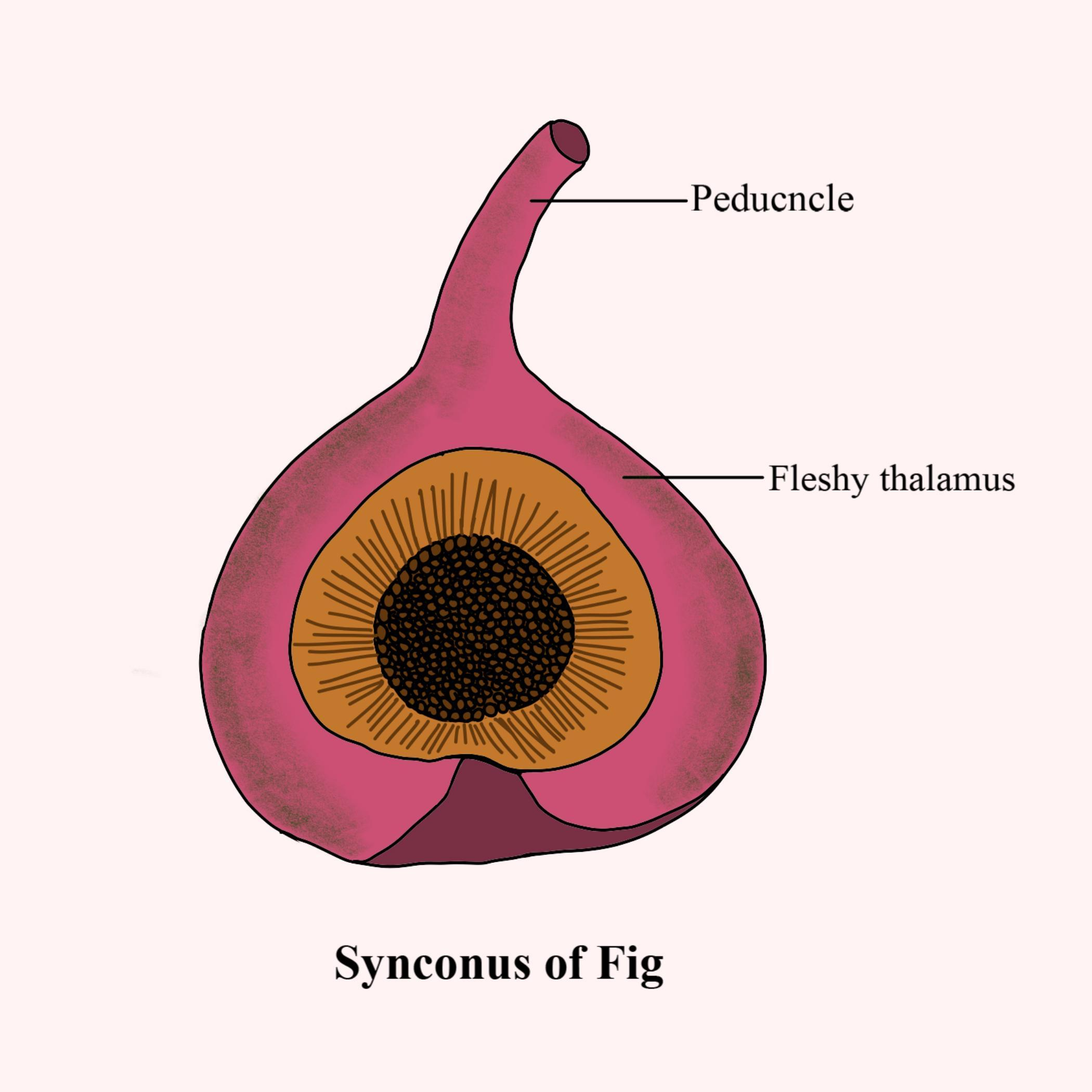
Usually, the fruit has a bulbous shape at the outward end with a narrow opening (ostiole) that allows access to pollinators. In search of a suitable place to lay eggs, the flowers are pollinated by very small wasps that crawl through the opening. The fig trees could not reproduce by seed without this pollinator operation. The flowers, in exchange, provide the next generation of wasps with a safe refuge and nourishment. The recurrent presence of wasp larvae in the fruit is accounted for, and has contributed to a coevolutionary relationship.
Additional information: Sorosis arises from inflorescences of the catkin, spike, or spadix type.
From a polycarpellary apocarpous ovary of a single flower, aggregate fruits develop.
Dry fruit is a wide range of simple fruit that develops out of a single flower ovary.
So, the correct answer is, ‘(b) Syconium’.
Note: Ficus is a genus present in the Moraceae family of around 850 species of woody trees, shrubs, vines, etc. They are native to the tropics, collectively known as fig trees or figs, with a few species spreading into the semi-warm temperate zone.
Complete answer:
From a hypanthodium inflorescence in which the fleshy receptacle encloses a hybrid fruit of achenes, the fruit in focus grows.
For their fruits, several fig species are grown, but only Ficus carica is cultivated for this purpose to any degree. A fig "fruit" is a type of multiple fruits known as a syconium, derived from an arrangement on an inverted, almost closed receptacle of several small flowers. Unless the fig is sliced open, the numerous small flowers are unseen.
Usually, the fruit has a bulbous shape at the outward end with a narrow opening (ostiole) that allows access to pollinators. In search of a suitable place to lay eggs, the flowers are pollinated by very small wasps that crawl through the opening. The fig trees could not reproduce by seed without this pollinator operation. The flowers, in exchange, provide the next generation of wasps with a safe refuge and nourishment. The recurrent presence of wasp larvae in the fruit is accounted for, and has contributed to a coevolutionary relationship.
Additional information: Sorosis arises from inflorescences of the catkin, spike, or spadix type.
From a polycarpellary apocarpous ovary of a single flower, aggregate fruits develop.
Dry fruit is a wide range of simple fruit that develops out of a single flower ovary.
So, the correct answer is, ‘(b) Syconium’.
Note: Ficus is a genus present in the Moraceae family of around 850 species of woody trees, shrubs, vines, etc. They are native to the tropics, collectively known as fig trees or figs, with a few species spreading into the semi-warm temperate zone.
Recently Updated Pages
Master Class 11 English: Engaging Questions & Answers for Success

Master Class 11 Social Science: Engaging Questions & Answers for Success
Master Class 11 Maths: Engaging Questions & Answers for Success
Master Class 11 Biology: Engaging Questions & Answers for Success
Master Class 11 Physics: Engaging Questions & Answers for Success
Master Class 11 Chemistry: Engaging Questions & Answers for Success
Trending doubts
Difference between physical and chemical change class 11 chemistry CBSE
How do I convert ms to kmh Give an example class 11 physics CBSE
What is the atomic mass of Sodium a 22 gmol b 23 gmol class 11 chemistry CBSE
In which country Lascaux cave is located A India B class 11 social science CBSE
Proton was discovered by A Thomson B Rutherford C Chadwick class 11 chemistry CBSE
The skull of the frog is a Tricondylic b Monocondylic class 11 biology CBSE