




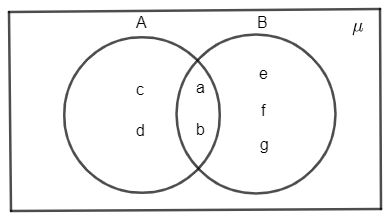
From Venn diagram show that $n\left( A\cup B \right)+n\left( A\cap B \right)=n\left( A \right)+n\left( B \right)$.
Answer
 Verified
533.7k+ views
Hint: In this question we have been given with a Venn diagram and using the Venn diagram we have to show that $n\left( A\cup B \right)+n\left( A\cap B \right)=n\left( A \right)+n\left( B \right)$. We will first write all the sets which include the intersection and union set of the given sets $A$ and $B$. We will then consider the left-hand side of the expression and find its value and then consider the right-hand side and find its value and check whether the condition holds true.
Complete step by step answer:
We can see from the Venn diagram that:
$\Rightarrow A=\left\{ a,b,c,d \right\}$
$\Rightarrow B=\left\{ a,b,e,f,g \right\}$
Therefore, we get:
$\Rightarrow n\left( A \right)=4$
$\Rightarrow n\left( B \right)=5$
The union set which is represented as $A\cup B$ represents the set of all the distinct elements that are present in the sets $A$ or $B$. We have the intersection as:
$\Rightarrow A\cup B=\left\{ a,b,c,d,e,f,g \right\}$
Therefore, we have:
$\Rightarrow n\left( A\cup B \right)=7$
The intersection set which is represented as $A\cap B$ represents the set of all the distinct elements that are present in the both sets $A$ and $B$. We have the intersection as:
$\Rightarrow A\cap B=\left\{ a,b \right\}$
Therefore, we have:
$\Rightarrow n\left( A\cap B \right)=2$
Now we have to prove that $n\left( A\cup B \right)+n\left( A\cap B \right)=n\left( A \right)+n\left( B \right)$.
Consider the left-hand side of the expression, we have:
$\Rightarrow n\left( A\cup B \right)+n\left( A\cap B \right)$
On substituting the values, we get:
$\Rightarrow 7+2$
On simplifying, we get:
$\Rightarrow 9$, which is the value of the left-hand side.
Consider the right-hand side of the expression, we have:
$\Rightarrow n\left( A \right)+n\left( B \right)$
On substituting the values, we get:
$\Rightarrow 4+5$
On simplifying, we get:
$\Rightarrow 9$, which is the value of the right-hand side.
Since the values of both the sides are the same the expression is correct, hence proved.
Note: It is to be remembered that the $n\left( P \right)$ represents the number of elements present in the set. A Venn diagram is a good method to simplify set problems such that they can be visualized. The various properties of Venn diagrams should be remembered to solve these types of questions.
Complete step by step answer:
We can see from the Venn diagram that:
$\Rightarrow A=\left\{ a,b,c,d \right\}$
$\Rightarrow B=\left\{ a,b,e,f,g \right\}$
Therefore, we get:
$\Rightarrow n\left( A \right)=4$
$\Rightarrow n\left( B \right)=5$
The union set which is represented as $A\cup B$ represents the set of all the distinct elements that are present in the sets $A$ or $B$. We have the intersection as:
$\Rightarrow A\cup B=\left\{ a,b,c,d,e,f,g \right\}$
Therefore, we have:
$\Rightarrow n\left( A\cup B \right)=7$
The intersection set which is represented as $A\cap B$ represents the set of all the distinct elements that are present in the both sets $A$ and $B$. We have the intersection as:
$\Rightarrow A\cap B=\left\{ a,b \right\}$
Therefore, we have:
$\Rightarrow n\left( A\cap B \right)=2$
Now we have to prove that $n\left( A\cup B \right)+n\left( A\cap B \right)=n\left( A \right)+n\left( B \right)$.
Consider the left-hand side of the expression, we have:
$\Rightarrow n\left( A\cup B \right)+n\left( A\cap B \right)$
On substituting the values, we get:
$\Rightarrow 7+2$
On simplifying, we get:
$\Rightarrow 9$, which is the value of the left-hand side.
Consider the right-hand side of the expression, we have:
$\Rightarrow n\left( A \right)+n\left( B \right)$
On substituting the values, we get:
$\Rightarrow 4+5$
On simplifying, we get:
$\Rightarrow 9$, which is the value of the right-hand side.
Since the values of both the sides are the same the expression is correct, hence proved.
Note: It is to be remembered that the $n\left( P \right)$ represents the number of elements present in the set. A Venn diagram is a good method to simplify set problems such that they can be visualized. The various properties of Venn diagrams should be remembered to solve these types of questions.
Recently Updated Pages
Master Class 11 Computer Science: Engaging Questions & Answers for Success

Master Class 11 Business Studies: Engaging Questions & Answers for Success
Master Class 11 Economics: Engaging Questions & Answers for Success
Master Class 11 English: Engaging Questions & Answers for Success
Master Class 11 Maths: Engaging Questions & Answers for Success
Master Class 11 Biology: Engaging Questions & Answers for Success
Trending doubts
One Metric ton is equal to kg A 10000 B 1000 C 100 class 11 physics CBSE
There are 720 permutations of the digits 1 2 3 4 5 class 11 maths CBSE
Discuss the various forms of bacteria class 11 biology CBSE
Draw a diagram of a plant cell and label at least eight class 11 biology CBSE
State the laws of reflection of light
Explain zero factorial class 11 maths CBSE