




From the top of a cliff $20m$ high, the angle of elevation of the top of a tower is found to be equal to the angle of depression of the foot of a tower. Find the height of the tower.
Answer
 Verified
590.1k+ views
Hint: The question belongs to the topic- heights and distances. In such questions, trigonometric ratios are used to find the required length or distance. Start by making a figure as per the question. Mark all the angles and lengths given. Find a relation between the given side and the side to be found. Using the relation between the two sides, use a suitable trigonometric ratio.
Complete step-by-step answer:
Start by making a diagram as per the question. Let CH be the cliff, AD be the tower whose length is to be found. We are given $CH = 20m$. We can see
$BD = CH = 20m$.
It is given that the two angles- one to the top of the tower and other to the bottom of the tower- are equal. Let $\angle ACB = \angle BCD = x^\circ $.
In $\vartriangle BCD$,
$ \Rightarrow \tan x^\circ = \dfrac{{BD}}{{BC}}$
Putting $BD = 20m$,
$ \Rightarrow \tan x^\circ = \dfrac{{20}}{{BC}}$ …..…. (1)
In $\vartriangle ABC$,
$ \Rightarrow \tan x^\circ = \dfrac{{AB}}{{BC}}$ ….…. (2)
Since LHS of equations (1) and (2) are same, we will equate them-
$ \Rightarrow \dfrac{{20}}{{BC}} = \dfrac{{AB}}{{BC}}$
Shifting and solving,
$ \Rightarrow \dfrac{{20}}{{AB}} = \dfrac{{BC}}{{BC}}$
$ \Rightarrow \dfrac{{20}}{{AB}} = 1$
$ \Rightarrow AB = 20m$
Now, we know that tower = $AB + BD$$ = 20m + 20m = 40m$
Hence, the height of the tower is $40m$.
Note: There are certain terms used in the question which are important to understand before solving any heights and distances question-
1) Angle of elevation: It is the angle formed when we see an object above our eye level.

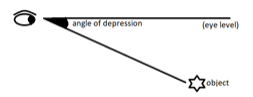
2) Angle of depression: It is an angle formed when we see an object below our eye level.
Complete step-by-step answer:
Start by making a diagram as per the question. Let CH be the cliff, AD be the tower whose length is to be found. We are given $CH = 20m$. We can see
$BD = CH = 20m$.
It is given that the two angles- one to the top of the tower and other to the bottom of the tower- are equal. Let $\angle ACB = \angle BCD = x^\circ $.
In $\vartriangle BCD$,
$ \Rightarrow \tan x^\circ = \dfrac{{BD}}{{BC}}$
Putting $BD = 20m$,
$ \Rightarrow \tan x^\circ = \dfrac{{20}}{{BC}}$ …..…. (1)
In $\vartriangle ABC$,
$ \Rightarrow \tan x^\circ = \dfrac{{AB}}{{BC}}$ ….…. (2)
Since LHS of equations (1) and (2) are same, we will equate them-
$ \Rightarrow \dfrac{{20}}{{BC}} = \dfrac{{AB}}{{BC}}$
Shifting and solving,
$ \Rightarrow \dfrac{{20}}{{AB}} = \dfrac{{BC}}{{BC}}$
$ \Rightarrow \dfrac{{20}}{{AB}} = 1$
$ \Rightarrow AB = 20m$
Now, we know that tower = $AB + BD$$ = 20m + 20m = 40m$
Hence, the height of the tower is $40m$.
Note: There are certain terms used in the question which are important to understand before solving any heights and distances question-
1) Angle of elevation: It is the angle formed when we see an object above our eye level.
2) Angle of depression: It is an angle formed when we see an object below our eye level.
Recently Updated Pages
Basicity of sulphurous acid and sulphuric acid are

Master Class 12 English: Engaging Questions & Answers for Success
Master Class 12 Social Science: Engaging Questions & Answers for Success
Master Class 12 Maths: Engaging Questions & Answers for Success
Master Class 12 Economics: Engaging Questions & Answers for Success
Master Class 12 Physics: Engaging Questions & Answers for Success
Trending doubts
Which are the Top 10 Largest Countries of the World?
Draw a labelled sketch of the human eye class 12 physics CBSE
Give 10 examples of unisexual and bisexual flowers
Coming together federation is practiced in A India class 12 social science CBSE
Write the formula to find the shortest distance between class 12 maths CBSE
Find the foot of the perpendicular from point232to class 12 maths CBSE