




From the top of a cliff 200 meters high, the angles of depression of the top and bottom of a tower are
observed to be $ 30{}^\circ $ and $ 60{}^\circ $ . Find the height of the tower and calculate the distance
between them.
A. Height = 156 m; Distance = 119.7 m
B. Height = $ 133\dfrac{1}{3} $ m; Distance = 115.46 m
C. Height = 220 m; Distance = 112.76 m
D. None of these.
Answer
 Verified
589.2k+ views
Hint:If a person stands and looks up at an object, the angle of elevation is the angle between the horizontal line of sight and the object. If a person stands and looks down at an object, the angle of depression is the angle between the horizontal line of sight and the object.
Draw a diagram with the positions of the given structures with respect to the level ground.
Draw some right-angled triangles and identify the given angles in it.
Recall the values of trigonometric ratios for $ 30{}^\circ $ and $ 60{}^\circ $ , and use them to find the unknown lengths of the right-angled triangles.
.g. $ \sin 30{}^\circ =\dfrac{1}{2},\ \cos 30{}^\circ =\dfrac{\sqrt{3}}{2},\ \tan 30{}^\circ
=\dfrac{1}{\sqrt{3}} $
$ \sin 60{}^\circ =\dfrac{\sqrt{3}}{2},\ \cos 60{}^\circ =\dfrac{1}{2},\ \tan 60{}^\circ =\sqrt{3} $
Complete step by step solution:
Let's say that AB is the cliff and CD is the tower, as shown in the following diagram:
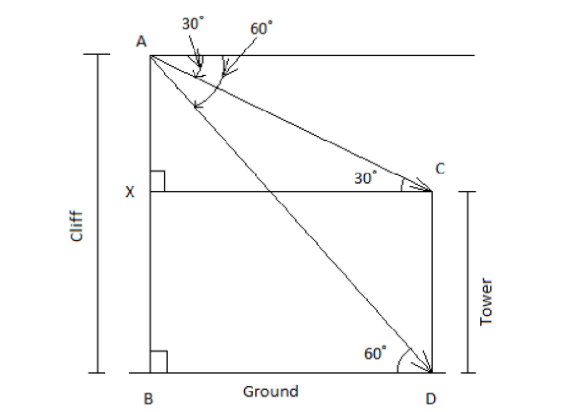
Using the definition of angle of depression and by the properties of parallel lines, we have $ \angle
ACB=30{}^\circ $ and $ \angle ADB=60{}^\circ $ . Also, $ AB=200\ m $ (height of the cliff).
Using the definition of $ \tan \theta $ in $ \Delta ABD $ , we have:
$ \tan 60{}^\circ =\dfrac{P}{B}=\dfrac{AB}{BD}=\dfrac{200}{BD} $
Using $ \tan 60{}^\circ =\sqrt{3} $ , we get:
⇒ $ \sqrt{3}=\dfrac{200}{BD} $
⇒ $ BD=\dfrac{200}{\sqrt{3}}=115.47\ m $
Now $ CX=BD=\dfrac{200}{\sqrt{3}} $ (why?). Using the definition of $ \tan \theta $ in $ \Delta AXC $ ,
we have:
$ \tan 30{}^\circ =\dfrac{P}{B}=\dfrac{AX}{XC} $
Using $ \tan 30{}^\circ =\dfrac{1}{\sqrt{3}} $ , we get:
⇒ $ AX=\dfrac{1}{\sqrt{3}}XC=\dfrac{1}{\sqrt{3}}\times
\dfrac{200}{\sqrt{3}}=\dfrac{200}{3}=66\dfrac{2}{3}\ m $
And $ CD=XB=AB-AX $ .
⇒ $ CD=200-66\dfrac{2}{3}=133\dfrac{1}{3}\ m $
The correct answer is B. Height = $ 133\dfrac{1}{3} $ m; Distance = 115.46 m.
Note:
In a right-angled triangle with length of the side opposite to angle θ as perpendicular (P), base (B) and hypotenuse (H):
$ \sin \theta =\dfrac{P}{H},\cos \theta =\dfrac{B}{H},\tan \theta =\dfrac{P}{B} $
$ {{P}^{2}}+{{B}^{2}}={{H}^{2}} $ (Pythagoras' Theorem)
If one trigonometric ratio is known, we can use Pythagoras' Theorem and calculate the values of all other trigonometric ratios.
Draw a diagram with the positions of the given structures with respect to the level ground.
Draw some right-angled triangles and identify the given angles in it.
Recall the values of trigonometric ratios for $ 30{}^\circ $ and $ 60{}^\circ $ , and use them to find the unknown lengths of the right-angled triangles.
.g. $ \sin 30{}^\circ =\dfrac{1}{2},\ \cos 30{}^\circ =\dfrac{\sqrt{3}}{2},\ \tan 30{}^\circ
=\dfrac{1}{\sqrt{3}} $
$ \sin 60{}^\circ =\dfrac{\sqrt{3}}{2},\ \cos 60{}^\circ =\dfrac{1}{2},\ \tan 60{}^\circ =\sqrt{3} $
Complete step by step solution:
Let's say that AB is the cliff and CD is the tower, as shown in the following diagram:
Using the definition of angle of depression and by the properties of parallel lines, we have $ \angle
ACB=30{}^\circ $ and $ \angle ADB=60{}^\circ $ . Also, $ AB=200\ m $ (height of the cliff).
Using the definition of $ \tan \theta $ in $ \Delta ABD $ , we have:
$ \tan 60{}^\circ =\dfrac{P}{B}=\dfrac{AB}{BD}=\dfrac{200}{BD} $
Using $ \tan 60{}^\circ =\sqrt{3} $ , we get:
⇒ $ \sqrt{3}=\dfrac{200}{BD} $
⇒ $ BD=\dfrac{200}{\sqrt{3}}=115.47\ m $
Now $ CX=BD=\dfrac{200}{\sqrt{3}} $ (why?). Using the definition of $ \tan \theta $ in $ \Delta AXC $ ,
we have:
$ \tan 30{}^\circ =\dfrac{P}{B}=\dfrac{AX}{XC} $
Using $ \tan 30{}^\circ =\dfrac{1}{\sqrt{3}} $ , we get:
⇒ $ AX=\dfrac{1}{\sqrt{3}}XC=\dfrac{1}{\sqrt{3}}\times
\dfrac{200}{\sqrt{3}}=\dfrac{200}{3}=66\dfrac{2}{3}\ m $
And $ CD=XB=AB-AX $ .
⇒ $ CD=200-66\dfrac{2}{3}=133\dfrac{1}{3}\ m $
The correct answer is B. Height = $ 133\dfrac{1}{3} $ m; Distance = 115.46 m.
Note:
In a right-angled triangle with length of the side opposite to angle θ as perpendicular (P), base (B) and hypotenuse (H):
$ \sin \theta =\dfrac{P}{H},\cos \theta =\dfrac{B}{H},\tan \theta =\dfrac{P}{B} $
$ {{P}^{2}}+{{B}^{2}}={{H}^{2}} $ (Pythagoras' Theorem)
If one trigonometric ratio is known, we can use Pythagoras' Theorem and calculate the values of all other trigonometric ratios.
Recently Updated Pages
Master Class 12 Business Studies: Engaging Questions & Answers for Success

Master Class 12 Biology: Engaging Questions & Answers for Success
Master Class 12 Chemistry: Engaging Questions & Answers for Success
Class 12 Question and Answer - Your Ultimate Solutions Guide
Master Class 11 Social Science: Engaging Questions & Answers for Success
Master Class 11 English: Engaging Questions & Answers for Success
Trending doubts
Explain the Treaty of Vienna of 1815 class 10 social science CBSE
Which Indian city is known as the "City of Victory"?
Which instrument is used to measure the Blood Pressure?
Who Won 36 Oscar Awards? Record Holder Revealed
What is the median of the first 10 natural numbers class 10 maths CBSE
Why is it 530 pm in india when it is 1200 afternoon class 10 social science CBSE