




From the picture, identify the methods of asexual reproduction in animals?
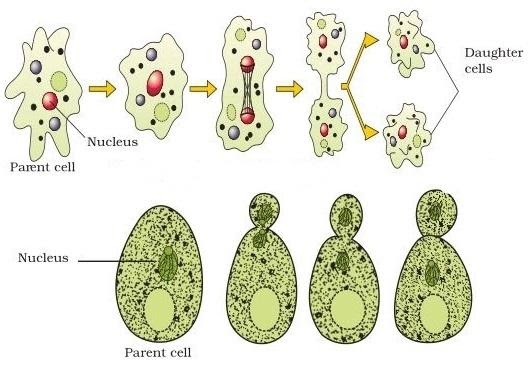
A. Binary fission, budding
B. Vegetative propagation
C. Both A and B
D. Asexual reproduction does not take place in animals
Answer
 Verified
533.4k+ views
Hint: Asexual reproduction is a type of reproduction where fusion of gametes does not take place. There is also no change in the number of chromosomes. Asexual reproduction is the main type of reproduction that take place in single celled organisms such as archaea and bacteria. Eukaryotic organisms such as plants, animals, and fungi can also reproduce asexually.
Complete answer:
Option A Binary fission, budding: In binary fission, the parent cell is split into two new daughter cells. During this process, division and duplication of the parent’s genetic matter into two parts occur. In budding a new organism is developed from a part of the parent’s body. The bud detaches to develop into a new organism. In the given diagram binary fission and budding is observed.
Option A is correct.
Option B vegetative propagation: Vegetative propagation is a reproduction method that occurs exclusively in plants and in some animals. It occurs through fragmentation and regeneration of specific vegetative parts of the organism. In the given diagram vegetative propagation is not present.
Option B is incorrect.
Option C both A and B: This option is incorrect because option B which is vegetative propagation is not given in the diagram.
Option C is incorrect.
Option D Asexual reproduction does not take place in multicellular animals: This statement is wrong because animals does reproduce asexually through methods like binary fission, budding, regeneration, fragmentation etc.
Option D is incorrect.
Hence, Option A. Binary fission, budding is the correct answer.
Note:
The animals also reproduce exclusively through sexual reproduction. In this method, a haploid male gamete fuses with a haploid female gamete to form a diploid zygote. The zygote divides through mitosis and differentiates into an embryo. The resulting organism is diploid in nature. Sexual reproduction leads to variation and diversity which is the main advantage of this method.
Complete answer:
Option A Binary fission, budding: In binary fission, the parent cell is split into two new daughter cells. During this process, division and duplication of the parent’s genetic matter into two parts occur. In budding a new organism is developed from a part of the parent’s body. The bud detaches to develop into a new organism. In the given diagram binary fission and budding is observed.
Option A is correct.
Option B vegetative propagation: Vegetative propagation is a reproduction method that occurs exclusively in plants and in some animals. It occurs through fragmentation and regeneration of specific vegetative parts of the organism. In the given diagram vegetative propagation is not present.
Option B is incorrect.
Option C both A and B: This option is incorrect because option B which is vegetative propagation is not given in the diagram.
Option C is incorrect.
Option D Asexual reproduction does not take place in multicellular animals: This statement is wrong because animals does reproduce asexually through methods like binary fission, budding, regeneration, fragmentation etc.
Option D is incorrect.
Hence, Option A. Binary fission, budding is the correct answer.
Note:
The animals also reproduce exclusively through sexual reproduction. In this method, a haploid male gamete fuses with a haploid female gamete to form a diploid zygote. The zygote divides through mitosis and differentiates into an embryo. The resulting organism is diploid in nature. Sexual reproduction leads to variation and diversity which is the main advantage of this method.
Recently Updated Pages
Master Class 12 Business Studies: Engaging Questions & Answers for Success

Master Class 12 Biology: Engaging Questions & Answers for Success
Master Class 12 Chemistry: Engaging Questions & Answers for Success
Class 12 Question and Answer - Your Ultimate Solutions Guide
Master Class 11 Social Science: Engaging Questions & Answers for Success
Master Class 11 English: Engaging Questions & Answers for Success
Trending doubts
Find the sum of series 1 + 2 + 3 + 4 + 5 + + 100 class 9 maths CBSE
On an outline map of India show its neighbouring c class 9 social science CBSE
Write an Article on Save Earth Save Life
On an outline map of India mark the Karakoram range class 9 social science CBSE
If HCF of 210 and 55 is expressed in the form of 210 class 9 maths CBSE
What is the difference between Atleast and Atmost in class 9 maths CBSE