



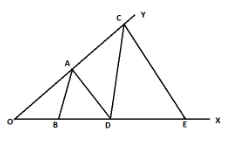
From the given figure XOY is an angle, where $AB\left\| {CD} \right.$and, \[AD\left\| {CE} \right.\], if $OA = 4cm$, $BD = 3cm$ and $OB = 2cm,$ then the length of $BE$ is:
A. $7.5cm$
B. $10.5cm$
C. $12.5cm$
D. $15.0cm$
Answer
 Verified
576.6k+ views
Hint: According to given in the question we have to find the length of $BE$when XOY is an angle, where $AB\left\| {CD} \right.$ and, \[AD\left\| {CE} \right.\], if $OA = 4cm$, $BD = 3cm$ and $OB = 2cm$ so, to find the length of $BE$ first of all we have to use the congruent property for triangle ABD and triangle CDE after that we will consider the triangle ADC to obtain the ratio between the length of lines $OA$ and $OC$ to find the length of $AC$
Now, we have to consider the quadrilateral OACE to find the ratio of the lines $OD$ and $DE$ to find the value of $DE$ from which we can obtain the value of $BE$
Complete step-by-step answer:
Given,
$AB\left\| {CD} \right.$ that means $AB$ is parallel to line $CD$
\[AD\left\| {CE} \right.\] that means $AD$ is parallel to line $CE$
$BD = 3cm$ and $OB = 2cm,$
Step 1: First of all we have to find the value of $AC$with the help of the triangle ABD and triangle CDE so first of all we have to use the congruent property as mentioned in the solution hint.
$AB\left\| {CD} \right.$ so,$AB$ is parallel to line $CD$
\[AD\left\| {CE} \right.\] so, $AD$ is parallel to line $CE$
Hence, in triangle ADC,
$OB = OA$ and $BD = OC$
Step 2: Now, on substituting the value of $OA,BD,$ and $AC$ as mentioned in the question.
$ \Rightarrow \dfrac{{OB}}{{BD}} = \dfrac{{OA}}{{OC}}$
$ \Rightarrow \dfrac{2}{3} = \dfrac{4}{{AC}}$
Now, to find the value of $AC$ we have to apply the cross-multiplication in the expression as obtained just above,
$
\Rightarrow AC = \dfrac{{4 \times 3}}{2} \\
\Rightarrow AC = 6cm \\
$
Step 3: Now, we have to solve the quadrilateral $OACE$ and as we obtained that,
$AD\left\| {CE} \right.$ that means $AD$ is parallel to $CE$
Hence,
$ \Rightarrow \dfrac{{OA}}{{AC}} = \dfrac{{OD}}{{DE}}$
Step 4: On substituting the values of $OA,AC,$ and $OD$ in the expression as just obtained above,
$ \Rightarrow \dfrac{4}{6} = \dfrac{5}{{DE}}$
Now, to find the value of $DE$ we have to apply the cross-multiplication in the expression as obtained just above,
$
\Rightarrow DE = \dfrac{{5 \times 6}}{4} \\
\Rightarrow DE = 7.5cm \\
$
And now as we know that $DE = BE$
Hence,
$BE = 7.5cm$
Hence, by using the properties for the triangle ABD and triangle CDE we have obtained the length of $BE = 7.5cm$
Note: If two sides of the given triangles and one angle or if two angles and one side of the given triangle is equal then the triangle is known as similar triangle or congruent triangles.
If all the three sides of a given triangle is equal to the three sides of another triangle and if the three angles are equal to all the three angles of the other triangle then both of the triangles are congruent or equal to each other.
Now, we have to consider the quadrilateral OACE to find the ratio of the lines $OD$ and $DE$ to find the value of $DE$ from which we can obtain the value of $BE$
Complete step-by-step answer:
Given,
$AB\left\| {CD} \right.$ that means $AB$ is parallel to line $CD$
\[AD\left\| {CE} \right.\] that means $AD$ is parallel to line $CE$
$BD = 3cm$ and $OB = 2cm,$
Step 1: First of all we have to find the value of $AC$with the help of the triangle ABD and triangle CDE so first of all we have to use the congruent property as mentioned in the solution hint.
$AB\left\| {CD} \right.$ so,$AB$ is parallel to line $CD$
\[AD\left\| {CE} \right.\] so, $AD$ is parallel to line $CE$
Hence, in triangle ADC,
$OB = OA$ and $BD = OC$
Step 2: Now, on substituting the value of $OA,BD,$ and $AC$ as mentioned in the question.
$ \Rightarrow \dfrac{{OB}}{{BD}} = \dfrac{{OA}}{{OC}}$
$ \Rightarrow \dfrac{2}{3} = \dfrac{4}{{AC}}$
Now, to find the value of $AC$ we have to apply the cross-multiplication in the expression as obtained just above,
$
\Rightarrow AC = \dfrac{{4 \times 3}}{2} \\
\Rightarrow AC = 6cm \\
$
Step 3: Now, we have to solve the quadrilateral $OACE$ and as we obtained that,
$AD\left\| {CE} \right.$ that means $AD$ is parallel to $CE$
Hence,
$ \Rightarrow \dfrac{{OA}}{{AC}} = \dfrac{{OD}}{{DE}}$
Step 4: On substituting the values of $OA,AC,$ and $OD$ in the expression as just obtained above,
$ \Rightarrow \dfrac{4}{6} = \dfrac{5}{{DE}}$
Now, to find the value of $DE$ we have to apply the cross-multiplication in the expression as obtained just above,
$
\Rightarrow DE = \dfrac{{5 \times 6}}{4} \\
\Rightarrow DE = 7.5cm \\
$
And now as we know that $DE = BE$
Hence,
$BE = 7.5cm$
Hence, by using the properties for the triangle ABD and triangle CDE we have obtained the length of $BE = 7.5cm$
Note: If two sides of the given triangles and one angle or if two angles and one side of the given triangle is equal then the triangle is known as similar triangle or congruent triangles.
If all the three sides of a given triangle is equal to the three sides of another triangle and if the three angles are equal to all the three angles of the other triangle then both of the triangles are congruent or equal to each other.
Recently Updated Pages
Master Class 9 General Knowledge: Engaging Questions & Answers for Success

Master Class 9 Social Science: Engaging Questions & Answers for Success
Master Class 9 English: Engaging Questions & Answers for Success
Master Class 9 Maths: Engaging Questions & Answers for Success
Master Class 9 Science: Engaging Questions & Answers for Success
Class 9 Question and Answer - Your Ultimate Solutions Guide
Trending doubts
Difference Between Plant Cell and Animal Cell
Fill the blanks with the suitable prepositions 1 The class 9 english CBSE
Who is eligible for RTE class 9 social science CBSE
Which places in India experience sunrise first and class 9 social science CBSE
What is pollution? How many types of pollution? Define it
Name 10 Living and Non living things class 9 biology CBSE