




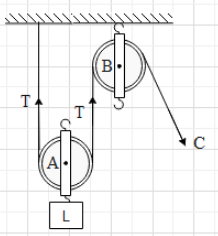
From the diagram given below, answer the questions that follow :
(i) What kind of pulleys are A and B?
(ii) State the purpose of pulley B.
(iii) What effort has to be applied at C to just raise the load $L=20kgf$.
(Neglect the weight of pulley and friction).
Answer
 Verified
583.2k+ views
Hint: A pulley with one end of the rope on it is fixed and the other end is free to move is called a single movable pulley as it becomes free to move up and down. Whereas if a pulley is fixed and connected moves in any direction, then it is called single fixed pulley.
Complete step by step answer:
A pulley is a simple machine that is used to perform a mechanical work on an object.
(i) In the diagram we can see that one end of the rope on pulley A is fixed and the other end of the rope is free to move in any direction. As a result, this pulley can move in the upwards and downwards directions. Therefore, pulley A is a single movable pulley. Pulley B is fixed to the ceiling and it cannot move and can rotate about the fixed axis. Therefore, pulley B is a single fixed pulley.
(ii) Since the pulley B is fixed, we can apply a force on the rope in any direction. This means that the direction of the applied force will not change the work done on the load. Therefore, pulley B helps us to drag the rope in the direction that is convenient to us.
The best example of this situation is fetching water from a well with help of the pulley. The fixed pulley helps us pull the rope in the direction that makes our job easy.
(iii) The effort at C is equal to the tension in the rope.
i.e. $E=T$
It is said that the masses of the pulleys and friction between the pulley and the rope are negligible. From the figure, we can understand that the net tension force on the load is equal to $2T$.Therefore, to just praise the load of 20kgf, the tension force on the load must be equal to the gravitational force on the load. The gravitational force on the load is equal to its weight, i.e. 20kgf. This means that $2T=20kgf$
$\Rightarrow T=10kgf$
Since $E=T$,
$\Rightarrow E=10kgf$.
Therefore, the effort needed to apply at C to just raise the given load is equal to 10kgf.
Note: It is said that the masses of the pulleys and friction between the pulley and the rope are negligible. Otherwise the tension force had to overcome the frictional force and the weight of the pulleys. As a result, the tension force would not be equal to the weight of the load.
Complete step by step answer:
A pulley is a simple machine that is used to perform a mechanical work on an object.
(i) In the diagram we can see that one end of the rope on pulley A is fixed and the other end of the rope is free to move in any direction. As a result, this pulley can move in the upwards and downwards directions. Therefore, pulley A is a single movable pulley. Pulley B is fixed to the ceiling and it cannot move and can rotate about the fixed axis. Therefore, pulley B is a single fixed pulley.
(ii) Since the pulley B is fixed, we can apply a force on the rope in any direction. This means that the direction of the applied force will not change the work done on the load. Therefore, pulley B helps us to drag the rope in the direction that is convenient to us.
The best example of this situation is fetching water from a well with help of the pulley. The fixed pulley helps us pull the rope in the direction that makes our job easy.
(iii) The effort at C is equal to the tension in the rope.
i.e. $E=T$
It is said that the masses of the pulleys and friction between the pulley and the rope are negligible. From the figure, we can understand that the net tension force on the load is equal to $2T$.Therefore, to just praise the load of 20kgf, the tension force on the load must be equal to the gravitational force on the load. The gravitational force on the load is equal to its weight, i.e. 20kgf. This means that $2T=20kgf$
$\Rightarrow T=10kgf$
Since $E=T$,
$\Rightarrow E=10kgf$.
Therefore, the effort needed to apply at C to just raise the given load is equal to 10kgf.
Note: It is said that the masses of the pulleys and friction between the pulley and the rope are negligible. Otherwise the tension force had to overcome the frictional force and the weight of the pulleys. As a result, the tension force would not be equal to the weight of the load.
Recently Updated Pages
Master Class 11 Social Science: Engaging Questions & Answers for Success

Master Class 11 Physics: Engaging Questions & Answers for Success
Master Class 11 Maths: Engaging Questions & Answers for Success
Master Class 11 Economics: Engaging Questions & Answers for Success
Master Class 11 Computer Science: Engaging Questions & Answers for Success
Master Class 11 Chemistry: Engaging Questions & Answers for Success
Trending doubts
One Metric ton is equal to kg A 10000 B 1000 C 100 class 11 physics CBSE
There are 720 permutations of the digits 1 2 3 4 5 class 11 maths CBSE
1 Quintal is equal to a 110 kg b 10 kg c 100kg d 1000 class 11 physics CBSE
State and prove Bernoullis theorem class 11 physics CBSE
Difference Between Prokaryotic Cells and Eukaryotic Cells
Which among the following are examples of coming together class 11 social science CBSE