




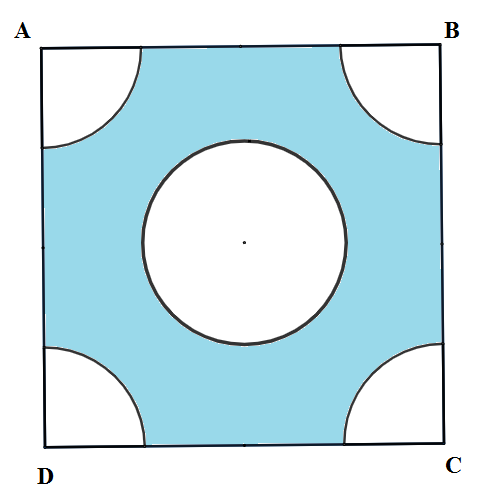
From each corner of a square of side 4 cm a quadrant of a circle of radius 1 cm is cut and also a circle of diameter 2 cm is cut as shown in fig. Find the area of the remaining portion of the square. \[\]
Answer
 Verified
609k+ views
Hint: We find the formula for the area of the square as $ {{a}^{2}} $ where is the length of the side. We find the area of the circle with radius $ r $ as $ \pi {{r}^{2}} $ . We find the area of one quadrant with radius $ r $ as $ \dfrac{1}{4}\pi {{r}^{2}} $ . We find the area of the shaded region by subtracting the sum of the areas of the circle and the four quadrants from the area of the square.
\[{{A}_{s}}=4\times 4=16\text{ c}{{\text{m}}^{2}}\]
Complete step by step answer:
Let us observe the given figure.\[\]
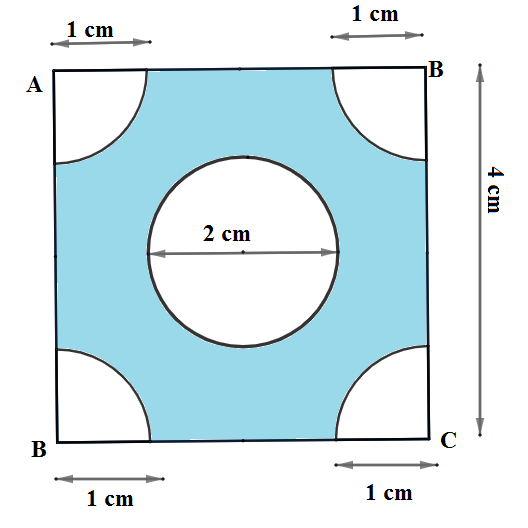
We are given the question that ABCD is square with length 4cm. So the area of the square is
\[{{A}_{s}}=4\times 4=16\text{ c}{{\text{m}}^{2}}\]
We are also given in the question that at each corner A,B,C and D a quadrant of a circle of radius 1 cm is cut. We also see that the area of four quadrants at the four corners is equal. We know that the area of the one quadrant is one –fourth of the area of the circle. Let us find the area of one quadrant as
\[{{A}_{q}}=\dfrac{1}{4}\pi {{\left( 1 \right)}^{2}}=\dfrac{1}{4}\times \pi \times 1=\dfrac{\pi }{4}\text{ c}{{\text{m}}^{2}}\]
We are further given the question that a circle of diameter 2 cm is cut as shown in fig. So the radius of the circle is $ \dfrac{2}{2}=1 $ cm. We find the area of the circle as
\[{{A}_{c}}=\pi {{\left( 1 \right)}^{2}}=\pi \text{ c}{{\text{m}}^{2}}\]
We are asked to find the area of the remaining portion. We see that the remaining portion is obtained when we remove the four quadrant regions and the circular regions. We have the required area as;
\[\begin{align}
& A={{A}_{s}}-\left( 4{{A}_{q}}+{{A}_{c}} \right) \\
& \Rightarrow A=16-\left( 4\times \dfrac{1}{4}\pi +\pi \right) \\
& \Rightarrow A=16-2\pi \\
\end{align}\]
We take the value of $ \pi =\dfrac{22}{7} $ and have;
\[\begin{align}
& \Rightarrow A=16-2\times \dfrac{22}{7} \\
& \Rightarrow A=16-\dfrac{44}{7} \\
& \Rightarrow A=\dfrac{168-44}{7} \\
& \Rightarrow A=\dfrac{68}{7}\text{ c}{{\text{m}}^{2}} \\
\end{align}\]
So the area of the remaining portion is $ \dfrac{68}{7}\text{ c}{{\text{m}}^{2}} $ .\[\]
Note:
We note that areas of congruent shapes are always equal and the quadrants of the circle are congruent when equal radii have. That is why the areas of four quadrants are equal. We also note that the question presumes that the center of the removed circle and the centre of the square (point of intersection of diagonals) coincide. We should always take care of units when calculating areas.
\[{{A}_{s}}=4\times 4=16\text{ c}{{\text{m}}^{2}}\]
Complete step by step answer:
Let us observe the given figure.\[\]
We are given the question that ABCD is square with length 4cm. So the area of the square is
\[{{A}_{s}}=4\times 4=16\text{ c}{{\text{m}}^{2}}\]
We are also given in the question that at each corner A,B,C and D a quadrant of a circle of radius 1 cm is cut. We also see that the area of four quadrants at the four corners is equal. We know that the area of the one quadrant is one –fourth of the area of the circle. Let us find the area of one quadrant as
\[{{A}_{q}}=\dfrac{1}{4}\pi {{\left( 1 \right)}^{2}}=\dfrac{1}{4}\times \pi \times 1=\dfrac{\pi }{4}\text{ c}{{\text{m}}^{2}}\]
We are further given the question that a circle of diameter 2 cm is cut as shown in fig. So the radius of the circle is $ \dfrac{2}{2}=1 $ cm. We find the area of the circle as
\[{{A}_{c}}=\pi {{\left( 1 \right)}^{2}}=\pi \text{ c}{{\text{m}}^{2}}\]
We are asked to find the area of the remaining portion. We see that the remaining portion is obtained when we remove the four quadrant regions and the circular regions. We have the required area as;
\[\begin{align}
& A={{A}_{s}}-\left( 4{{A}_{q}}+{{A}_{c}} \right) \\
& \Rightarrow A=16-\left( 4\times \dfrac{1}{4}\pi +\pi \right) \\
& \Rightarrow A=16-2\pi \\
\end{align}\]
We take the value of $ \pi =\dfrac{22}{7} $ and have;
\[\begin{align}
& \Rightarrow A=16-2\times \dfrac{22}{7} \\
& \Rightarrow A=16-\dfrac{44}{7} \\
& \Rightarrow A=\dfrac{168-44}{7} \\
& \Rightarrow A=\dfrac{68}{7}\text{ c}{{\text{m}}^{2}} \\
\end{align}\]
So the area of the remaining portion is $ \dfrac{68}{7}\text{ c}{{\text{m}}^{2}} $ .\[\]
Note:
We note that areas of congruent shapes are always equal and the quadrants of the circle are congruent when equal radii have. That is why the areas of four quadrants are equal. We also note that the question presumes that the center of the removed circle and the centre of the square (point of intersection of diagonals) coincide. We should always take care of units when calculating areas.
Recently Updated Pages
Master Class 11 English: Engaging Questions & Answers for Success

Master Class 11 Social Science: Engaging Questions & Answers for Success
Master Class 11 Maths: Engaging Questions & Answers for Success
Master Class 11 Biology: Engaging Questions & Answers for Success
Master Class 11 Physics: Engaging Questions & Answers for Success
Master Class 11 Chemistry: Engaging Questions & Answers for Success
Trending doubts
Explain the Treaty of Vienna of 1815 class 10 social science CBSE
First Cotton Mill of India
In which year voting age was reduced from 21 to 18?
What planets have no moons Which one has only one moon class 10 physics CBSE
What is the full form of POSCO class 10 social science CBSE
10 examples of evaporation in daily life with explanations