




From a window 15 m high above the ground in a street, the angles of elevation and depression of the top and foot off another house on the opposite side of the street are 30 and 45 degrees, respectively. Show that the height of the opposite house is 23.66 m. [take $\sqrt{3}=1.732$].
Answer
 Verified
558.2k+ views
Hint: Let the window be at P at a height of 15m above the ground. Let CD be the house on the opposite side of the street having height as h meter. Let AP is the length of the window above the ground street which is 15 m high. Using tan 45 degree in triangle PQC, we find the value of PQ. After applying tan 30 degree angle in triangle PQD, we find the value of DQ. At the end by adding both DQ and QC we get the value h.
Complete step-by-step answer:
Let the window be at P at a height 15 m above the ground.
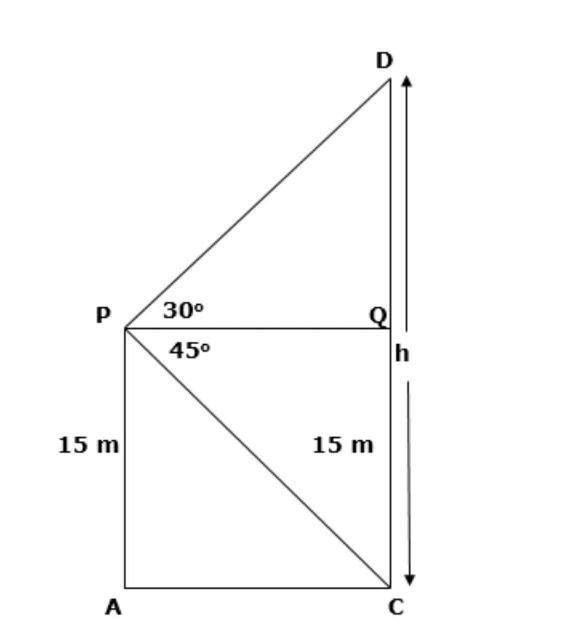
Let the height of the house CD $=\text{ h meters}$.
Now,
QD = CD – CQ =CD – AP =$\left( h-15 \right)metres$.
Consider triangle PQC, applying $\tan {{45}^{\circ }}$ in it to get the value of PQ.
In triangle PQC,
$\tan {{45}^{\circ }}=\dfrac{QC}{PQ}$
The value of $\tan {{45}^{\circ }}=1$ and the value of QC is 15m.
$\begin{align}
& \Rightarrow 1=\dfrac{15}{PQ} \\
& \Rightarrow PQ=15meters \\
\end{align}$
Now, consider triangle PQC, applying $\tan {{30}^{0}}$ in it to get the value of h.
In triangle PQD,
$\tan {{30}^{\circ }}=\dfrac{QD}{PQ}$
The value of $\tan {{30}^{\circ }}$ is $\dfrac{1}{\sqrt{3}}$.
Let the value of QD be $\left( h-15 \right)$ and the value of PQ is $15$m.
$\begin{align}
& \Rightarrow \dfrac{1}{\sqrt{3}}=\dfrac{h-15}{15} \\
& \Rightarrow h-15=\dfrac{15}{\sqrt{3}} \\
& \Rightarrow h=15+\dfrac{15}{\sqrt{3}} \\
& \Rightarrow h=15+15\sqrt{3} \\
& \Rightarrow h=5\left( 3+\sqrt{3} \right)=5(3+1.732)=5\times 4.732 \\
& \Rightarrow h=23.66m \\
\end{align}$
The height of the opposite house is $23.66m$ as you see above.
Hence, the height of the opposite house is $23.66m$.
Note: The key step for solving this problem is the knowledge of trigonometry in geometrical mathematics. By using trigonometry, we can calculate the value of height of a complex system in seconds by measuring the angle of elevation from a fixed surface.
Complete step-by-step answer:
Let the window be at P at a height 15 m above the ground.
Let the height of the house CD $=\text{ h meters}$.
Now,
QD = CD – CQ =CD – AP =$\left( h-15 \right)metres$.
Consider triangle PQC, applying $\tan {{45}^{\circ }}$ in it to get the value of PQ.
In triangle PQC,
$\tan {{45}^{\circ }}=\dfrac{QC}{PQ}$
The value of $\tan {{45}^{\circ }}=1$ and the value of QC is 15m.
$\begin{align}
& \Rightarrow 1=\dfrac{15}{PQ} \\
& \Rightarrow PQ=15meters \\
\end{align}$
Now, consider triangle PQC, applying $\tan {{30}^{0}}$ in it to get the value of h.
In triangle PQD,
$\tan {{30}^{\circ }}=\dfrac{QD}{PQ}$
The value of $\tan {{30}^{\circ }}$ is $\dfrac{1}{\sqrt{3}}$.
Let the value of QD be $\left( h-15 \right)$ and the value of PQ is $15$m.
$\begin{align}
& \Rightarrow \dfrac{1}{\sqrt{3}}=\dfrac{h-15}{15} \\
& \Rightarrow h-15=\dfrac{15}{\sqrt{3}} \\
& \Rightarrow h=15+\dfrac{15}{\sqrt{3}} \\
& \Rightarrow h=15+15\sqrt{3} \\
& \Rightarrow h=5\left( 3+\sqrt{3} \right)=5(3+1.732)=5\times 4.732 \\
& \Rightarrow h=23.66m \\
\end{align}$
The height of the opposite house is $23.66m$ as you see above.
Hence, the height of the opposite house is $23.66m$.
Note: The key step for solving this problem is the knowledge of trigonometry in geometrical mathematics. By using trigonometry, we can calculate the value of height of a complex system in seconds by measuring the angle of elevation from a fixed surface.
Recently Updated Pages
Master Class 10 English: Engaging Questions & Answers for Success

Master Class 10 Social Science: Engaging Questions & Answers for Success
Master Class 10 Computer Science: Engaging Questions & Answers for Success
Class 10 Question and Answer - Your Ultimate Solutions Guide
Master Class 10 General Knowledge: Engaging Questions & Answers for Success
Master Class 10 Maths: Engaging Questions & Answers for Success
Trending doubts
What is the full form of NDA a National Democratic class 10 social science CBSE
Explain the Treaty of Vienna of 1815 class 10 social science CBSE
Who Won 36 Oscar Awards? Record Holder Revealed
Bharatiya Janata Party was founded in the year A 1979 class 10 social science CBSE
What is the median of the first 10 natural numbers class 10 maths CBSE
Why is it 530 pm in india when it is 1200 afternoon class 10 social science CBSE