




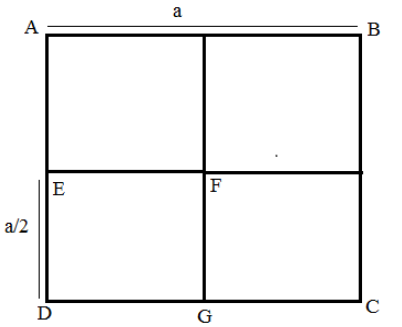
From a uniform square plate of side \[a\] and mass m, a square portion DEFG of side \[\dfrac{a}{2}\] is removed. Then, the moment of inertia of remaining portion about the axis AB is
A. \[\dfrac{{7m{a^2}}}{{16}}\]
B. \[\dfrac{{3m{a^2}}}{{16}}\]
C. \[\dfrac{{3m{a^2}}}{4}\]
D. \[\dfrac{{9m{a^2}}}{{16}}\]
Answer
 Verified
570k+ views
Hint: To find out the moment of inertia of the part excluding DEFG part, we need to find the moment of inertia of the full square plate and subtract the moment of inertia of square DEFG about AB axis. Moreover, moment of inertia is defined as the quantity expressed by the body resisting angular acceleration which is the sum of the product of the mass of every particle with its square of a distance from the axis of rotation.
Complete step by step answer:
The formula for moment of inertia of square plate about a parallel axis through its centre of mass is \[\dfrac{{m{l^2}}}{{12}}\] where \[l\] the length of the side of the square is and m is the mass of the square plate.
First, we find the moment of inertia of the whole square about the axis AB. From parallel axis theorem, we have moment of inertia about a parallel axis through its centre of mass \[I = {I_o} + m{d^2}\], where \[{I_o}\] is the moment of inertia about an axis through the centre of mass of the body, d is the distance between the axes, \[m\] is the mass of the body.
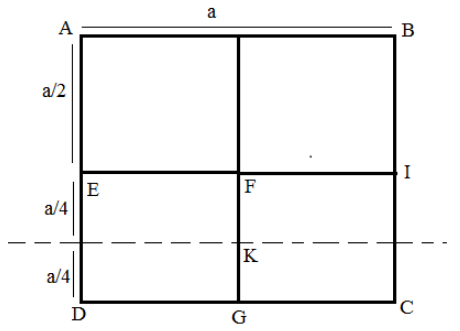
Moment of inertia of a square about an axis parallel to two of its sides and passing through the centre of mass is given by; \[I = \dfrac{{m{l^2}}}{{12}}\], where \[m\] is the mass of the square and \[l\] is the length of the side.
Using parallel axis theorem, moment of inertia of the full square plate about the axis AB is
\[{I_{ABCD}} = \dfrac{{m{a^2}}}{{12}} + m{\left( {\dfrac{a}{2}} \right)^2}\], where \[\dfrac{{m{a^2}}}{{12}}\] is the moment of inertia about the axis EI passing through the centre of mass and \[\dfrac{a}{2}\] is the distance between axis AB and EI
\[ \Rightarrow {I_{ABCD}} = \dfrac{{m{a^2}}}{3}\]...................\[(i)\]
Now, we find out the moment of inertia of the square DEFG about the axis AB. Total mass is\[m\], the mass of the square DEFG is \[\dfrac{m}{4}\] and the side is \[\dfrac{a}{2}\]. For the square DEFG the axis JK passes through its centre of mass. So, moment of inertia about JK for the square DEFG is
\[{I_{JK}} = \dfrac{{\left( {\dfrac{m}{4}} \right){{\left( {\dfrac{a}{2}} \right)}^2}}}{{12}}\]
The moment of inertia of square DEFG about the axis AB, using parallel axis theorem is
\[{I_{DEFG}} = {I_{JK}} + \dfrac{m}{4}{\left( {\dfrac{a}{2} + \dfrac{a}{4}} \right)^2}\], where \[\left( {\dfrac{a}{2} + \dfrac{a}{4}} \right)\]is the distance between axis JK and AB.
\[
\Rightarrow {I_{DEFG}} = \dfrac{{\left( {\dfrac{m}{4}} \right){{\left( {\dfrac{a}{2}} \right)}^2}}}{{12}} + \dfrac{m}{4}{\left( {\dfrac{{3a}}{4}} \right)^2} \\
\Rightarrow {I_{DEFG}} = \dfrac{{m{a^2}}}{{192}} + \dfrac{{9m{a^2}}}{{64}} \\
\]
\[ \Rightarrow {I_{DEFG}} = \dfrac{{28m{a^2}}}{{192}}\]...................\[(ii)\]
Now, when the square DEFG is removed, the moment of inertia of the remaining portion about axis AB is given by
\[{I_{remaining}} = {I_{ABCD}} - {I_{DEFG}}\]
\[ \Rightarrow {I_{remaining}} = \dfrac{{m{a^2}}}{3} - \dfrac{{28m{a^2}}}{{192}}\]
(Using values of \[{I_{ABCD}}\] and \[{I_{DEFG}}\] from equations \[(i)\]and\[(ii)\])
\[ \therefore {I_{remaining}} = \dfrac{{3m{a^2}}}{{16}}\]
Therefore, the moment of inertia of the remaining portion is \[\dfrac{{3m{a^2}}}{{16}}\]. Hence, option B is correct.
Note: In case of moment of inertia, whenever some part of the body is removed or a part is added then we can apply the principle of superposition. But we should check that we are taking the moment of inertia about the same axis for all the parts. When a part is removed we can subtract the moment of inertia of that part from the moment of inertia of the full body as we have done in this question.
Complete step by step answer:
The formula for moment of inertia of square plate about a parallel axis through its centre of mass is \[\dfrac{{m{l^2}}}{{12}}\] where \[l\] the length of the side of the square is and m is the mass of the square plate.
First, we find the moment of inertia of the whole square about the axis AB. From parallel axis theorem, we have moment of inertia about a parallel axis through its centre of mass \[I = {I_o} + m{d^2}\], where \[{I_o}\] is the moment of inertia about an axis through the centre of mass of the body, d is the distance between the axes, \[m\] is the mass of the body.
Moment of inertia of a square about an axis parallel to two of its sides and passing through the centre of mass is given by; \[I = \dfrac{{m{l^2}}}{{12}}\], where \[m\] is the mass of the square and \[l\] is the length of the side.
Using parallel axis theorem, moment of inertia of the full square plate about the axis AB is
\[{I_{ABCD}} = \dfrac{{m{a^2}}}{{12}} + m{\left( {\dfrac{a}{2}} \right)^2}\], where \[\dfrac{{m{a^2}}}{{12}}\] is the moment of inertia about the axis EI passing through the centre of mass and \[\dfrac{a}{2}\] is the distance between axis AB and EI
\[ \Rightarrow {I_{ABCD}} = \dfrac{{m{a^2}}}{3}\]...................\[(i)\]
Now, we find out the moment of inertia of the square DEFG about the axis AB. Total mass is\[m\], the mass of the square DEFG is \[\dfrac{m}{4}\] and the side is \[\dfrac{a}{2}\]. For the square DEFG the axis JK passes through its centre of mass. So, moment of inertia about JK for the square DEFG is
\[{I_{JK}} = \dfrac{{\left( {\dfrac{m}{4}} \right){{\left( {\dfrac{a}{2}} \right)}^2}}}{{12}}\]
The moment of inertia of square DEFG about the axis AB, using parallel axis theorem is
\[{I_{DEFG}} = {I_{JK}} + \dfrac{m}{4}{\left( {\dfrac{a}{2} + \dfrac{a}{4}} \right)^2}\], where \[\left( {\dfrac{a}{2} + \dfrac{a}{4}} \right)\]is the distance between axis JK and AB.
\[
\Rightarrow {I_{DEFG}} = \dfrac{{\left( {\dfrac{m}{4}} \right){{\left( {\dfrac{a}{2}} \right)}^2}}}{{12}} + \dfrac{m}{4}{\left( {\dfrac{{3a}}{4}} \right)^2} \\
\Rightarrow {I_{DEFG}} = \dfrac{{m{a^2}}}{{192}} + \dfrac{{9m{a^2}}}{{64}} \\
\]
\[ \Rightarrow {I_{DEFG}} = \dfrac{{28m{a^2}}}{{192}}\]...................\[(ii)\]
Now, when the square DEFG is removed, the moment of inertia of the remaining portion about axis AB is given by
\[{I_{remaining}} = {I_{ABCD}} - {I_{DEFG}}\]
\[ \Rightarrow {I_{remaining}} = \dfrac{{m{a^2}}}{3} - \dfrac{{28m{a^2}}}{{192}}\]
(Using values of \[{I_{ABCD}}\] and \[{I_{DEFG}}\] from equations \[(i)\]and\[(ii)\])
\[ \therefore {I_{remaining}} = \dfrac{{3m{a^2}}}{{16}}\]
Therefore, the moment of inertia of the remaining portion is \[\dfrac{{3m{a^2}}}{{16}}\]. Hence, option B is correct.
Note: In case of moment of inertia, whenever some part of the body is removed or a part is added then we can apply the principle of superposition. But we should check that we are taking the moment of inertia about the same axis for all the parts. When a part is removed we can subtract the moment of inertia of that part from the moment of inertia of the full body as we have done in this question.
Recently Updated Pages
Master Class 11 Computer Science: Engaging Questions & Answers for Success

Master Class 11 Business Studies: Engaging Questions & Answers for Success
Master Class 11 Economics: Engaging Questions & Answers for Success
Master Class 11 English: Engaging Questions & Answers for Success
Master Class 11 Maths: Engaging Questions & Answers for Success
Master Class 11 Biology: Engaging Questions & Answers for Success
Trending doubts
One Metric ton is equal to kg A 10000 B 1000 C 100 class 11 physics CBSE
There are 720 permutations of the digits 1 2 3 4 5 class 11 maths CBSE
Discuss the various forms of bacteria class 11 biology CBSE
Draw a diagram of a plant cell and label at least eight class 11 biology CBSE
State the laws of reflection of light
Explain zero factorial class 11 maths CBSE