




From a solid cylinder of height 2.8 cm and diameter 4.2 cm, a conical cavity of same height and same diameter is hollowed out. Find the total surface area of the remaining solid. (Take $ \pi =\dfrac{22}{7}$)
Answer
 Verified
598.2k+ views
Hint: First we need to draw a diagram then assume that the radius of the cylinder is r and the height of the cylinder be h. So, we get the same for the conical cavity, and then we will calculate the total surface area of the remaining solid. The total surface area of the remaining solid will be equal to the sum of the lateral surface area of the cylinder, lateral surface area of the cone, and area of the remaining circular base.
Complete step by step answer:
We have been given that from a solid cylinder of height 2.8 cm and diameter 4.2 cm, a conical cavity of the same height and same diameter is hollowed out.
We have to find the total surface area of the remaining solid.
Let us first draw a diagram we get
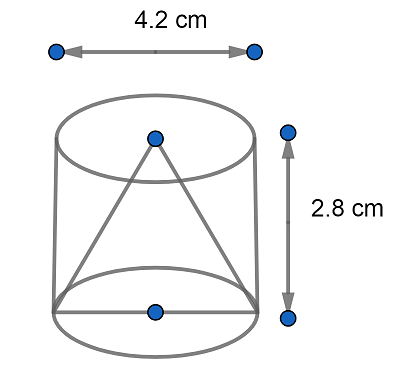
Now, let the height of the solid cylinder is h and the radius is r.
So we have given in the question $ h=2.8cm$ and $ r=\dfrac{4.2}{2}=2.1cm$ .
When we cut out the hollowed conical cavity from the solid cylinder the total surface area of the remaining solid will be equal to the sum of the lateral surface area of the cylinder, lateral surface area of the cone, and area of the remaining circular base.
So we have to find the value of $ TSA=2\pi rh+\pi rl+\pi {{r}^{2}}$
Here l=slant the height of the cone.
Now, we know that the slant height of cone will be $ l=\sqrt{{{h}^{2}}+{{r}^{2}}}$
Now, we have given in the question that a conical cavity of same height and same diameter is hollowed out. So we have the height and radius of the cone $ h=2.8cm$ and $ r=\dfrac{4.2}{2}=2.1cm$
Now, substituting the values we get
\[\begin{align}
& \Rightarrow l=\sqrt{{{\left( 2.8 \right)}^{2}}+{{\left( 2.1 \right)}^{2}}} \\
& \Rightarrow l=\sqrt{7.84+4.41} \\
& \Rightarrow l=\sqrt{12.25} \\
& \Rightarrow l=3.5cm \\
\end{align}\]
Now, the required area will be $ TSA=2\pi rh+\pi rl+\pi {{r}^{2}}$
Substituting the values we get
$\Rightarrow TSA=2\times \dfrac{22}{7}\times 2.1\times 2.8+\dfrac{22}{7}\times 2.1\times 3.5+\dfrac{22}{7}\times 2.1\times 2.1$
Now, simplifying further we get
$\begin{align}
& \Rightarrow TSA=36.96+23.1+13.86 \\
& \Rightarrow TSA=73.92 \\
\end{align}$
So, we get the total surface area of the remaining solid $ =73.92\text{ c}{{\text{m}}^{2}}$
Note:
The key point to solve this question is drawing the figure. To solve such a type of question first draw the figure than by using formulas of different shapes go ahead. One can remove the part of the cutout shape and then imagine how the remaining portion will look and then solve the question accordingly.
Complete step by step answer:
We have been given that from a solid cylinder of height 2.8 cm and diameter 4.2 cm, a conical cavity of the same height and same diameter is hollowed out.
We have to find the total surface area of the remaining solid.
Let us first draw a diagram we get
Now, let the height of the solid cylinder is h and the radius is r.
So we have given in the question $ h=2.8cm$ and $ r=\dfrac{4.2}{2}=2.1cm$ .
When we cut out the hollowed conical cavity from the solid cylinder the total surface area of the remaining solid will be equal to the sum of the lateral surface area of the cylinder, lateral surface area of the cone, and area of the remaining circular base.
So we have to find the value of $ TSA=2\pi rh+\pi rl+\pi {{r}^{2}}$
Here l=slant the height of the cone.
Now, we know that the slant height of cone will be $ l=\sqrt{{{h}^{2}}+{{r}^{2}}}$
Now, we have given in the question that a conical cavity of same height and same diameter is hollowed out. So we have the height and radius of the cone $ h=2.8cm$ and $ r=\dfrac{4.2}{2}=2.1cm$
Now, substituting the values we get
\[\begin{align}
& \Rightarrow l=\sqrt{{{\left( 2.8 \right)}^{2}}+{{\left( 2.1 \right)}^{2}}} \\
& \Rightarrow l=\sqrt{7.84+4.41} \\
& \Rightarrow l=\sqrt{12.25} \\
& \Rightarrow l=3.5cm \\
\end{align}\]
Now, the required area will be $ TSA=2\pi rh+\pi rl+\pi {{r}^{2}}$
Substituting the values we get
$\Rightarrow TSA=2\times \dfrac{22}{7}\times 2.1\times 2.8+\dfrac{22}{7}\times 2.1\times 3.5+\dfrac{22}{7}\times 2.1\times 2.1$
Now, simplifying further we get
$\begin{align}
& \Rightarrow TSA=36.96+23.1+13.86 \\
& \Rightarrow TSA=73.92 \\
\end{align}$
So, we get the total surface area of the remaining solid $ =73.92\text{ c}{{\text{m}}^{2}}$
Note:
The key point to solve this question is drawing the figure. To solve such a type of question first draw the figure than by using formulas of different shapes go ahead. One can remove the part of the cutout shape and then imagine how the remaining portion will look and then solve the question accordingly.
Recently Updated Pages
Master Class 11 Social Science: Engaging Questions & Answers for Success

Master Class 11 English: Engaging Questions & Answers for Success
Master Class 11 Maths: Engaging Questions & Answers for Success
Master Class 11 Chemistry: Engaging Questions & Answers for Success
Master Class 11 Biology: Engaging Questions & Answers for Success
Class 11 Question and Answer - Your Ultimate Solutions Guide
Trending doubts
Explain the Treaty of Vienna of 1815 class 10 social science CBSE
Why is it 530 pm in india when it is 1200 afternoon class 10 social science CBSE
What is the full form of POSCO class 10 social science CBSE
Define Potential, Developed, Stock and Reserved resources
Which Country Has the Largest Border with India?
Choose the feminine form of the given noun Fox AFoxess class 10 english CBSE