




Frogs differ from humans in possessing
(a)Paired cerebral hemispheres
(b)Hepatic portal system
(c)Nucleated red blood cells
(d)Thyroid as well as parathyroid
Answer
 Verified
595.2k+ views
Hint: Frogs require less amount of gaseous exchange through the circulatory system because they have some other modes of gaseous exchange like cutaneous respiration. Also, the metabolic requirement of oxygen is low in frogs in comparison to humans.
Complete step-by-step answer:
Though frogs and humans are different in many aspects, we have to decide the difference between these two in the context of features mentioned in the options. Nucleated red blood cells are found in all the non-mammalian vertebrates and since frogs belong to such groups, they have a nucleus in their red blood cells but in humans, the red blood cells are without a nucleus. We know that humans are mammals that have the property of thermoregulation and thus are homeothermic. Since the process of maintaining constant internal temperature is expensive in terms of energy and requires a large amount of energy, and the energy is obtained by the process of cellular respiration that occurs with the help of oxygen, more oxygen is needed by the homeothermic animals to maintain the constant internal body temperature. For the successful delivery of an adequate amount of oxygen to the cell in the body of homeothermic animals like humans, the de-nucleation of red blood cells is an advantage because it increases the gas carrying capacity of the red blood cells and thus supports the high metabolic rate in the endotherms.
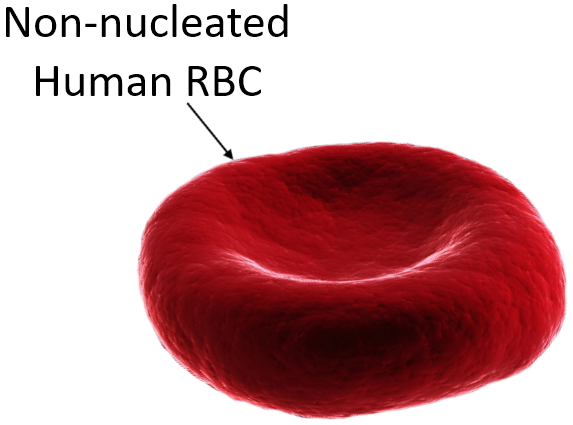
So, the correct answer is ‘Nucleated red blood cells’.
Note: For the successful completion and regulation of all the metabolic processes occurring in the body of frogs, they require less amount of gaseous exchange through the blood and thus nucleated RBCs are enough to fulfill the need for a lower amount of gases as compared to the human beings. Also, frogs have some other modes of gaseous exchange so they do not fully depend on the circulatory system for their gaseous exchange purposes.
Complete step-by-step answer:
Though frogs and humans are different in many aspects, we have to decide the difference between these two in the context of features mentioned in the options. Nucleated red blood cells are found in all the non-mammalian vertebrates and since frogs belong to such groups, they have a nucleus in their red blood cells but in humans, the red blood cells are without a nucleus. We know that humans are mammals that have the property of thermoregulation and thus are homeothermic. Since the process of maintaining constant internal temperature is expensive in terms of energy and requires a large amount of energy, and the energy is obtained by the process of cellular respiration that occurs with the help of oxygen, more oxygen is needed by the homeothermic animals to maintain the constant internal body temperature. For the successful delivery of an adequate amount of oxygen to the cell in the body of homeothermic animals like humans, the de-nucleation of red blood cells is an advantage because it increases the gas carrying capacity of the red blood cells and thus supports the high metabolic rate in the endotherms.
So, the correct answer is ‘Nucleated red blood cells’.
Note: For the successful completion and regulation of all the metabolic processes occurring in the body of frogs, they require less amount of gaseous exchange through the blood and thus nucleated RBCs are enough to fulfill the need for a lower amount of gases as compared to the human beings. Also, frogs have some other modes of gaseous exchange so they do not fully depend on the circulatory system for their gaseous exchange purposes.
Recently Updated Pages
Master Class 11 Computer Science: Engaging Questions & Answers for Success

Master Class 11 Business Studies: Engaging Questions & Answers for Success
Master Class 11 Economics: Engaging Questions & Answers for Success
Master Class 11 English: Engaging Questions & Answers for Success
Master Class 11 Maths: Engaging Questions & Answers for Success
Master Class 11 Biology: Engaging Questions & Answers for Success
Trending doubts
One Metric ton is equal to kg A 10000 B 1000 C 100 class 11 physics CBSE
There are 720 permutations of the digits 1 2 3 4 5 class 11 maths CBSE
Discuss the various forms of bacteria class 11 biology CBSE
Draw a diagram of a plant cell and label at least eight class 11 biology CBSE
State the laws of reflection of light
Explain zero factorial class 11 maths CBSE