




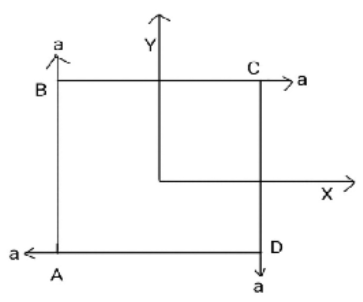
Four particles of masses $m_A=m, m_B=2m, m_C=3m$ and $m_D=4m$ are at the
corners of a square. They have accelerations of equal magnitude with directions as shown. The acceleration of the center of mass of the particles is
$\begin{align}
& A.\dfrac{a}{5}(\hat{i}-\hat{j}) \\
& B.\dfrac{a}{5}(\hat{i}+\hat{j}) \\
& C.\text{Zero} \\
& D.a(\hat{i}+\hat{j}) \\
\end{align}$
Answer
 Verified
657.9k+ views
Hint: Here we just need to know the mathematical formula of the center of mass of a system of particles. Also, we need to write the accelerations in vector form. We can assume the origin to be at the center of the square (not centre of mass). Then after simply putting the accelerations in the formula, the acceleration of centre of mass is found.
Formula used:
$\vec A=\dfrac{\sum m_i \vec a_i}{\sum m_i}$
Complete step-by-step solution:
The magnitude of acceleration of the four particles are the same. But they have different directions.
Hence the accelerations of the different particles in vector form is given by,
$\vec a_A=-a \hat i$
$\vec a_B=a \hat j$
$\vec a_C=a \hat i$
$\vec a_D=-a \hat j$
(Considering their directions as given in the question)
Now center of mass of a system of particles is mathematically defined as,
$\vec R=\dfrac{\sum m_i \vec r_i}{\sum m_i}$
Where the $m_i$ is the mass of the i-th particle and $\vec r_i$ is its position.
Now differentiating this twice, we just obtain the acceleration of the center of mass of the
particle. Hence, we get
$\vec{A}=\dfrac{\sum{{{m}_{i}}}{{{\vec{a}}}_{i}}}{\sum{{{m}_{i}}}}=\dfrac{\sum{{{m}_{i}}}{{{\vec{
a}}}_{i}}}{10m}=\dfrac{2ma\hat{i}-2ma\hat{j}}{10m}=\dfrac{a}{5}(\hat{i}-\hat{j})$
Hence, option A is the correct answer.
Additional information:
The center of mass of a system of particles is independent of the choice of the origin. But its position vector may have different expressions for different frames of reference. Again, the position of the origin is not so important while dealing with acceleration, we just need the magnitude and direction of the acceleration.
Note: Remember the following things:
1. While calculating the summation on the numerator, always multiply the mass with
corresponding acceleration.
2. Moreover take care of the signs of the different terms as well.
3. You have to do the summation of the denominator and the numerator differently.
Formula used:
$\vec A=\dfrac{\sum m_i \vec a_i}{\sum m_i}$
Complete step-by-step solution:
The magnitude of acceleration of the four particles are the same. But they have different directions.
Hence the accelerations of the different particles in vector form is given by,
$\vec a_A=-a \hat i$
$\vec a_B=a \hat j$
$\vec a_C=a \hat i$
$\vec a_D=-a \hat j$
(Considering their directions as given in the question)
Now center of mass of a system of particles is mathematically defined as,
$\vec R=\dfrac{\sum m_i \vec r_i}{\sum m_i}$
Where the $m_i$ is the mass of the i-th particle and $\vec r_i$ is its position.
Now differentiating this twice, we just obtain the acceleration of the center of mass of the
particle. Hence, we get
$\vec{A}=\dfrac{\sum{{{m}_{i}}}{{{\vec{a}}}_{i}}}{\sum{{{m}_{i}}}}=\dfrac{\sum{{{m}_{i}}}{{{\vec{
a}}}_{i}}}{10m}=\dfrac{2ma\hat{i}-2ma\hat{j}}{10m}=\dfrac{a}{5}(\hat{i}-\hat{j})$
Hence, option A is the correct answer.
Additional information:
The center of mass of a system of particles is independent of the choice of the origin. But its position vector may have different expressions for different frames of reference. Again, the position of the origin is not so important while dealing with acceleration, we just need the magnitude and direction of the acceleration.
Note: Remember the following things:
1. While calculating the summation on the numerator, always multiply the mass with
corresponding acceleration.
2. Moreover take care of the signs of the different terms as well.
3. You have to do the summation of the denominator and the numerator differently.
Recently Updated Pages
Master Class 11 Social Science: Engaging Questions & Answers for Success

Master Class 11 English: Engaging Questions & Answers for Success
Master Class 11 Accountancy: Engaging Questions & Answers for Success
Master Class 11 Physics: Engaging Questions & Answers for Success
Master Class 11 Computer Science: Engaging Questions & Answers for Success
Master Class 11 Business Studies: Engaging Questions & Answers for Success
Trending doubts
One Metric ton is equal to kg A 10000 B 1000 C 100 class 11 physics CBSE
Find the value of the expression given below sin 30circ class 11 maths CBSE
Draw a diagram of nephron and explain its structur class 11 biology CBSE
10 examples of friction in our daily life
Proton was discovered by A Thomson B Rutherford C Chadwick class 11 chemistry CBSE
The teeth used for biting and cutting food are called class 11 biology CBSE