



Four particles each of mass M and equidistant from each other, move along a circle of radius R under the action of their mutual gravitational attraction. The speed of each particle is

(A) $\sqrt {\dfrac{{Gm}}{R}(1 + 2\sqrt 2 )} $
(B) $\dfrac{1}{2}\sqrt {\dfrac{{GM}}{R}(1 + 2\sqrt 2 )} $
(C) $\sqrt {\dfrac{{GM}}{R}} $
(D) $\sqrt {2\sqrt 2 \dfrac{{GM}}{R}} $
Answer
 Verified
633.3k+ views
Hint: In particle are moving in circle then gravitational force on each particle is balanced by centripetal force i.e.,
${F_g} = {F_C} = \dfrac{{{\rm M}{u^2}}}{R}$
Where
u $ = $ velocity of particle
R $ = $ radius of circle
M $ = $ mass of particle
Complete step by step answer:
From the figure we can easily calculate the net force on any one particle.
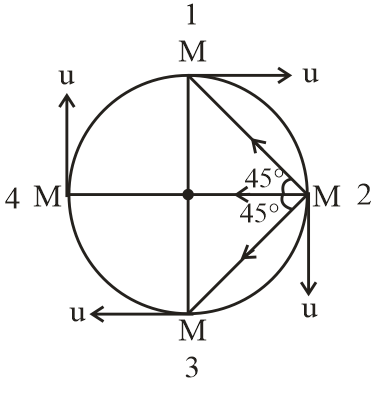
Now we can calculate the net force on particle 2 by vector component method.
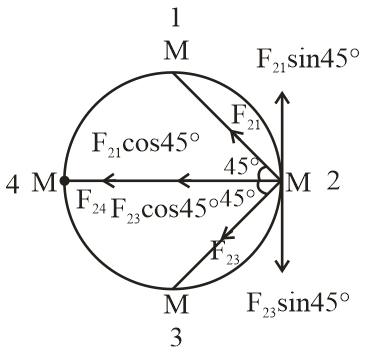
First, we resolve the 2 forces ${F_{21}}$ & ${F_{23}}$ by component method. Let the resultant of ${F_{21}}$ & ${F_{23}}$ is ${F^1}$. So, ${F^1}$ is given as by diagram
${F^1} = {F_{21}}\cos 45^\circ + {F_{23}}\cos 45^\circ $ ….(1)
Because sine components of ${F_{21}}$ & ${F_{23}}$ cancel out to each other because ${F_{21}}$ & ${F_{23}}$ having same magnitude but direction are opposite. So, the combined force of ${F_{21}}$ & ${F_{23}}$ on 2 is only due to their cosine components.
We know that gravitational force is given by
${F_g} = \dfrac{{G{m_1}{m_2}}}{{{r^2}}}$
Here r $ = $ distance between mass ${m_1}$ and ${m_2}$.
So, ${F_{21}} = \dfrac{{G{m_1}{m_2}}}{{{r^2}}}$
Here r is distance between ${m_1}$ and ${m_2}$
$r = \sqrt 2 R$ and ${m_1} = {m_2} = M$
So, ${F_{21}} = \dfrac{{G{M^2}}}{{{{(\sqrt 2 R)}^2}}} = \dfrac{{G{M^2}}}{{2{R^2}}}$ …..(2)
And ${F_{23}} = \dfrac{{G{m_2}{m_3}}}{{{r^2}}}$
Here r $ = $ distance between ${m_2}$ & ${m_3}$ which is $\sqrt 2 R$.
and ${m_3} = {m_2} = M$
${F_{23}} = \dfrac{{G{M^2}}}{{{{(\sqrt 2 R)}^2}}} = \dfrac{{G{M^2}}}{{2{R^2}}}$ …..(3)
From equation 1, 2 and 3
${F^1} = 2\left( {\dfrac{{G{M^2}}}{{2{R^2}}}} \right)\cos 45^\circ $
$\because $ $\cos 45^\circ = \dfrac{1}{{\sqrt 2 }}$
${F^1} = \dfrac{{G{M^2}}}{{\sqrt 2 {R^2}}}$ …..(4)
In diagram, we can easily see that the direction of ${F^1}$ and ${F_{24}}$ is same i.e., –x
So, the net force on particle 2 is
${F_2} = {F^1} + {F_{24}}$ …..(5)
Now, ${F_{24}} = \dfrac{{G{m_2}{m_4}}}{{{r^2}}}$
Here r $ = $ distance between ${m_2}$ and ${m_4}$
And ${m_2} = {m_4} = M$
So, ${F_{24}} = \dfrac{{G{M^2}}}{{{{(2R)}^2}}} = \dfrac{{G{M^2}}}{{4{R^2}}}$ …..(6)
From equation 4, 5 and 6
${F_2} = \dfrac{{G{M^2}}}{{\sqrt 2 {R^2}}} + \dfrac{{G{M^2}}}{{4{R^2}}}$
${F_2} = \dfrac{{G{M^2}}}{{{R^2}}}\left( {\dfrac{1}{4} + \dfrac{1}{{\sqrt 2 }}} \right)$ …..(7)
This net force on 2 is balanced by centripetal force because the particle is moving with velocity u in circular orbit of radius R.
So, ${F_2} = \dfrac{{M{u^2}}}{R}$ …..(8)
From equation 7 & 8
$\dfrac{{M{u^2}}}{R} = \dfrac{{G{M^2}}}{{{R^2}}}\left( {\dfrac{1}{4} + \dfrac{1}{{\sqrt 2 }}} \right)$
$ = \dfrac{{GM}}{R}\left( {\dfrac{{\sqrt 2 + 4}}{{4\sqrt 2 }}} \right)$
$\implies {u^2} = \dfrac{1}{4}\dfrac{{GM}}{R}\left( {1 + 2\sqrt 2 } \right)$
$\implies u = \sqrt {\dfrac{{GM}}{{4R}}\left( {1 + 2\sqrt 2 } \right)} $
$\therefore u = \dfrac{1}{2}\sqrt {\dfrac{{GM}}{R}\left( {1 + 2\sqrt 2 } \right)} $
So, the correct answer is “Option B”.
Note:
A centripetal force is a net force that acts on an object to keep it moving along a circular path. If 2 charges having distance r between them are moving in a circular path then centripetal force is balanced by electrostatic force. i.e.,
${F_e} = \dfrac{{m{v^2}}}{r} = \dfrac{{k{q_1}{q_2}}}{{{r^2}}}$
${F_g} = {F_C} = \dfrac{{{\rm M}{u^2}}}{R}$
Where
u $ = $ velocity of particle
R $ = $ radius of circle
M $ = $ mass of particle
Complete step by step answer:
From the figure we can easily calculate the net force on any one particle.
Now we can calculate the net force on particle 2 by vector component method.
First, we resolve the 2 forces ${F_{21}}$ & ${F_{23}}$ by component method. Let the resultant of ${F_{21}}$ & ${F_{23}}$ is ${F^1}$. So, ${F^1}$ is given as by diagram
${F^1} = {F_{21}}\cos 45^\circ + {F_{23}}\cos 45^\circ $ ….(1)
Because sine components of ${F_{21}}$ & ${F_{23}}$ cancel out to each other because ${F_{21}}$ & ${F_{23}}$ having same magnitude but direction are opposite. So, the combined force of ${F_{21}}$ & ${F_{23}}$ on 2 is only due to their cosine components.
We know that gravitational force is given by
${F_g} = \dfrac{{G{m_1}{m_2}}}{{{r^2}}}$
Here r $ = $ distance between mass ${m_1}$ and ${m_2}$.
So, ${F_{21}} = \dfrac{{G{m_1}{m_2}}}{{{r^2}}}$
Here r is distance between ${m_1}$ and ${m_2}$
$r = \sqrt 2 R$ and ${m_1} = {m_2} = M$
So, ${F_{21}} = \dfrac{{G{M^2}}}{{{{(\sqrt 2 R)}^2}}} = \dfrac{{G{M^2}}}{{2{R^2}}}$ …..(2)
And ${F_{23}} = \dfrac{{G{m_2}{m_3}}}{{{r^2}}}$
Here r $ = $ distance between ${m_2}$ & ${m_3}$ which is $\sqrt 2 R$.
and ${m_3} = {m_2} = M$
${F_{23}} = \dfrac{{G{M^2}}}{{{{(\sqrt 2 R)}^2}}} = \dfrac{{G{M^2}}}{{2{R^2}}}$ …..(3)
From equation 1, 2 and 3
${F^1} = 2\left( {\dfrac{{G{M^2}}}{{2{R^2}}}} \right)\cos 45^\circ $
$\because $ $\cos 45^\circ = \dfrac{1}{{\sqrt 2 }}$
${F^1} = \dfrac{{G{M^2}}}{{\sqrt 2 {R^2}}}$ …..(4)
In diagram, we can easily see that the direction of ${F^1}$ and ${F_{24}}$ is same i.e., –x
So, the net force on particle 2 is
${F_2} = {F^1} + {F_{24}}$ …..(5)
Now, ${F_{24}} = \dfrac{{G{m_2}{m_4}}}{{{r^2}}}$
Here r $ = $ distance between ${m_2}$ and ${m_4}$
And ${m_2} = {m_4} = M$
So, ${F_{24}} = \dfrac{{G{M^2}}}{{{{(2R)}^2}}} = \dfrac{{G{M^2}}}{{4{R^2}}}$ …..(6)
From equation 4, 5 and 6
${F_2} = \dfrac{{G{M^2}}}{{\sqrt 2 {R^2}}} + \dfrac{{G{M^2}}}{{4{R^2}}}$
${F_2} = \dfrac{{G{M^2}}}{{{R^2}}}\left( {\dfrac{1}{4} + \dfrac{1}{{\sqrt 2 }}} \right)$ …..(7)
This net force on 2 is balanced by centripetal force because the particle is moving with velocity u in circular orbit of radius R.
So, ${F_2} = \dfrac{{M{u^2}}}{R}$ …..(8)
From equation 7 & 8
$\dfrac{{M{u^2}}}{R} = \dfrac{{G{M^2}}}{{{R^2}}}\left( {\dfrac{1}{4} + \dfrac{1}{{\sqrt 2 }}} \right)$
$ = \dfrac{{GM}}{R}\left( {\dfrac{{\sqrt 2 + 4}}{{4\sqrt 2 }}} \right)$
$\implies {u^2} = \dfrac{1}{4}\dfrac{{GM}}{R}\left( {1 + 2\sqrt 2 } \right)$
$\implies u = \sqrt {\dfrac{{GM}}{{4R}}\left( {1 + 2\sqrt 2 } \right)} $
$\therefore u = \dfrac{1}{2}\sqrt {\dfrac{{GM}}{R}\left( {1 + 2\sqrt 2 } \right)} $
So, the correct answer is “Option B”.
Note:
A centripetal force is a net force that acts on an object to keep it moving along a circular path. If 2 charges having distance r between them are moving in a circular path then centripetal force is balanced by electrostatic force. i.e.,
${F_e} = \dfrac{{m{v^2}}}{r} = \dfrac{{k{q_1}{q_2}}}{{{r^2}}}$
Recently Updated Pages
Basicity of sulphurous acid and sulphuric acid are

Master Class 11 English: Engaging Questions & Answers for Success
Master Class 11 Physics: Engaging Questions & Answers for Success
Master Class 11 Computer Science: Engaging Questions & Answers for Success
Master Class 11 Chemistry: Engaging Questions & Answers for Success
Master Class 11 Social Science: Engaging Questions & Answers for Success
Trending doubts
Draw a diagram of a plant cell and label at least eight class 11 biology CBSE
Proton was discovered by A Thomson B Rutherford C Chadwick class 11 chemistry CBSE
What is the purity of pure gold in carat class 11 chemistry CBSE
Can anyone list 10 advantages and disadvantages of friction
Lysosomes are known as suicidal bags of cell why class 11 biology CBSE
Derive the equation of motion by the calculus method class 11 physics CBSE