




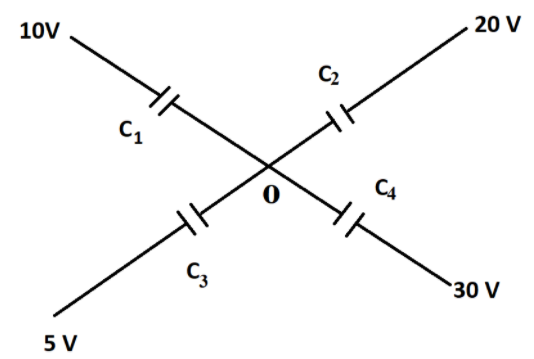
Four capacitors ${{C}_{1}}=1\mu F$, \[{{C}_{2}}=2\mu F\], ${{C}_{3}}=3\mu F$ and ${{C}_{4}}=4\mu F$ are connected as given in the figure. The potential of the junction O is
A. 16.5 V
B. 18 V
C. 15.5 V
D. 18.5 V
Answer
 Verified
591.3k+ views
Hint: A capacitor is a device that, in an electric field, retains electrical energy. It is a passive electronic component with two terminals. The effect of a capacitor is known as capacitance. The difference in electric potential between two points, which is defined as the work required per unit of charge to move a test charge between the two points, is voltage, electric potential difference, electric pressure, or electric tension.
Complete step-by-step solution
Before we start solving the question that is given to us, let us take a look at all the parameters that are given to us in the above question
${{C}_{1}}=1\mu F$
\[{{C}_{2}}=2\mu F\]
${{C}_{3}}=3\mu F$
${{C}_{4}}=4\mu F$
So,
Now, the total charge must be zero
So,
${{Q}_{1}}+{{Q}_{2}}+{{Q}_{3}}+{{Q}_{4}}=0$
As,
$Q = CV$
Now, the potential at O
$\Rightarrow $ (V−10) (1) + (V−20) (2) + (V−30) (4) + (V−5) (3) = 0
$\Rightarrow $ V – 10 + 2V – 40 + 4V – 120 + 3V − 15=0
$\Rightarrow $ 10V = 185
$\Rightarrow $ V = 18.5 V
So, The potential of the junction O is 18.5 V, i.e., Option - D
Note: In electronic circuits, capacitors are commonly used for blocking direct current while allowing alternating current to flow. They smooth the performance of power supplies in analog filter networks. They tune radios to various frequencies in the resonant circuits. They stabilize the voltage and power flow in electric power transmission systems.
Complete step-by-step solution
Before we start solving the question that is given to us, let us take a look at all the parameters that are given to us in the above question
${{C}_{1}}=1\mu F$
\[{{C}_{2}}=2\mu F\]
${{C}_{3}}=3\mu F$
${{C}_{4}}=4\mu F$
So,
Now, the total charge must be zero
So,
${{Q}_{1}}+{{Q}_{2}}+{{Q}_{3}}+{{Q}_{4}}=0$
As,
$Q = CV$
Now, the potential at O
$\Rightarrow $ (V−10) (1) + (V−20) (2) + (V−30) (4) + (V−5) (3) = 0
$\Rightarrow $ V – 10 + 2V – 40 + 4V – 120 + 3V − 15=0
$\Rightarrow $ 10V = 185
$\Rightarrow $ V = 18.5 V
So, The potential of the junction O is 18.5 V, i.e., Option - D
Note: In electronic circuits, capacitors are commonly used for blocking direct current while allowing alternating current to flow. They smooth the performance of power supplies in analog filter networks. They tune radios to various frequencies in the resonant circuits. They stabilize the voltage and power flow in electric power transmission systems.
Recently Updated Pages
Basicity of sulphurous acid and sulphuric acid are

Master Class 12 English: Engaging Questions & Answers for Success
Master Class 12 Social Science: Engaging Questions & Answers for Success
Master Class 12 Maths: Engaging Questions & Answers for Success
Master Class 12 Economics: Engaging Questions & Answers for Success
Master Class 12 Physics: Engaging Questions & Answers for Success
Trending doubts
Which are the Top 10 Largest Countries of the World?
Draw a labelled sketch of the human eye class 12 physics CBSE
Draw ray diagrams each showing i myopic eye and ii class 12 physics CBSE
Give 10 examples of unisexual and bisexual flowers
Coming together federation is practiced in A India class 12 social science CBSE
Write the formula to find the shortest distance between class 12 maths CBSE