




Four bells begin to toll together and then each one at intervals of 6s, 7s, 8s and 9s, respectively. The number of times they will toll together in the next 1 hour is which of the following:
(a) 7 times
(b) 8 times
(c) 6 times
(d) Never
Answer
 Verified
630.9k+ views
Hint: First, find the LCM of 6, 7, 8, and 9 which is 504. So, the bells will toll together after every 504 seconds. Divide this b the number of seconds in an hour: 3600 seconds and find its greatest integer function to arrive at the final answer.
Complete step-by-step answer:
In this question, we are given that four bells begin to toll together and then each one at intervals of 6s, 7s, 8s and 9s, respectively.
We need to find the number of times they will toll together in the next 1 hour.
Let us first find the first time these bells will toll together.
This will be after the number of seconds equal to the LCM of 6, 7, 8, and 9.
Let us find the LCM of these numbers.
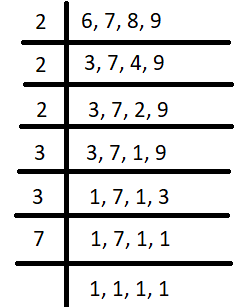
So, LCM = 2 $\times $ 2 $\times $ 2 $\times $ 3 $\times $ 3 $\times $ 7 = 504
So, the bells will toll together for the first time from the start after 504 seconds.
Or, the bells will toll together every 504 seconds.
We know that one hour consists of 3600 seconds.
So, to find the number of times these bells will toll together in an hour, we will divide 3600 by 504 and take the integer value (greatest integer function) which will be our final answer.
So, the number of times these bells will toll together in an hour = $\left[ \dfrac{3600}{504} \right]$,
Where [ ] is the greatest integer function which rounds down a real number to the nearest integer.
The number of times these bells will toll together in an hour = $\left[ \dfrac{3600}{504} \right]=\left[ 7.14 \right]=7$
So, the bells will toll together 7 times in the next one hour.
Hence, option (a) is correct.
Note: In this question, it is very important to know the method to find the LCM of two or more numbers as without it, you will not be able to solve the question. Also, it is important to know about the greatest integer function.
Complete step-by-step answer:
In this question, we are given that four bells begin to toll together and then each one at intervals of 6s, 7s, 8s and 9s, respectively.
We need to find the number of times they will toll together in the next 1 hour.
Let us first find the first time these bells will toll together.
This will be after the number of seconds equal to the LCM of 6, 7, 8, and 9.
Let us find the LCM of these numbers.
So, LCM = 2 $\times $ 2 $\times $ 2 $\times $ 3 $\times $ 3 $\times $ 7 = 504
So, the bells will toll together for the first time from the start after 504 seconds.
Or, the bells will toll together every 504 seconds.
We know that one hour consists of 3600 seconds.
So, to find the number of times these bells will toll together in an hour, we will divide 3600 by 504 and take the integer value (greatest integer function) which will be our final answer.
So, the number of times these bells will toll together in an hour = $\left[ \dfrac{3600}{504} \right]$,
Where [ ] is the greatest integer function which rounds down a real number to the nearest integer.
The number of times these bells will toll together in an hour = $\left[ \dfrac{3600}{504} \right]=\left[ 7.14 \right]=7$
So, the bells will toll together 7 times in the next one hour.
Hence, option (a) is correct.
Note: In this question, it is very important to know the method to find the LCM of two or more numbers as without it, you will not be able to solve the question. Also, it is important to know about the greatest integer function.
Recently Updated Pages
Master Class 10 Social Science: Engaging Questions & Answers for Success

Master Class 10 Science: Engaging Questions & Answers for Success
Master Class 10 Maths: Engaging Questions & Answers for Success
Master Class 10 General Knowledge: Engaging Questions & Answers for Success
Master Class 10 Computer Science: Engaging Questions & Answers for Success
Class 10 Question and Answer - Your Ultimate Solutions Guide
Trending doubts
What is the full form of PNG A Petrol Natural Gas B class 10 chemistry CBSE
Explain the Treaty of Vienna of 1815 class 10 social science CBSE
In cricket, how many legal balls are there in a standard over?
Why is there a time difference of about 5 hours between class 10 social science CBSE
Who Won 36 Oscar Awards? Record Holder Revealed
What is the median of the first 10 natural numbers class 10 maths CBSE