




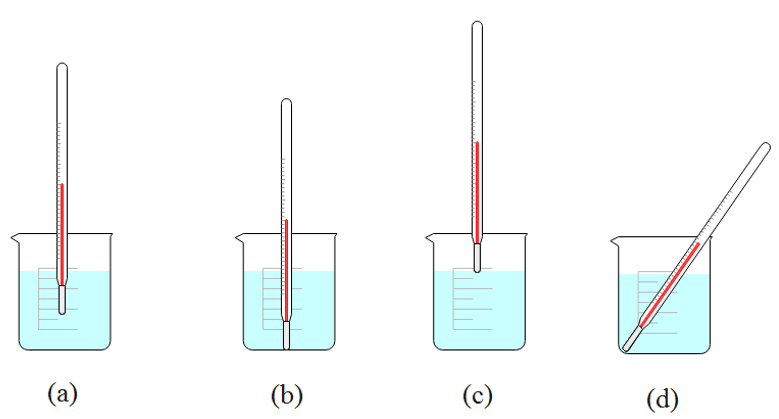
Four arrangements to measure the temperature of ice in a beaker with laboratory thermometer are shown in figure (\[a,b,c\] and \[d\]). Which one of them shows the correct arrangement for accurate measurement of temperature?
Answer
 Verified
552.9k+ views
Hint: When dealing with questions regarding thermometers keep in mind the do’s and don’ts regarding how to use one, and how not to use it. Keep in mind that one should only read the thermometer while keeping the level of mercury along your line of sight and handle the thermometer with care.
Complete step by step solution:
A clinical thermometer is a thermometer used to measure human body temperature. Most show both Celsius scale and Fahrenheit temperature scales, and run from 35 degree Celsius (\[{{35}^{\circ }}C\]) to 42 degree Celsius (\[{{42}^{\circ }}C\]). Medical thermometers are cleaned before and after each use, with alcohol.
Now whenever we use a clinical thermometer there are some things we need to keep in mind. These are;
Precautions to be taken while using a clinical thermometer
Thermometer should be washed before and after each use, preferably with an antiseptic solution
Do not wash the thermometer with hot water
Ensure that before use the mercury level is below \[{{35}^{\circ }}C\]
Read the thermometer keeping the level of mercury along the line of sight.
Handle the thermometer with care, as you handle any glass articles
Don't hold the thermometer by the bulb while reading it.
Now that we know the precautions that need to be taken, let's look at the pictures we are given in the question.
In picture (A) the thermometer is placed exactly vertical and placed in between the container, and the thermometer scale is perfectly along our line of sight. So we can say that picture (A) shows the correct way to handle a clinical thermometer.
In picture (B) if you look closely the bulb of the thermometer is touching the glass beaker. This is a strict no for reading the thermometer because firstly it will give us wrong readings and secondly if too much pressure is applied, the bulb might break and then the clinical thermometer will be of no use.
In picture (C) the thermometer is barely or maybe not touching the surface of liquid at all. This will lead to wrong readings because the bulb is mostly surrounded by air and would not be able to show correct readings of the temperature of the liquid required.
In picture (D) the thermometer is tilted to the side, and the bulb also touches the beaker. So therefore this thermometer position will also not give the proper readings required.
Hence we can conclude by saying Picture (A) shows the correct arrangement for accurate measurement of temperature.
Note: Nowadays people prefer not to use clinical thermometers which are filled with mercury because they are made of glass and are often prone to damage which can cause the mercury to leak out and cause bodily harm. So instead of that people prefer to use digital thermometers, electronic ear thermometers et cetera.
Complete step by step solution:
A clinical thermometer is a thermometer used to measure human body temperature. Most show both Celsius scale and Fahrenheit temperature scales, and run from 35 degree Celsius (\[{{35}^{\circ }}C\]) to 42 degree Celsius (\[{{42}^{\circ }}C\]). Medical thermometers are cleaned before and after each use, with alcohol.
Now whenever we use a clinical thermometer there are some things we need to keep in mind. These are;
Precautions to be taken while using a clinical thermometer
Thermometer should be washed before and after each use, preferably with an antiseptic solution
Do not wash the thermometer with hot water
Ensure that before use the mercury level is below \[{{35}^{\circ }}C\]
Read the thermometer keeping the level of mercury along the line of sight.
Handle the thermometer with care, as you handle any glass articles
Don't hold the thermometer by the bulb while reading it.
Now that we know the precautions that need to be taken, let's look at the pictures we are given in the question.
In picture (A) the thermometer is placed exactly vertical and placed in between the container, and the thermometer scale is perfectly along our line of sight. So we can say that picture (A) shows the correct way to handle a clinical thermometer.
In picture (B) if you look closely the bulb of the thermometer is touching the glass beaker. This is a strict no for reading the thermometer because firstly it will give us wrong readings and secondly if too much pressure is applied, the bulb might break and then the clinical thermometer will be of no use.
In picture (C) the thermometer is barely or maybe not touching the surface of liquid at all. This will lead to wrong readings because the bulb is mostly surrounded by air and would not be able to show correct readings of the temperature of the liquid required.
In picture (D) the thermometer is tilted to the side, and the bulb also touches the beaker. So therefore this thermometer position will also not give the proper readings required.
Hence we can conclude by saying Picture (A) shows the correct arrangement for accurate measurement of temperature.
Note: Nowadays people prefer not to use clinical thermometers which are filled with mercury because they are made of glass and are often prone to damage which can cause the mercury to leak out and cause bodily harm. So instead of that people prefer to use digital thermometers, electronic ear thermometers et cetera.
Recently Updated Pages
Basicity of sulphurous acid and sulphuric acid are

Master Class 11 English: Engaging Questions & Answers for Success
Master Class 11 Physics: Engaging Questions & Answers for Success
Master Class 11 Computer Science: Engaging Questions & Answers for Success
Master Class 11 Chemistry: Engaging Questions & Answers for Success
Master Class 11 Social Science: Engaging Questions & Answers for Success
Trending doubts
One Metric ton is equal to kg A 10000 B 1000 C 100 class 11 physics CBSE
Draw a diagram of nephron and explain its structur class 11 biology CBSE
What will happen if the mucus is not secreted by the class 11 biology CBSE
Draw a diagram of a plant cell and label at least eight class 11 biology CBSE
What is the purity of pure gold in carat class 11 chemistry CBSE
Lysosomes are known as suicidal bags of cell why class 11 biology CBSE