




Fossil extinct birdlike reptile were first found out by-
A) Leonardo da vinci
B) Seward
C) Cuvier
D) Sahini
Answer
 Verified
584.1k+ views
Hint:There was a scientist known as “founding father of palaeontology”, he is the one who incorporated fossils in the classification system.
Complete Answer:
Baron Cuvier or George Cuvier, was a French naturalist and zoologist, also known as the "founding father of palaeontology". He expanded taxonomy by introducing and incorporating both fossils and living species into the classification. Palaeontology is the study of fossils, it helps to understand the history of life on Earth by studying the fossil record of remains of dead organisms. Palaeontology is closely related to geology. The bird-like reptile is considered a transition between non-avian winged dinosaurs and modern birds. The name of that bird-like reptile is named Archaeopteryx, it was considered as the oldest known bird by palaeontologists until the early 21st century.
Archaeopteryx were alive during the Late Jurassic around 150 million years ago. During that time, Europe was an archipelago of islands present in a shallow warm tropical sea, it was much closer to the equator. Talking about the size, the largest species of Archaeopteryx was about 0.5 m in length. They had small size, wings were broad, and possessed the ability to fly and glide. Archaeopteryx had more similarities with Mesozoic dinosaurs than with modern birds.
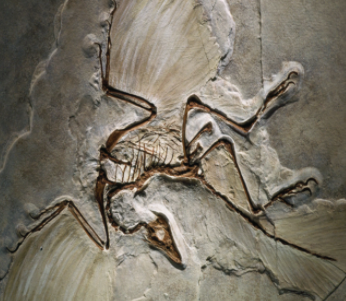
Reptilian features-
->Jawed teeth
->Clawed fingers
->Long tail with free caudal vertebrae
->Sternum devoid of keel
->Scaled body
Avian characters-
->Body feather
->Modification of forelimbs into wings
->Presence of beak
->Birds like limbs.
Thus, the correct answer is- C. Cuvier
Note:The bird-like reptile being talked about in this question is Archaeopteryx, and such fossils were found out by Cuvier. Cuvier proposed that now-extinct species had been wiped out by periodic catastrophic flooding events.
Complete Answer:
Baron Cuvier or George Cuvier, was a French naturalist and zoologist, also known as the "founding father of palaeontology". He expanded taxonomy by introducing and incorporating both fossils and living species into the classification. Palaeontology is the study of fossils, it helps to understand the history of life on Earth by studying the fossil record of remains of dead organisms. Palaeontology is closely related to geology. The bird-like reptile is considered a transition between non-avian winged dinosaurs and modern birds. The name of that bird-like reptile is named Archaeopteryx, it was considered as the oldest known bird by palaeontologists until the early 21st century.
Archaeopteryx were alive during the Late Jurassic around 150 million years ago. During that time, Europe was an archipelago of islands present in a shallow warm tropical sea, it was much closer to the equator. Talking about the size, the largest species of Archaeopteryx was about 0.5 m in length. They had small size, wings were broad, and possessed the ability to fly and glide. Archaeopteryx had more similarities with Mesozoic dinosaurs than with modern birds.
Reptilian features-
->Jawed teeth
->Clawed fingers
->Long tail with free caudal vertebrae
->Sternum devoid of keel
->Scaled body
Avian characters-
->Body feather
->Modification of forelimbs into wings
->Presence of beak
->Birds like limbs.
Thus, the correct answer is- C. Cuvier
Note:The bird-like reptile being talked about in this question is Archaeopteryx, and such fossils were found out by Cuvier. Cuvier proposed that now-extinct species had been wiped out by periodic catastrophic flooding events.
Recently Updated Pages
Master Class 12 Business Studies: Engaging Questions & Answers for Success

Master Class 12 Biology: Engaging Questions & Answers for Success
Master Class 12 Chemistry: Engaging Questions & Answers for Success
Class 12 Question and Answer - Your Ultimate Solutions Guide
Complete reduction of benzene diazonium chloride with class 12 chemistry CBSE
How can you identify optical isomers class 12 chemistry CBSE
Trending doubts
Which are the Top 10 Largest Countries of the World?
What are the major means of transport Explain each class 12 social science CBSE
Draw a labelled sketch of the human eye class 12 physics CBSE
Differentiate between insitu conservation and exsitu class 12 biology CBSE
Draw a neat and well labeled diagram of TS of ovary class 12 biology CBSE
Differentiate between homogeneous and heterogeneous class 12 chemistry CBSE