



What is the formula for the surface area of a cylinder?
Answer
 Verified
595.5k+ views
Hint: In this question we have been asked to find the total surface area of a cylinder which is a three-dimensional object. The surface area of an object is the area of the outermost part or the surface of an object or a shape. We will find the surface area of the cylinder by splitting it into its constituent parts which is the area of the top base, area of the bottom base and the area of the entire side. We will add the three parts to get the total surface area of a cylinder.
Complete step-by-step solution:
We know that a cylinder is a three-dimensional shape which has $h$ as the height and $r$ as the radius as follows:
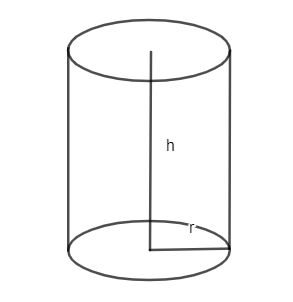
We can see from the figure the cylinder consists of three parts, the top base, the bottom base and the area of the side.
We can visualize that the top and bottom base of the cylinder is circular in shape, and the area of the circle on the top and bottom would give us the surface area therefore, we can write:
Area of top base: $\pi {{r}^{2}}$
Area of bottom base: $\pi {{r}^{2}}$
Now the area of the side can be measured by visualizing the cylinder as a rectangle. the formula for the area of the side will be:
Area of side: $2\pi rh$
Now the total surface area will be:
Total surface area = Area of top base + Area of bottom base + Area of side
On substituting the values, we get:
Total surface area = $\pi {{r}^{2}}+\pi {{r}^{2}}+2\pi rh$
On simplifying, we get:
Total surface area = $2\pi {{r}^{2}}+2\pi rh$, which is the required solution.
Note: A cylinder is one of the most common curved geometric shapes. There also exists open cylinders which do not have the top and the bottom base. These types of cylinders can be visualized as a pipe. The formula for the surface area will be only $2\pi rh$ in that case. The formulas of the volume of a cylinder should also be remembered which is $v=\pi {{r}^{2}}h$.
Complete step-by-step solution:
We know that a cylinder is a three-dimensional shape which has $h$ as the height and $r$ as the radius as follows:
We can see from the figure the cylinder consists of three parts, the top base, the bottom base and the area of the side.
We can visualize that the top and bottom base of the cylinder is circular in shape, and the area of the circle on the top and bottom would give us the surface area therefore, we can write:
Area of top base: $\pi {{r}^{2}}$
Area of bottom base: $\pi {{r}^{2}}$
Now the area of the side can be measured by visualizing the cylinder as a rectangle. the formula for the area of the side will be:
Area of side: $2\pi rh$
Now the total surface area will be:
Total surface area = Area of top base + Area of bottom base + Area of side
On substituting the values, we get:
Total surface area = $\pi {{r}^{2}}+\pi {{r}^{2}}+2\pi rh$
On simplifying, we get:
Total surface area = $2\pi {{r}^{2}}+2\pi rh$, which is the required solution.
Note: A cylinder is one of the most common curved geometric shapes. There also exists open cylinders which do not have the top and the bottom base. These types of cylinders can be visualized as a pipe. The formula for the surface area will be only $2\pi rh$ in that case. The formulas of the volume of a cylinder should also be remembered which is $v=\pi {{r}^{2}}h$.
Recently Updated Pages
Master Class 12 Economics: Engaging Questions & Answers for Success

Master Class 12 Social Science: Engaging Questions & Answers for Success
Master Class 12 English: Engaging Questions & Answers for Success
Master Class 12 Maths: Engaging Questions & Answers for Success
Master Class 12 Physics: Engaging Questions & Answers for Success
Master Class 12 Biology: Engaging Questions & Answers for Success
Trending doubts
The common name of Rheo leaf is A Oyster plant B Boat class 9 biology CBSE
Difference Between Plant Cell and Animal Cell
Fill the blanks with the suitable prepositions 1 The class 9 english CBSE
What is the full form of pH?
Any five important events between the years 1930 to class 9 social science CBSE
What is the Full Form of ICSE, CBSE and SSC