




What is the formula for the compound that forms when magnesium bonds with phosphorus?
Answer
 Verified
541.2k+ views
Hint :First we will determine the valency of magnesium and phosphorus. We will use the ions of magnesium and phosphorus to get the valency of both the elements. Once valency is determined, we will simply use the crossover rule to form the compound and hence name it accordingly.
Complete Step By Step Answer:
When magnesium $ (Mg) $ bonds with phosphorus $ (P) $ , it will produce magnesium phosphide $ (M{g_3}{P_2}) $ .
Magnesium has an atomic number of $ 12 $ which means that to attain a stable octet configuration, it will tend to lose $ 2 $ electrons and hence it will become a positive ion with $ + 2 $ charge. Similarly, phosphorus has an atomic number of $ 15 $ . Therefore, to attain a stable octet configuration, phosphorus will tend to gain $ 3 $ more electrons. Hence, it will become a negative ion with $ - 3 $ charge.
We know that the valency of an ion is the same as the charge on that ion. Hence, the valency of $ M{g^{ + 2}} $ is $ 2 $ and the valency of $ {P^{3 - }} $ is $ 3 $ .
Now, to form a compound of magnesium and phosphorous, we will use the crossover rule to cross the valency of each element to one another as shown:
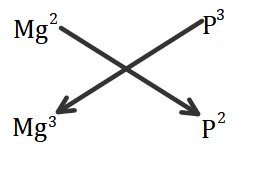
Hence the valency gets swapped and the compound formed is $ M{g_3}{P_2} $ , magnesium phosphide.
Magnesium phosphide is an ionic compound since it formed by the exchange of electrons.
Note :
In stable octet configuration, all the orbits of an element are completely filled with electrons. For example, after losing two electrons the two remaining shells are completely filled with electrons (having $ 2 $ in the first shell and $ 8 $ in the second shell). Be careful while determining the charge of magnesium and phosphorus ion. If you do not know the atomic number of the elements then just use a periodic table.
Complete Step By Step Answer:
When magnesium $ (Mg) $ bonds with phosphorus $ (P) $ , it will produce magnesium phosphide $ (M{g_3}{P_2}) $ .
Magnesium has an atomic number of $ 12 $ which means that to attain a stable octet configuration, it will tend to lose $ 2 $ electrons and hence it will become a positive ion with $ + 2 $ charge. Similarly, phosphorus has an atomic number of $ 15 $ . Therefore, to attain a stable octet configuration, phosphorus will tend to gain $ 3 $ more electrons. Hence, it will become a negative ion with $ - 3 $ charge.
We know that the valency of an ion is the same as the charge on that ion. Hence, the valency of $ M{g^{ + 2}} $ is $ 2 $ and the valency of $ {P^{3 - }} $ is $ 3 $ .
Now, to form a compound of magnesium and phosphorous, we will use the crossover rule to cross the valency of each element to one another as shown:
Hence the valency gets swapped and the compound formed is $ M{g_3}{P_2} $ , magnesium phosphide.
Magnesium phosphide is an ionic compound since it formed by the exchange of electrons.
Note :
In stable octet configuration, all the orbits of an element are completely filled with electrons. For example, after losing two electrons the two remaining shells are completely filled with electrons (having $ 2 $ in the first shell and $ 8 $ in the second shell). Be careful while determining the charge of magnesium and phosphorus ion. If you do not know the atomic number of the elements then just use a periodic table.
Recently Updated Pages
Master Class 11 Social Science: Engaging Questions & Answers for Success

Master Class 11 Physics: Engaging Questions & Answers for Success
Master Class 11 Maths: Engaging Questions & Answers for Success
Master Class 11 Economics: Engaging Questions & Answers for Success
Master Class 11 Computer Science: Engaging Questions & Answers for Success
Master Class 11 Chemistry: Engaging Questions & Answers for Success
Trending doubts
One Metric ton is equal to kg A 10000 B 1000 C 100 class 11 physics CBSE
There are 720 permutations of the digits 1 2 3 4 5 class 11 maths CBSE
1 Quintal is equal to a 110 kg b 10 kg c 100kg d 1000 class 11 physics CBSE
State and prove Bernoullis theorem class 11 physics CBSE
Difference Between Prokaryotic Cells and Eukaryotic Cells
Which among the following are examples of coming together class 11 social science CBSE