



How is the formula for the area of a parallelogram $ABCD$ derived$?$
Answer
 Verified
606.3k+ views
Hint: In this question, we are going to derive the formula for the area of the parallelogram $ABCD$.
To derive the area of the parallelogram, multiply the base of the perpendicular by its height.
The area of the parallelogram can be calculated, by using its base and height.
By using the formula we can derive the result.
Hence we can get the required result.
Formula used: The area of the parallelogram is written as
Area=$b \times h$ square units.
Where $b$ is the base and $h$ is the height of the parallelogram
Complete step-by-step solution:
In this question, we are going to derive the formula for the area of the parallelogram $ABCD$
First, to find the area of the parallelogram, multiply the base of the perpendicular by its height. It should be noted that the base and the height of the parallelogram are perpendicular to each other, whereas the lateral side of the parallelogram is not perpendicular to the base.
Therefore,
Area=$b \times h$ square units.
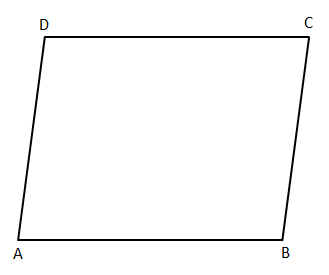
Here the base is marked as $A$ and $B$ then the top is marked as $C$ and $D$
The parallelogram area can be calculated, using its base and height. Apart from it the area of the parallelogram can also be evaluated, if its two diagonals are known along with any of their intersecting angles, or if the length of the parallel sides is known, along with any of the angles between the sides.
Let side lengths of parallelogram be $A$,$D$ and height be $h$ and interior angle be $\alpha $then
Area=$ah$
Area=$ab\sin \alpha $
Note: A parallelogram is a two dimensional shape that has four sides and two pairs of parallel lines.
The following are some of the properties of the parallelogram:
In a parallelogram opposite sides and angles are equal.
The sums of adjacent angles are supplementary.
In a parallelogram, if one angle is right, then all the angles are right.
Diagonals of a parallelogram bisect each other.
Each diagonal of a parallelogram divides it into two congruent triangles.
To derive the area of the parallelogram, multiply the base of the perpendicular by its height.
The area of the parallelogram can be calculated, by using its base and height.
By using the formula we can derive the result.
Hence we can get the required result.
Formula used: The area of the parallelogram is written as
Area=$b \times h$ square units.
Where $b$ is the base and $h$ is the height of the parallelogram
Complete step-by-step solution:
In this question, we are going to derive the formula for the area of the parallelogram $ABCD$
First, to find the area of the parallelogram, multiply the base of the perpendicular by its height. It should be noted that the base and the height of the parallelogram are perpendicular to each other, whereas the lateral side of the parallelogram is not perpendicular to the base.
Therefore,
Area=$b \times h$ square units.
Here the base is marked as $A$ and $B$ then the top is marked as $C$ and $D$
The parallelogram area can be calculated, using its base and height. Apart from it the area of the parallelogram can also be evaluated, if its two diagonals are known along with any of their intersecting angles, or if the length of the parallel sides is known, along with any of the angles between the sides.
Let side lengths of parallelogram be $A$,$D$ and height be $h$ and interior angle be $\alpha $then
Area=$ah$
Area=$ab\sin \alpha $
Note: A parallelogram is a two dimensional shape that has four sides and two pairs of parallel lines.
The following are some of the properties of the parallelogram:
In a parallelogram opposite sides and angles are equal.
The sums of adjacent angles are supplementary.
In a parallelogram, if one angle is right, then all the angles are right.
Diagonals of a parallelogram bisect each other.
Each diagonal of a parallelogram divides it into two congruent triangles.

Recently Updated Pages
Basicity of sulphurous acid and sulphuric acid are

Master Class 12 Economics: Engaging Questions & Answers for Success
Master Class 12 Biology: Engaging Questions & Answers for Success
Master Class 11 English: Engaging Questions & Answers for Success
Master Class 11 Physics: Engaging Questions & Answers for Success
Master Class 11 Computer Science: Engaging Questions & Answers for Success
Trending doubts
Difference Between Plant Cell and Animal Cell
Fill the blanks with the suitable prepositions 1 The class 9 english CBSE
What is pollution? How many types of pollution? Define it
What is the full form of pH?
What is the Full Form of ICSE, CBSE and SSC
Name 10 Living and Non living things class 9 biology CBSE