




What is the formula for copper $ \left( {II} \right) $ carbonate?
Answer
 Verified
519k+ views
Hint: Copper $ \left( {II} \right) $ carbonate is a chemical compound which is an ionic solid at ambient temperatures. It consists of copper $ \left( {II} \right) $ cations $ C{u^{2 + }} $ and carbonate anions $ CO_3^{2 - } $ . Copper $ \left( {II} \right) $ carbonate is a grey coloured ionic solid. It is a non-flammable compound.
Complete Step By Step Answer:
Copper $ \left( {II} \right) $ carbonate is rarely confronted because it is very strenuous to prepare and reacts with water moisture of the air very rapidly. The terms “Copper carbonate”, “Copper $ \left( {II} \right) $ carbonate” and “cupric carbonate” are referring to the basic copper carbonate.
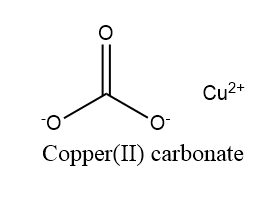
The structure of Copper $ \left( {II} \right) $ carbonate is shown in the figure below:
The Copper $ \left( {II} \right) $ carbonate reacts very rapidly with water and air thus it is practically a monotonous process to prepare.
Copper $ \left( {II} \right) $ carbonate can be yield by the reaction of copper $ \left( {II} \right) $ sulphate $ CuS{O_4} $ and sodium carbonate $ N{a_2}C{O_3} $ in ambient condition, produce instead a basic carbonate and $ C{O_2} $ , because of the great affinity of the $ C{u^{2 + }} $ ion for the hydroxide anion $ O{H^ - } $ .
W.F.T Pistorius in $ 1960 $ ; asserted synthesis by heating basic copper carbonate at $ {180^ \circ }C $ in the atmosphere of carbon dioxide and water for $ 36 $ hours. The proportions of the products were malachite $ C{u_2}C{O_3}{\left( {OH} \right)_2} $ , but small amount of rhombohedral substance was also formed, claimed $ CuC{O_3} $ . But this synthesis was apparently not reproduced.
The chemical formula of Copper $ \left( {II} \right) $ carbonate is $ CuC{O_3} $ which contain Copper $ \left( {II} \right) $ cation $ C{u^{2 + }} $ and carbonate anion $ CO_3^{2 - } $ .
Note:
The stability of dry carbon $ \left( {II} \right) $ carbonate depends upon the partial pressure of carbon dioxide $ C{O_2} $ . It is stable for months in dry air however slowly decomposes into copper $ \left( {II} \right) $ oxide and carbon dioxide.
Complete Step By Step Answer:
Copper $ \left( {II} \right) $ carbonate is rarely confronted because it is very strenuous to prepare and reacts with water moisture of the air very rapidly. The terms “Copper carbonate”, “Copper $ \left( {II} \right) $ carbonate” and “cupric carbonate” are referring to the basic copper carbonate.
The structure of Copper $ \left( {II} \right) $ carbonate is shown in the figure below:
The Copper $ \left( {II} \right) $ carbonate reacts very rapidly with water and air thus it is practically a monotonous process to prepare.
Copper $ \left( {II} \right) $ carbonate can be yield by the reaction of copper $ \left( {II} \right) $ sulphate $ CuS{O_4} $ and sodium carbonate $ N{a_2}C{O_3} $ in ambient condition, produce instead a basic carbonate and $ C{O_2} $ , because of the great affinity of the $ C{u^{2 + }} $ ion for the hydroxide anion $ O{H^ - } $ .
W.F.T Pistorius in $ 1960 $ ; asserted synthesis by heating basic copper carbonate at $ {180^ \circ }C $ in the atmosphere of carbon dioxide and water for $ 36 $ hours. The proportions of the products were malachite $ C{u_2}C{O_3}{\left( {OH} \right)_2} $ , but small amount of rhombohedral substance was also formed, claimed $ CuC{O_3} $ . But this synthesis was apparently not reproduced.
The chemical formula of Copper $ \left( {II} \right) $ carbonate is $ CuC{O_3} $ which contain Copper $ \left( {II} \right) $ cation $ C{u^{2 + }} $ and carbonate anion $ CO_3^{2 - } $ .
Note:
The stability of dry carbon $ \left( {II} \right) $ carbonate depends upon the partial pressure of carbon dioxide $ C{O_2} $ . It is stable for months in dry air however slowly decomposes into copper $ \left( {II} \right) $ oxide and carbon dioxide.
Recently Updated Pages
Master Class 11 English: Engaging Questions & Answers for Success

Master Class 11 Social Science: Engaging Questions & Answers for Success
Master Class 11 Maths: Engaging Questions & Answers for Success
Master Class 11 Biology: Engaging Questions & Answers for Success
Master Class 11 Physics: Engaging Questions & Answers for Success
Master Class 11 Chemistry: Engaging Questions & Answers for Success
Trending doubts
One Metric ton is equal to kg A 10000 B 1000 C 100 class 11 physics CBSE
Difference Between Prokaryotic Cells and Eukaryotic Cells
1 ton equals to A 100 kg B 1000 kg C 10 kg D 10000 class 11 physics CBSE
Find the value of the expression given below sin 30circ class 11 maths CBSE
Two of the body parts which do not appear in MRI are class 11 biology CBSE
Draw a diagram of a plant cell and label at least eight class 11 biology CBSE