




Forces of magnitude 3, P, 5, 10, Q are respectively acting along the sides AB, BC, CD, AD and the diagonal CA of a rectangle ABCD, where AB = 4m and BC = 3m. if the resultant is a single force along the other diagonal BD, then P, Q and the resultant are-
${\text{A}}{\text{. 4, 10}}\dfrac{5}{{12}},12\dfrac{{11}}{{12}}$
${\text{B}}{\text{. 5, 6}},7$
${\text{C}}{\text{. 3}}\dfrac{1}{2},8,9\dfrac{1}{2}$
${\text{D}}{\text{.}}$ None of the above
Answer
 Verified
613.8k+ views
Hint – Draw a rough sketch of all the forces acting along the sides AB, BC, CD, AD and the diagonal CA of the rectangle ABCD, then solve the question.
Complete step-by-step answer:
Given in the question that forces of magnitude 3, P, 5, 10, Q are respectively acting along the sides AB, BC, CD, AD and the diagonal CA of a rectangle ABCD.
Also given that, AB = 4m and BC = 3m.
The figure of the rectangle ABCD showing all the forces is shown below-
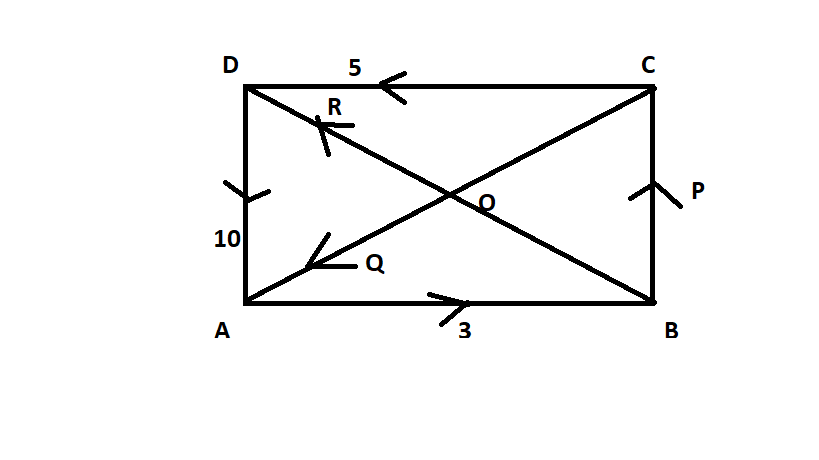
Now, if we find, $\tan \theta = \dfrac{{BC}}{{AB}} = \dfrac{3}{4}$.
Now, the forces 3, P, 5, 10 and Q Newtons have the resultant R as shown in figure.
So, we can write, $R\cos \theta + 5 - 3 = Q\cos \theta + 2 \to (1)$
And, $R\sin \theta = P + 10 - Q\sin \theta \to (2)$
Also, $QAB\sin \theta + 5.BC = 10.AB$
Or, $Q.4.\dfrac{3}{5} + 5 \times 3 = 10 \times 4\left( {\because \sin \theta = \dfrac{3}{5},\cos \theta = \dfrac{4}{5}} \right)$
Solving further, we get-
$
\Rightarrow \dfrac{{12}}{5}Q = 40 - 15 = 25 \\
\Rightarrow Q = \dfrac{{125}}{{12}} \\
$
Then, find R from equation (1) and P from equation (2).
$
\dfrac{{4R}}{5} = \dfrac{{125}}{{12}} \times \dfrac{4}{5} + 2 \\
\Rightarrow 4R = \dfrac{{125}}{3} + 10 = \dfrac{{155}}{3} \\
\Rightarrow R = \dfrac{{155}}{{12}} \\
$
And $
\dfrac{{155}}{{12}} \times \dfrac{3}{5} = P + 10 - \dfrac{{125}}{{12}} \times \dfrac{3}{5} \\
\Rightarrow \dfrac{{155}}{4} = 5P + 50 - \dfrac{{125}}{4} \\
\Rightarrow 5P = \dfrac{{155}}{4} + \dfrac{{125}}{4} - 50 \\
\Rightarrow 5P = \dfrac{{280}}{4} - 50 = 70 - 50 = 20 \\
\Rightarrow P = 4. \\
$
Hence, the forces along the diagonal BD is $R = \dfrac{{155}}{{12}} = 12\dfrac{{11}}{{12}}$ , the value of forces P and Q are $P = 4$ and $Q = 10\dfrac{5}{{12}}$ , respectively.
Hence, the correct option is ${\text{A}}{\text{. 4, 10}}\dfrac{5}{{12}},12\dfrac{{11}}{{12}}$.
Note – Whenever such types of questions appear, then always note down the things given in the question first. Then draw the figure using the information given in the question. And then applying basic mathematics from the equations and solving them to get the result.
Complete step-by-step answer:
Given in the question that forces of magnitude 3, P, 5, 10, Q are respectively acting along the sides AB, BC, CD, AD and the diagonal CA of a rectangle ABCD.
Also given that, AB = 4m and BC = 3m.
The figure of the rectangle ABCD showing all the forces is shown below-
Now, if we find, $\tan \theta = \dfrac{{BC}}{{AB}} = \dfrac{3}{4}$.
Now, the forces 3, P, 5, 10 and Q Newtons have the resultant R as shown in figure.
So, we can write, $R\cos \theta + 5 - 3 = Q\cos \theta + 2 \to (1)$
And, $R\sin \theta = P + 10 - Q\sin \theta \to (2)$
Also, $QAB\sin \theta + 5.BC = 10.AB$
Or, $Q.4.\dfrac{3}{5} + 5 \times 3 = 10 \times 4\left( {\because \sin \theta = \dfrac{3}{5},\cos \theta = \dfrac{4}{5}} \right)$
Solving further, we get-
$
\Rightarrow \dfrac{{12}}{5}Q = 40 - 15 = 25 \\
\Rightarrow Q = \dfrac{{125}}{{12}} \\
$
Then, find R from equation (1) and P from equation (2).
$
\dfrac{{4R}}{5} = \dfrac{{125}}{{12}} \times \dfrac{4}{5} + 2 \\
\Rightarrow 4R = \dfrac{{125}}{3} + 10 = \dfrac{{155}}{3} \\
\Rightarrow R = \dfrac{{155}}{{12}} \\
$
And $
\dfrac{{155}}{{12}} \times \dfrac{3}{5} = P + 10 - \dfrac{{125}}{{12}} \times \dfrac{3}{5} \\
\Rightarrow \dfrac{{155}}{4} = 5P + 50 - \dfrac{{125}}{4} \\
\Rightarrow 5P = \dfrac{{155}}{4} + \dfrac{{125}}{4} - 50 \\
\Rightarrow 5P = \dfrac{{280}}{4} - 50 = 70 - 50 = 20 \\
\Rightarrow P = 4. \\
$
Hence, the forces along the diagonal BD is $R = \dfrac{{155}}{{12}} = 12\dfrac{{11}}{{12}}$ , the value of forces P and Q are $P = 4$ and $Q = 10\dfrac{5}{{12}}$ , respectively.
Hence, the correct option is ${\text{A}}{\text{. 4, 10}}\dfrac{5}{{12}},12\dfrac{{11}}{{12}}$.
Note – Whenever such types of questions appear, then always note down the things given in the question first. Then draw the figure using the information given in the question. And then applying basic mathematics from the equations and solving them to get the result.
Recently Updated Pages
Master Class 12 Economics: Engaging Questions & Answers for Success

Master Class 12 Physics: Engaging Questions & Answers for Success
Master Class 12 English: Engaging Questions & Answers for Success
Master Class 12 Social Science: Engaging Questions & Answers for Success
Master Class 12 Maths: Engaging Questions & Answers for Success
Master Class 12 Business Studies: Engaging Questions & Answers for Success
Trending doubts
Which are the Top 10 Largest Countries of the World?
What are the major means of transport Explain each class 12 social science CBSE
Draw a labelled sketch of the human eye class 12 physics CBSE
Differentiate between insitu conservation and exsitu class 12 biology CBSE
Draw a neat and well labeled diagram of TS of ovary class 12 biology CBSE
Differentiate between homogeneous and heterogeneous class 12 chemistry CBSE