




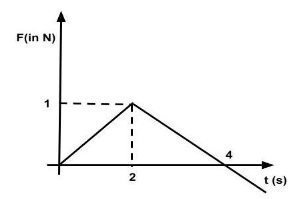
Force acting on a body varies with time as shown below. If the initial momentum of the body is \[\mathop P\limits^ \to \] then the time taken by the body to retain its momentum \[\mathop P\limits^ \to \] again is?
A. $8s$
B. $\left( {4 + \sqrt[2]{2}} \right)s$
C. $6s$
D. Can never be obtained.
Answer
 Verified
515.1k+ views
Hint: In physics, a force is any interaction that, while unopposed, causes an object to change its velocity. As a result of a force, an object with mass can change its velocity, or accelerate. Force is intuitively described as a push or a pull. Because it has both magnitude and direction, a force is a vector quantity.
Complete step by step answer:
For $t = 0$ to $t = 2$ , Force equation can be written in the standard form;
$y = mx + c$
${\mathop F _1}\left( t \right) = \dfrac{t}{2}$
When a force acts on a mass, Newton's Second Law of Motion states that acceleration (gaining speed) occurs (object). According to Newton's Second Law, the larger the mass of the item being propelled, the more force is required to accelerate the object.
Let, $m$ be the mass of body from Newton’s second law of motion
$\mathop a\limits^ \to (t) = \dfrac{1}{m} \times \dfrac{t}{2}$
Acceleration,
$\mathop a\limits^ \to \equiv \dfrac{{d\mathop v\limits^ \to }}{{dt}} \\
\Rightarrow \mathop v\limits^ \to (t) = \dfrac{1}{m}\int {\dfrac{t}{2}} dt \\
\Rightarrow \dfrac{{\overrightarrow p }}{m} = c \\
\mathop v\limits^ \to (t) = \dfrac{1}{m}\left( {\dfrac{{{t^2}}}{4} + \mathop p\limits^ \to } \right)\,\,......(1) \\ $
Velocity at $t = 2$ is found as
$\mathop v\limits^ \to (2) = \dfrac{1}{m}\left( {1 + \mathop p\limits^ \to } \right)\,\,.........(2)$
Velocity at $t = 2$ and thereafter becomes
$\mathop F\limits^ \to (t) = - \dfrac{1}{2}t + 2 \\
\Rightarrow \mathop a\limits^ \to (t) = - \dfrac{1}{m}\left( {\dfrac{t}{2} - 2} \right) \\
\Rightarrow {\mathop v_2}(t) = - \dfrac{1}{m}\int {\left( {\dfrac{t}{2} - 2} \right)} \,dt \\
\Rightarrow {\mathop v_2}(t) = - \dfrac{1}{m}\left( {\dfrac{{{t^2}}}{4} - 2t + {C_1}} \right) \\ $
Where, ${C_1}$ is constant of integration
Using (2) to find out ${C_1}$
${\mathop v _2}(2) = - \dfrac{1}{m}\left( {\dfrac{{{t^2}}}{4} - 2t + 2 - \mathop p\limits^ \to } \right)\,\,......(3)$
Imposing the given condition we will solve for $t$ :
$- \mathop p\limits^ \to = \dfrac{{{t^2}}}{4} - 2t + 2 - \mathop p\limits^ \to \\
\Rightarrow {t^2} - 8t + 8 = 0 \\ $
Solution of the quadratic gives us
$t = \dfrac{{8 \pm \sqrt {64 - 4 \times 1 \times 8} }}{2} \\
\therefore t = 4 \pm \sqrt[2]{2} \\ $
For the original query, only the $ - ve$ sign will suffice. We have two answers for the magnitude of momentum, as shown above.
Note: Most people's instinctive notion of momentum is that a large, fast-moving item has more momentum than a smaller, slower thing. The product of a system's mass multiplied by its velocity is defined as linear momentum. Linear momentum is written as \[p{\text{ }} = {\text{ }}mv\] in symbols. The mass and velocity of an object are both directly related to its momentum. As a result, the larger an object's mass or velocity, the higher its momentum.
Complete step by step answer:
For $t = 0$ to $t = 2$ , Force equation can be written in the standard form;
$y = mx + c$
${\mathop F _1}\left( t \right) = \dfrac{t}{2}$
When a force acts on a mass, Newton's Second Law of Motion states that acceleration (gaining speed) occurs (object). According to Newton's Second Law, the larger the mass of the item being propelled, the more force is required to accelerate the object.
Let, $m$ be the mass of body from Newton’s second law of motion
$\mathop a\limits^ \to (t) = \dfrac{1}{m} \times \dfrac{t}{2}$
Acceleration,
$\mathop a\limits^ \to \equiv \dfrac{{d\mathop v\limits^ \to }}{{dt}} \\
\Rightarrow \mathop v\limits^ \to (t) = \dfrac{1}{m}\int {\dfrac{t}{2}} dt \\
\Rightarrow \dfrac{{\overrightarrow p }}{m} = c \\
\mathop v\limits^ \to (t) = \dfrac{1}{m}\left( {\dfrac{{{t^2}}}{4} + \mathop p\limits^ \to } \right)\,\,......(1) \\ $
Velocity at $t = 2$ is found as
$\mathop v\limits^ \to (2) = \dfrac{1}{m}\left( {1 + \mathop p\limits^ \to } \right)\,\,.........(2)$
Velocity at $t = 2$ and thereafter becomes
$\mathop F\limits^ \to (t) = - \dfrac{1}{2}t + 2 \\
\Rightarrow \mathop a\limits^ \to (t) = - \dfrac{1}{m}\left( {\dfrac{t}{2} - 2} \right) \\
\Rightarrow {\mathop v_2}(t) = - \dfrac{1}{m}\int {\left( {\dfrac{t}{2} - 2} \right)} \,dt \\
\Rightarrow {\mathop v_2}(t) = - \dfrac{1}{m}\left( {\dfrac{{{t^2}}}{4} - 2t + {C_1}} \right) \\ $
Where, ${C_1}$ is constant of integration
Using (2) to find out ${C_1}$
${\mathop v _2}(2) = - \dfrac{1}{m}\left( {\dfrac{{{t^2}}}{4} - 2t + 2 - \mathop p\limits^ \to } \right)\,\,......(3)$
Imposing the given condition we will solve for $t$ :
$- \mathop p\limits^ \to = \dfrac{{{t^2}}}{4} - 2t + 2 - \mathop p\limits^ \to \\
\Rightarrow {t^2} - 8t + 8 = 0 \\ $
Solution of the quadratic gives us
$t = \dfrac{{8 \pm \sqrt {64 - 4 \times 1 \times 8} }}{2} \\
\therefore t = 4 \pm \sqrt[2]{2} \\ $
For the original query, only the $ - ve$ sign will suffice. We have two answers for the magnitude of momentum, as shown above.
Note: Most people's instinctive notion of momentum is that a large, fast-moving item has more momentum than a smaller, slower thing. The product of a system's mass multiplied by its velocity is defined as linear momentum. Linear momentum is written as \[p{\text{ }} = {\text{ }}mv\] in symbols. The mass and velocity of an object are both directly related to its momentum. As a result, the larger an object's mass or velocity, the higher its momentum.
Recently Updated Pages
Master Class 11 Computer Science: Engaging Questions & Answers for Success

Master Class 11 Business Studies: Engaging Questions & Answers for Success
Master Class 11 Economics: Engaging Questions & Answers for Success
Master Class 11 English: Engaging Questions & Answers for Success
Master Class 11 Maths: Engaging Questions & Answers for Success
Master Class 11 Biology: Engaging Questions & Answers for Success
Trending doubts
One Metric ton is equal to kg A 10000 B 1000 C 100 class 11 physics CBSE
There are 720 permutations of the digits 1 2 3 4 5 class 11 maths CBSE
Discuss the various forms of bacteria class 11 biology CBSE
Draw a diagram of a plant cell and label at least eight class 11 biology CBSE
State the laws of reflection of light
Explain zero factorial class 11 maths CBSE