




What is the forbidden energy gap (${E_g}$) or band gap?
A. Forbidden energy gap ${E_g}$ is the difference of energy levels of conduction band and within conduction band
B. Forbidden energy gap ${E_g}$ is the difference of energy levels of conduction band and valence band.
C. when there is no energy
D. conduction band
Answer
 Verified
683.4k+ views
Hint – In order to solve this problem we need to draw the diagram of conduction band and valence band and then the portion of the energy band structure of a semiconductor or insulator between the valence and conduction bands is forbidden energy gap.
Complete Step-by-Step solution:
The diagram of conduction and valence band can be drawn as:
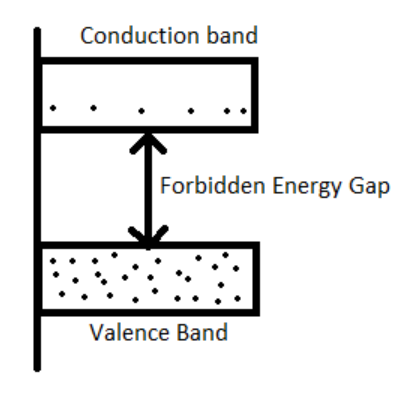
Forbidden energy gap, also known as band gap refers to the energy difference (eV) between the top of valence band and the bottom of the conduction band in materials. Current flowing through the materials is due to the electron transfer from the valence band to the conduction band.
Hence, the correct option is B.
Note – To solve such problems we just need to know that Forbidden energy gap, also known as band gap refers to the energy difference (eV) between the top of valence band and the bottom of the conduction band in materials. Current flowing through the materials is due to the electron transfer from the valence band to the conduction band.
Complete Step-by-Step solution:
The diagram of conduction and valence band can be drawn as:
Forbidden energy gap, also known as band gap refers to the energy difference (eV) between the top of valence band and the bottom of the conduction band in materials. Current flowing through the materials is due to the electron transfer from the valence band to the conduction band.
Hence, the correct option is B.
Note – To solve such problems we just need to know that Forbidden energy gap, also known as band gap refers to the energy difference (eV) between the top of valence band and the bottom of the conduction band in materials. Current flowing through the materials is due to the electron transfer from the valence band to the conduction band.
Recently Updated Pages
A Paragraph on Pollution in about 100-150 Words

What is BLO What is the full form of BLO class 8 social science CBSE
10 examples of friction in our daily life
Draw a diagram of nephron and explain its structur class 11 biology CBSE
Write structures of the following compounds i 2 Chloro3methylpentane class 11 chemistry CBSE
XIX+XXX A 49 B 51 C 55 D 44 class 5 maths CBSE
Trending doubts
Explain the Treaty of Vienna of 1815 class 10 social science CBSE
10 examples of evaporation in daily life with explanations
What is the full form of POSCO class 10 social science CBSE
Make a sketch of the human nerve cell What function class 10 biology CBSE
The uses of bleaching powder are A It is used bleaching class 10 chemistry CBSE
Choose the feminine form of the given noun Fox AFoxess class 10 english CBSE