




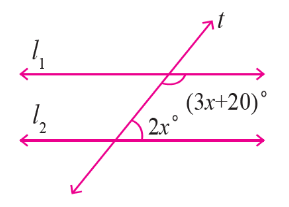
For what value of $x$ will ${l_1}$ and ${l_2}$ be parallel lines and why?
Answer
 Verified
574.5k+ views
Hint: Use the property, “If two parallel lines are cut by any transversal, then the sum of two consecutive interior angles is ${180^\circ }$” to find the value of $x$.
Complete step-by-step answer:
Here ${l_1}\parallel {l_2}$ and a transversal $t$ cut both the lines.
We know that when two parallel lines are cut by any transversal, then the sum of two consecutive interior angles is ${180^\circ }$.
Here $2{x^\circ }$ and ${\left( {3x + 20} \right)^\circ }$ are consecutive interior angles.
So, $2{x^\circ } + {\left( {3x + 20} \right)^\circ } = {180^\circ }$
$ \Rightarrow $$5x + {20^\circ } = {180^\circ }$
$ \Rightarrow $$5x = {180^\circ } - {20^\circ }$
$ \Rightarrow $$5x = {160^\circ }$
$ \Rightarrow $$x = \dfrac{{{{160}^\circ }}}{5}$
$ \Rightarrow $$x = {32^\circ }$
$\therefore $For $x = {32^\circ }$, ${l_1}$ and ${l_2}$ be parallel lines.
Note: For checking that two lines are parallel or not, any one of the conditions mentioned below is to be satisfied:
If two lines are cut by a transversal such that the pair of corresponding angles are equal to each other, then the pair of lines are parallel.
If two lines are cut by a transversal such that the sum of interior angles on the same side of the transversal is ${180^\circ }$, then the pair of lines are parallel.
If two lines are cut by a transversal such that the pair of alternate interior angles are equal to each other, then the pair of lines are parallel.
Complete step-by-step answer:
Here ${l_1}\parallel {l_2}$ and a transversal $t$ cut both the lines.
We know that when two parallel lines are cut by any transversal, then the sum of two consecutive interior angles is ${180^\circ }$.
Here $2{x^\circ }$ and ${\left( {3x + 20} \right)^\circ }$ are consecutive interior angles.
So, $2{x^\circ } + {\left( {3x + 20} \right)^\circ } = {180^\circ }$
$ \Rightarrow $$5x + {20^\circ } = {180^\circ }$
$ \Rightarrow $$5x = {180^\circ } - {20^\circ }$
$ \Rightarrow $$5x = {160^\circ }$
$ \Rightarrow $$x = \dfrac{{{{160}^\circ }}}{5}$
$ \Rightarrow $$x = {32^\circ }$
$\therefore $For $x = {32^\circ }$, ${l_1}$ and ${l_2}$ be parallel lines.
Note: For checking that two lines are parallel or not, any one of the conditions mentioned below is to be satisfied:
If two lines are cut by a transversal such that the pair of corresponding angles are equal to each other, then the pair of lines are parallel.
If two lines are cut by a transversal such that the sum of interior angles on the same side of the transversal is ${180^\circ }$, then the pair of lines are parallel.
If two lines are cut by a transversal such that the pair of alternate interior angles are equal to each other, then the pair of lines are parallel.

Recently Updated Pages
Master Class 9 General Knowledge: Engaging Questions & Answers for Success

Master Class 9 Social Science: Engaging Questions & Answers for Success
Master Class 9 English: Engaging Questions & Answers for Success
Master Class 9 Maths: Engaging Questions & Answers for Success
Master Class 9 Science: Engaging Questions & Answers for Success
Class 9 Question and Answer - Your Ultimate Solutions Guide
Trending doubts
Difference Between Plant Cell and Animal Cell
Fill the blanks with the suitable prepositions 1 The class 9 english CBSE
Who is eligible for RTE class 9 social science CBSE
Which places in India experience sunrise first and class 9 social science CBSE
What is pollution? How many types of pollution? Define it
Name 10 Living and Non living things class 9 biology CBSE