




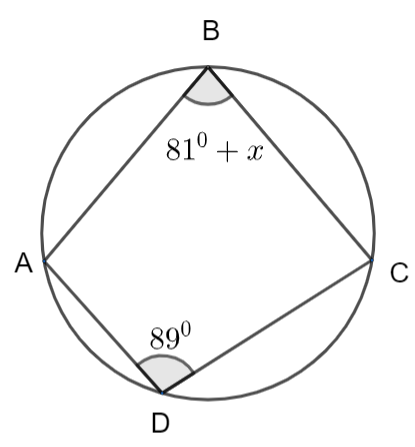
For what value of x in the figure points A, B, C, and D are concyclic?
(A) \[9{}^\circ \]
(B) \[10{}^\circ \]
(C) \[11{}^\circ \]
(D) \[12{}^\circ \]
Answer
 Verified
657.3k+ views
Hint: According to the question, we have a quadrilateral whose all vertices are lying on the circumference of the circle. It means that the quadrilateral ABCD is a cyclic quadrilateral. We know the property that the opposite angle of a cyclic quadrilateral is supplementary. Here, \[\angle B\] and \[\angle D\] are opposite to each other. So, the summation of the measure of \[\angle B\] and \[\angle D\] is \[180{}^\circ \] i.e, \[\angle B+\angle D=180{}^\circ \] . The measure of the \[\angle B\] and \[\angle D\] are \[\left( 81{}^\circ +x \right)\] and \[89{}^\circ \] . Put the measure of \[\angle B\] and \[\angle D\]in the equation, \[\angle B+\angle D=180{}^\circ \]. Now, solve it further and get the value of x.
Complete step-by-step answer:
According to the question, we have a quadrilateral ABCD whose all vertices are lying on the circumference of the circle. The measure of the angles \[\angle B\] and \[\angle D\] is given.
The measure of \[\angle B=81{}^\circ +x\] ………………………………(1)
The measure of \[\angle D=89{}^\circ \] …………………………………(2)
Since a cyclic quadrilateral is a quadrilateral whose all vertices lie on the circumference of the circle and the quadrilateral ABCD has its all vertices on the circumference of the circle so, the quadrilateral ABCD is cyclic.
In the given cyclic quadrilateral ABCD, we have \[\angle B\] and \[\angle D\] opposite to each other.
We know the property of a cyclic quadrilateral that the opposite angles are supplementary. In other words, the summation of the opposite angles is equal to \[180{}^\circ \] .
Using this property, we can say that the summation of the angles, \[\angle B\] and \[\angle D\] is equal to \[180{}^\circ \] . So,
\[\angle B+\angle D=180{}^\circ \] ………………………..(3)
From equation (1) and equation (2), we have the measure of the angles \[\angle B\] and \[\angle D\] that is \[\angle B=81{}^\circ +x\] and \[\angle D=89{}^\circ \] .
Now, putting the measure of \[\angle B\] and \[\angle D\] in equation (3), we get
\[\begin{align}
& \Rightarrow \angle B+\angle D=180{}^\circ \\
& \Rightarrow 81{}^\circ +x+89{}^\circ =180{}^\circ \\
\end{align}\]
Solving the above equation further to get the value of x,
\[\begin{align}
& \Rightarrow x+170{}^\circ =180{}^\circ \\
& \Rightarrow x=180{}^\circ -170{}^\circ \\
\end{align}\]
\[\Rightarrow x=10{}^\circ \]
Now, from the above equation, we have got the value of x.
Therefore, the value of x is equal to \[10{}^\circ \] .
Hence, the correct option is (B).
Note: We know that the summation of the opposite angles of a cyclic quadrilateral is supplementary. Here, one might make a silly mistake and take the measure of the supplementary angle equal to \[360{}^\circ \] . this is wrong because when two angles are supplementary then their sum is equal to \[180{}^\circ .\]
Complete step-by-step answer:
According to the question, we have a quadrilateral ABCD whose all vertices are lying on the circumference of the circle. The measure of the angles \[\angle B\] and \[\angle D\] is given.
The measure of \[\angle B=81{}^\circ +x\] ………………………………(1)
The measure of \[\angle D=89{}^\circ \] …………………………………(2)
Since a cyclic quadrilateral is a quadrilateral whose all vertices lie on the circumference of the circle and the quadrilateral ABCD has its all vertices on the circumference of the circle so, the quadrilateral ABCD is cyclic.
In the given cyclic quadrilateral ABCD, we have \[\angle B\] and \[\angle D\] opposite to each other.
We know the property of a cyclic quadrilateral that the opposite angles are supplementary. In other words, the summation of the opposite angles is equal to \[180{}^\circ \] .
Using this property, we can say that the summation of the angles, \[\angle B\] and \[\angle D\] is equal to \[180{}^\circ \] . So,
\[\angle B+\angle D=180{}^\circ \] ………………………..(3)
From equation (1) and equation (2), we have the measure of the angles \[\angle B\] and \[\angle D\] that is \[\angle B=81{}^\circ +x\] and \[\angle D=89{}^\circ \] .
Now, putting the measure of \[\angle B\] and \[\angle D\] in equation (3), we get
\[\begin{align}
& \Rightarrow \angle B+\angle D=180{}^\circ \\
& \Rightarrow 81{}^\circ +x+89{}^\circ =180{}^\circ \\
\end{align}\]
Solving the above equation further to get the value of x,
\[\begin{align}
& \Rightarrow x+170{}^\circ =180{}^\circ \\
& \Rightarrow x=180{}^\circ -170{}^\circ \\
\end{align}\]
\[\Rightarrow x=10{}^\circ \]
Now, from the above equation, we have got the value of x.
Therefore, the value of x is equal to \[10{}^\circ \] .
Hence, the correct option is (B).
Note: We know that the summation of the opposite angles of a cyclic quadrilateral is supplementary. Here, one might make a silly mistake and take the measure of the supplementary angle equal to \[360{}^\circ \] . this is wrong because when two angles are supplementary then their sum is equal to \[180{}^\circ .\]
Recently Updated Pages
Class 10 Question and Answer - Your Ultimate Solutions Guide

Master Class 12 Economics: Engaging Questions & Answers for Success
Master Class 12 Social Science: Engaging Questions & Answers for Success
Master Class 12 English: Engaging Questions & Answers for Success
Master Class 12 Maths: Engaging Questions & Answers for Success
Master Class 12 Physics: Engaging Questions & Answers for Success
Trending doubts
Explain the Treaty of Vienna of 1815 class 10 social science CBSE
The slogan Jai Hind was given by A Lal Bahadur Shastri class 10 social science CBSE
10 examples of evaporation in daily life with explanations
What is the full form of POSCO class 10 social science CBSE
Identify the feminine form of noun nephew a shenephew class 10 english CBSE
CSIR full form?