




For two molecules of glucose, glycolysis uses and produces ATP molecules
A. 4 and 8
B. 2 and 4
C. 2 and 8
D. 2 and 2
Answer
 Verified
577.5k+ views
Hint: Glycolysis is the process during which one glucose molecule gets converted into two molecules of pyruvate. It takes place in the cytosol of cells in all living organisms. The process of glycolysis can be broken down into two main phases i.e., the energy-requiring phase and the energy-releasing phase.
Complete answer:
Two main phases of glycolysis are the energy-requiring phase and the energy-releasing phase. These two phases can be explained further to determine the number of ATP molecules that have been used and produced in glycolysis.
Energy-requiring phase: During this phase, the substrate i.e., glucose molecule gets rearranged followed by the attachment of two phosphate groups. The attachment of the phosphate groups makes the modified sugar (fructose-1, 6-bisphosphate) unstable that allows it to break into half and forms two molecules of phosphate-bearing 3-carbon sugars. The two phosphate molecules that get attached to the glucose molecule after its rearrangement come from the two ATP molecules. Thus, two ATP molecules are used up.
Energy-releasing phase: During this phase, each 3-carbon sugar gets converted into another 3-carbon molecule i.e., pyruvate through a series of reactions. In this phase of glycolysis, for a single 3-carbon sugar getting converted into a single pyruvate molecule; 2 ATP and 1 NADH are produced. So, the total yield during this phase will be 4 ATP molecules and 2 NADH molecules as this phase takes place twice for each of the three-carbon sugar that was made earlier in the energy-requiring phase to get converted into 2 molecules of pyruvate.
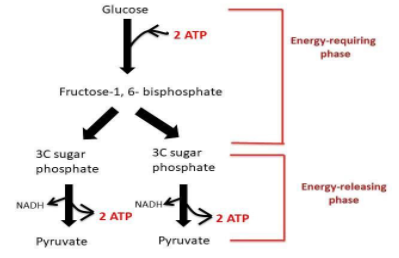
Total ATP used and produced during glycolysis of one molecule of glucose = 2 ATP were used up and 4 ATP were produced.
So, for two molecules of glucose, total ATP used and produced during glycolysis = 2$\times$2 ATP were used and 4$\times$2 ATP were produced i.e., 4 ATP molecules were used and 8 ATP molecules were produced.
Thus, only option (A) shows the correct amount of ATP used and produced during glycolysis of two molecules of glucose, and the rest of the other options are incorrect.
Hence, the correct answer is option (A).
Note: Phosphofructokinase is the most important enzyme for the regulation of glycolysis and it is known for catalyzing the formation of fructose-1, 6-bisphosphate i.e., unstable. This enzyme thus speeds up or slows down glycolysis in response to the energy requirements of the cell.
Complete answer:
Two main phases of glycolysis are the energy-requiring phase and the energy-releasing phase. These two phases can be explained further to determine the number of ATP molecules that have been used and produced in glycolysis.
Energy-requiring phase: During this phase, the substrate i.e., glucose molecule gets rearranged followed by the attachment of two phosphate groups. The attachment of the phosphate groups makes the modified sugar (fructose-1, 6-bisphosphate) unstable that allows it to break into half and forms two molecules of phosphate-bearing 3-carbon sugars. The two phosphate molecules that get attached to the glucose molecule after its rearrangement come from the two ATP molecules. Thus, two ATP molecules are used up.
Energy-releasing phase: During this phase, each 3-carbon sugar gets converted into another 3-carbon molecule i.e., pyruvate through a series of reactions. In this phase of glycolysis, for a single 3-carbon sugar getting converted into a single pyruvate molecule; 2 ATP and 1 NADH are produced. So, the total yield during this phase will be 4 ATP molecules and 2 NADH molecules as this phase takes place twice for each of the three-carbon sugar that was made earlier in the energy-requiring phase to get converted into 2 molecules of pyruvate.
Total ATP used and produced during glycolysis of one molecule of glucose = 2 ATP were used up and 4 ATP were produced.
So, for two molecules of glucose, total ATP used and produced during glycolysis = 2$\times$2 ATP were used and 4$\times$2 ATP were produced i.e., 4 ATP molecules were used and 8 ATP molecules were produced.
Thus, only option (A) shows the correct amount of ATP used and produced during glycolysis of two molecules of glucose, and the rest of the other options are incorrect.
Hence, the correct answer is option (A).
Note: Phosphofructokinase is the most important enzyme for the regulation of glycolysis and it is known for catalyzing the formation of fructose-1, 6-bisphosphate i.e., unstable. This enzyme thus speeds up or slows down glycolysis in response to the energy requirements of the cell.
Recently Updated Pages
Basicity of sulphurous acid and sulphuric acid are

Master Class 11 Business Studies: Engaging Questions & Answers for Success
Master Class 11 Computer Science: Engaging Questions & Answers for Success
Master Class 11 Economics: Engaging Questions & Answers for Success
Master Class 11 Social Science: Engaging Questions & Answers for Success
Master Class 11 English: Engaging Questions & Answers for Success
Trending doubts
One Metric ton is equal to kg A 10000 B 1000 C 100 class 11 physics CBSE
The largest wind power cluster is located in the state class 11 social science CBSE
Explain zero factorial class 11 maths CBSE
State and prove Bernoullis theorem class 11 physics CBSE
Which among the following are examples of coming together class 11 social science CBSE
Can anyone list 10 advantages and disadvantages of friction