




For three events A, B and C, P(exactly one of the events A or B) $=$ P(exactly one of the events B or C) $=$ P(exactly one of the events C or A) $=$ P and P(all the three events occur simultaneously) $={{P}^{2}}$ , where 0$<$P$<$$\dfrac{1}{2}$ . If the probability of at least one of the three events A, B and C occurs is $\dfrac{11}{18}$ , the value of P is
(a) $\dfrac{1}{6}$
(b) $\dfrac{1}{4}$
(c) $\dfrac{1}{5}$
(d) $\dfrac{1}{3}$
Answer
 Verified
629.7k+ views
Hint: First, we should know that $P\left( A\text{ or }B \right)$ means either $P\left( A \right)$ will occur or $P\left( B \right)$ will occur and subtracting the intersection part from set. Similarly, $P\left( \text{B or C} \right)$ and $P\left( \text{C or A} \right)$ writing the 3 equation for this using the formula $P\left( A\cup B \right)=P\left( A \right)+P\left( B \right)-P\left( A\cap B \right)$ . Then adding all the 3 equations so, answer will be in terms of P. Then probability of all three events is given, so adding the value of event with the value of above 3 equation and thus finding the answer of P.
Complete step-by-step answer:
Now, we are given with, P (exactly one of the events A or B) having value equal to P which is written as
$P\left( A\text{ or }B \right)=P\left( A \right)+P\left( B \right)-2P\left( A\cap B \right)=P$ ……………………………(i)
The above equation can be explained by showing Venn diagram i.e.
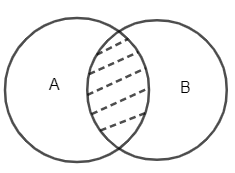
Here, shaded part is called intersection i.e. $P\left( A\cap B \right)$
Now, it is told that either event A will occur or event B so, if A is occurring than intersection part should be subtracted and is B event is occurring than also intersection part should be subtracted because it contains elements of set A as well as B. Therefore, we have subtracted 2 times intersection part in equation (i).
Similarly, we will write remaining two equation i.e. P (exactly one of the events B or C)
$P\left( \text{B or C} \right)=P\left( B \right)+P\left( C \right)-2P\left( B\cap C \right)=P$ ……………….………….(ii)
For P (exactly one of the events C or A)
$P\left( \text{C or A} \right)=P\left( C \right)+P\left( A \right)-2P\left( C\cap A \right)=P$ …………………………………(iii)
Now adding above 3 equation, we get as
$\Rightarrow 2P\left( A \right)+2P\left( B \right)+2P\left( C \right)-2P\left( A\cap B \right)-2P\left( B\cap C \right)-2P\left( C\cap A \right)=3P$ ……………………(iv)
Also, another data is given that P (all the three events occur simultaneously) $={{P}^{2}}$ . So, in mathematical form it is written as
$P\left( A\cup B\cup C \right)={{P}^{2}}$ …………………………(v)
If at least any one event occurs then its probability is given as $P\left( A\text{ or }B\text{ or }C \right)=\dfrac{11}{18}$ …………..(vi)
Now, solving equation (iv) we get
$\Rightarrow P\left( A \right)+P\left( B \right)+P\left( C \right)-P\left( A\cap B \right)-P\left( B\cap C \right)-P\left( C\cap A \right)=\dfrac{3P}{2}$
Now, we know that formula for finding at least one event occur is given as
$\Rightarrow P\left( A\text{ or }B\text{ or }C \right)=P\left( A\cup B\cup C \right)+P\left( A \right)+P\left( B \right)+P\left( C \right)-P\left( A\cap B \right)-P\left( B\cap C \right)-P\left( C\cap A \right)$
We have all the values with us so, just substituting it in above equation, we get
$\Rightarrow \dfrac{11}{18}={{P}^{2}}+\dfrac{3P}{2}$
On solving further, we get
$\Rightarrow \dfrac{11\times 2}{18}=2{{P}^{2}}+3P$
$\Rightarrow \dfrac{11}{9}=2{{P}^{2}}+3P$ ………………………………….(vii)
Now, we can just directly solve using option value and comparing LHS and RHS.
So, taking $\dfrac{1}{3}$ as it is given that the range of P is from 0 to 0.5. So, on putting $\dfrac{1}{3}$ in equation (vii) on RHS side, we get
$=2{{\left( \dfrac{1}{3} \right)}^{2}}+3\left( \dfrac{1}{3} \right)$
$=\dfrac{2}{9}+1$
$=\dfrac{2+9}{9}=\dfrac{11}{9}$
Thus, our LHS is also $\dfrac{11}{9}$ . So, the value of P is $\dfrac{11}{9}$ .
Hence, option (d) is the correct answer.
Note: Be careful with the formula of union as the general formula of A union B is given as $P\left( A\cup B \right)=P\left( A \right)+P\left( B \right)-P\left( A\cap B \right)$ but we are given A “OR'' B in the question so 2 times intersection will be subtracted. If you miss this subtraction then the whole answer will go wrong. Also, in finding value of P from quadratic equation form, it will take some time to solve in finding factors and will become complex. So, it's better sometimes to go with the option method and find an answer easily.
Complete step-by-step answer:
Now, we are given with, P (exactly one of the events A or B) having value equal to P which is written as
$P\left( A\text{ or }B \right)=P\left( A \right)+P\left( B \right)-2P\left( A\cap B \right)=P$ ……………………………(i)
The above equation can be explained by showing Venn diagram i.e.
Here, shaded part is called intersection i.e. $P\left( A\cap B \right)$
Now, it is told that either event A will occur or event B so, if A is occurring than intersection part should be subtracted and is B event is occurring than also intersection part should be subtracted because it contains elements of set A as well as B. Therefore, we have subtracted 2 times intersection part in equation (i).
Similarly, we will write remaining two equation i.e. P (exactly one of the events B or C)
$P\left( \text{B or C} \right)=P\left( B \right)+P\left( C \right)-2P\left( B\cap C \right)=P$ ……………….………….(ii)
For P (exactly one of the events C or A)
$P\left( \text{C or A} \right)=P\left( C \right)+P\left( A \right)-2P\left( C\cap A \right)=P$ …………………………………(iii)
Now adding above 3 equation, we get as
$\Rightarrow 2P\left( A \right)+2P\left( B \right)+2P\left( C \right)-2P\left( A\cap B \right)-2P\left( B\cap C \right)-2P\left( C\cap A \right)=3P$ ……………………(iv)
Also, another data is given that P (all the three events occur simultaneously) $={{P}^{2}}$ . So, in mathematical form it is written as
$P\left( A\cup B\cup C \right)={{P}^{2}}$ …………………………(v)
If at least any one event occurs then its probability is given as $P\left( A\text{ or }B\text{ or }C \right)=\dfrac{11}{18}$ …………..(vi)
Now, solving equation (iv) we get
$\Rightarrow P\left( A \right)+P\left( B \right)+P\left( C \right)-P\left( A\cap B \right)-P\left( B\cap C \right)-P\left( C\cap A \right)=\dfrac{3P}{2}$
Now, we know that formula for finding at least one event occur is given as
$\Rightarrow P\left( A\text{ or }B\text{ or }C \right)=P\left( A\cup B\cup C \right)+P\left( A \right)+P\left( B \right)+P\left( C \right)-P\left( A\cap B \right)-P\left( B\cap C \right)-P\left( C\cap A \right)$
We have all the values with us so, just substituting it in above equation, we get
$\Rightarrow \dfrac{11}{18}={{P}^{2}}+\dfrac{3P}{2}$
On solving further, we get
$\Rightarrow \dfrac{11\times 2}{18}=2{{P}^{2}}+3P$
$\Rightarrow \dfrac{11}{9}=2{{P}^{2}}+3P$ ………………………………….(vii)
Now, we can just directly solve using option value and comparing LHS and RHS.
So, taking $\dfrac{1}{3}$ as it is given that the range of P is from 0 to 0.5. So, on putting $\dfrac{1}{3}$ in equation (vii) on RHS side, we get
$=2{{\left( \dfrac{1}{3} \right)}^{2}}+3\left( \dfrac{1}{3} \right)$
$=\dfrac{2}{9}+1$
$=\dfrac{2+9}{9}=\dfrac{11}{9}$
Thus, our LHS is also $\dfrac{11}{9}$ . So, the value of P is $\dfrac{11}{9}$ .
Hence, option (d) is the correct answer.
Note: Be careful with the formula of union as the general formula of A union B is given as $P\left( A\cup B \right)=P\left( A \right)+P\left( B \right)-P\left( A\cap B \right)$ but we are given A “OR'' B in the question so 2 times intersection will be subtracted. If you miss this subtraction then the whole answer will go wrong. Also, in finding value of P from quadratic equation form, it will take some time to solve in finding factors and will become complex. So, it's better sometimes to go with the option method and find an answer easily.
Recently Updated Pages
Master Class 12 Business Studies: Engaging Questions & Answers for Success

Master Class 12 Biology: Engaging Questions & Answers for Success
Master Class 12 Chemistry: Engaging Questions & Answers for Success
Class 12 Question and Answer - Your Ultimate Solutions Guide
Master Class 11 Social Science: Engaging Questions & Answers for Success
Master Class 11 English: Engaging Questions & Answers for Success
Trending doubts
Which is more stable and why class 12 chemistry CBSE
What are the major means of transport Explain each class 12 social science CBSE
Name the part of the flower which the tassels of the class 12 biology CBSE
The value of constant k in coulombs law is beginalign class 12 physics CBSE
Suicide bags of cells are aEndoplasmic reticulum bLysosome class 12 biology CBSE
Quantisation of charge implies a Charge does not exist class 12 physics CBSE