




For the refraction of light through a prism
(A) For every angle of deviation there are two angles of incidence
(B) The light travelling inside an equilateral prism is necessarily parallel to the base when prism is set for minimum deviation
(C) There are two angles of incidence for maximum deviation
(D) Angle of minimum deviation will increase if refractive index of prism is increased keeping the outside medium unchanged if $ {\mu _p} > {\mu _s} $
Answer
 Verified
570.3k+ views
Hint :In order to solve this question, we are going to first draw the ray diagram for the refraction of light through a prism. After that, some of the phenomena or the observations made in this case are discussed and finally the correct option(s) is/are chosen from the above.
Complete Step By Step Answer:
For the refraction of light through a prism, we have the following phenomenon observed.
Let us first draw a diagram for the refraction of light through prism.
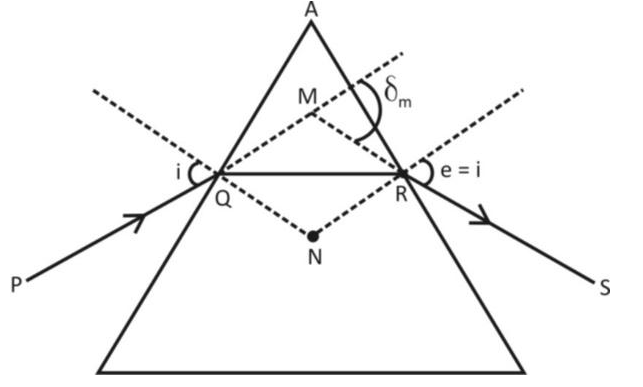
For every angle of deviation, we have two angles of the incidence.
The light ray that is travelling inside of an isosceles prism is necessarily parallel to the base when the prism is set for the minimum deviation.
For the maximum deviation, there are two angles of the incidence.
If the outside medium remains the same, and the material of the prism is changed such that its refractive index also changes, then, the angle of the minimum deviation will increase.
Hence, from the above observations, we get that the options(C) and (D) are the correct answers.
Note :
The ray of light gets deviated two times simply when entering the prism and while leaving it too which is because the two refracting surfaces of the prism are not parallel. The light ray travelling from the rarer to the denser medium gets refracted and bends towards the normal and vice versa.
Complete Step By Step Answer:
For the refraction of light through a prism, we have the following phenomenon observed.
Let us first draw a diagram for the refraction of light through prism.
For every angle of deviation, we have two angles of the incidence.
The light ray that is travelling inside of an isosceles prism is necessarily parallel to the base when the prism is set for the minimum deviation.
For the maximum deviation, there are two angles of the incidence.
If the outside medium remains the same, and the material of the prism is changed such that its refractive index also changes, then, the angle of the minimum deviation will increase.
Hence, from the above observations, we get that the options(C) and (D) are the correct answers.
Note :
The ray of light gets deviated two times simply when entering the prism and while leaving it too which is because the two refracting surfaces of the prism are not parallel. The light ray travelling from the rarer to the denser medium gets refracted and bends towards the normal and vice versa.
Recently Updated Pages
Basicity of sulphurous acid and sulphuric acid are

Master Class 12 Economics: Engaging Questions & Answers for Success
Master Class 12 Biology: Engaging Questions & Answers for Success
Master Class 11 English: Engaging Questions & Answers for Success
Master Class 11 Physics: Engaging Questions & Answers for Success
Master Class 11 Computer Science: Engaging Questions & Answers for Success
Trending doubts
Draw a labelled sketch of the human eye class 12 physics CBSE
Which are the Top 10 Largest Countries of the World?
Draw ray diagrams each showing i myopic eye and ii class 12 physics CBSE
Which is the correct genotypic ratio of mendel dihybrid class 12 biology CBSE
Draw a ray diagram of compound microscope when the class 12 physics CBSE
Give 10 examples of unisexual and bisexual flowers