




For the mass on the spring, how is the period of the harmonic motion related to the spring constant, k?
Answer
 Verified
551.7k+ views
Hint:In mechanics and physics, simple harmonic motion or SHM is a special type of periodic motion where the restoring force(F) on the moving object is directly proportional to the object's displacement and acts towards the object's equilibrium position. Simple Harmonic Motion is also a type of a periodic motion which repeats itself after an interval of time.
Complete answer:
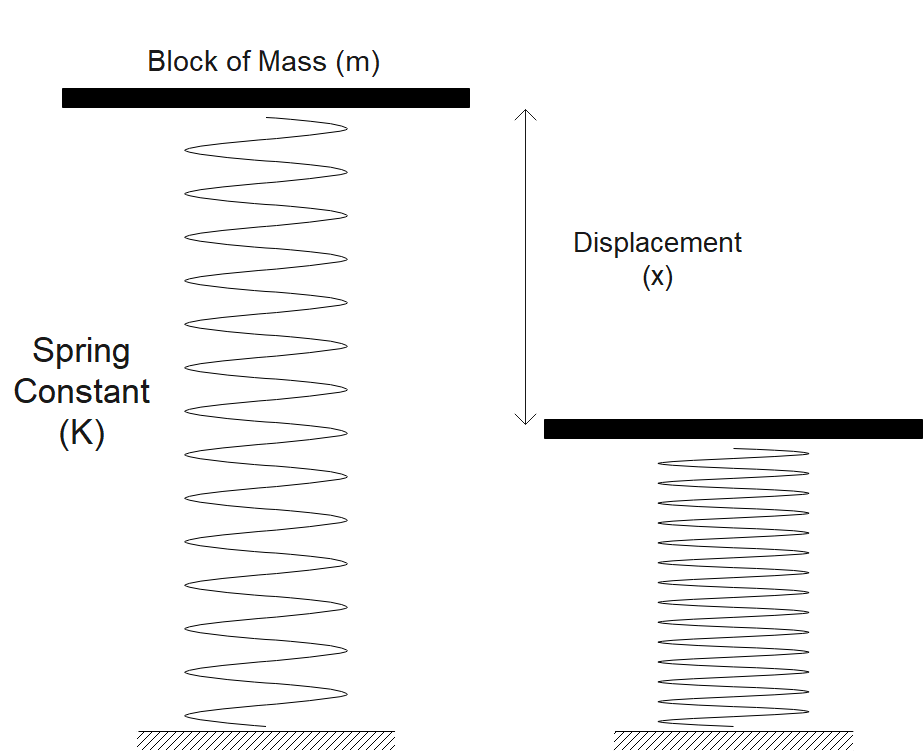
For a spring we know that the restoring force is equal to F= Kx ………… (1)
Where x is the displacement and K is known as spring constant.
We know that for Simple Harmonic Motion $F=-m{{\omega }^{2}}x$ ………….. (2)
Where m is the mass and $\omega $ is the angular frequency.
Now if we compare both equation (1) and equation (2) we get
$kx=-m{{\omega }^{2}}x$
Or $k=-m{{\omega }^{2}}$
Now we know that $\omega =\sqrt{\dfrac{k}{m}}$ ….. (3)
And we also know that the time period of a simple harmonic motion is given by $T=\dfrac{2\pi }{\omega }$
Now putting the value of $\omega $ in above equation form equation (3) we get,
$T=2\pi \sqrt{\dfrac{m}{k}}$
This is the time period of a simple harmonic motion in terms of mass (m) and spring constant (k). where $2\pi $is a content.
Now this is our required relation for spring constant (k) and the time period (T) of a simple harmonic motion.
Note:
All the SHM’s are oscillatory and periodic motions but not all oscillatory or periodic motions are SHM. For example, revolution of earth around the sun is a periodic motion but that is not Simple harmonic motion even though it repeats itself after a fixed interval of time. In Simple Harmonic motion displacement, velocity and acceleration and force vary with respect to time.
Complete answer:
For a spring we know that the restoring force is equal to F= Kx ………… (1)
Where x is the displacement and K is known as spring constant.
We know that for Simple Harmonic Motion $F=-m{{\omega }^{2}}x$ ………….. (2)
Where m is the mass and $\omega $ is the angular frequency.
Now if we compare both equation (1) and equation (2) we get
$kx=-m{{\omega }^{2}}x$
Or $k=-m{{\omega }^{2}}$
Now we know that $\omega =\sqrt{\dfrac{k}{m}}$ ….. (3)
And we also know that the time period of a simple harmonic motion is given by $T=\dfrac{2\pi }{\omega }$
Now putting the value of $\omega $ in above equation form equation (3) we get,
$T=2\pi \sqrt{\dfrac{m}{k}}$
This is the time period of a simple harmonic motion in terms of mass (m) and spring constant (k). where $2\pi $is a content.
Now this is our required relation for spring constant (k) and the time period (T) of a simple harmonic motion.
Note:
All the SHM’s are oscillatory and periodic motions but not all oscillatory or periodic motions are SHM. For example, revolution of earth around the sun is a periodic motion but that is not Simple harmonic motion even though it repeats itself after a fixed interval of time. In Simple Harmonic motion displacement, velocity and acceleration and force vary with respect to time.
Recently Updated Pages
Master Class 11 Computer Science: Engaging Questions & Answers for Success

Master Class 11 Business Studies: Engaging Questions & Answers for Success
Master Class 11 Economics: Engaging Questions & Answers for Success
Master Class 11 English: Engaging Questions & Answers for Success
Master Class 11 Maths: Engaging Questions & Answers for Success
Master Class 11 Biology: Engaging Questions & Answers for Success
Trending doubts
One Metric ton is equal to kg A 10000 B 1000 C 100 class 11 physics CBSE
There are 720 permutations of the digits 1 2 3 4 5 class 11 maths CBSE
Discuss the various forms of bacteria class 11 biology CBSE
Draw a diagram of a plant cell and label at least eight class 11 biology CBSE
State the laws of reflection of light
Explain zero factorial class 11 maths CBSE