



For the formation of \[MgC{l_2}\] , which of the following are correct ?
(A) \[Mg\] loses two electrons
(B) Each \[Cl\] atom gains $2$ electrons
(C) Each \[Cl\] atom gains one electron
(D) \[Mg\] and \[Cl\] shares electron to gain stable octet configuration
Answer
 Verified
573.6k+ views
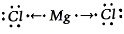
Hint:In the given question firstly we have to define the compound which is called Magnesium chloride. The chemical formula would be \[MgC{l_2}\] and the nature fo the bond formation would be ionic. Therefore we would be getting the bond formed as
Complete step-by-step answer:The given question statement asks about the compound which is called Magnesium chloride. Apart from that we also have to know the nature of the bond formation and the elemental knowledge of the elements.
When we talk about the elements as an individual they show this kind of structure
For the case of chlorine it is :

For the case of magnesium it is :

So when we talk about the bond formation we get that the ionic bond that is formed between the magnesium and the chlorine would be ionic were the one will lose the electrons in order to et the octet to be filled whereas the chlorine would be there to gain the solo electron and get the octet filled.
Therefore the transfer of the electron would be completely depicted in the given image of the bond formation.
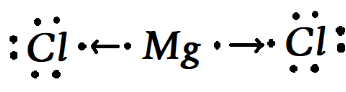
So therefore we get two conclusions that the
1.The Magnesium will loose couple of electrons
2.The Chlorine would going to receive an electron
Therefore the right options among the following would be :Option A, \[Mg\] loses two electrons.
Option C, Each \[Cl\] atom gains one electron.
Note:Some magnesium chloride is made from solar evaporation of seawater. Anhydrous magnesium chloride is the principal precursor to magnesium metal, which is produced on a large scale. Hydrated magnesium chloride is the form most readily available.
Complete step-by-step answer:The given question statement asks about the compound which is called Magnesium chloride. Apart from that we also have to know the nature of the bond formation and the elemental knowledge of the elements.
When we talk about the elements as an individual they show this kind of structure
For the case of chlorine it is :
For the case of magnesium it is :
So when we talk about the bond formation we get that the ionic bond that is formed between the magnesium and the chlorine would be ionic were the one will lose the electrons in order to et the octet to be filled whereas the chlorine would be there to gain the solo electron and get the octet filled.
Therefore the transfer of the electron would be completely depicted in the given image of the bond formation.
So therefore we get two conclusions that the
1.The Magnesium will loose couple of electrons
2.The Chlorine would going to receive an electron
Therefore the right options among the following would be :Option A, \[Mg\] loses two electrons.
Option C, Each \[Cl\] atom gains one electron.
Note:Some magnesium chloride is made from solar evaporation of seawater. Anhydrous magnesium chloride is the principal precursor to magnesium metal, which is produced on a large scale. Hydrated magnesium chloride is the form most readily available.
Recently Updated Pages
Basicity of sulphurous acid and sulphuric acid are

Master Class 12 English: Engaging Questions & Answers for Success
Master Class 12 Social Science: Engaging Questions & Answers for Success
Master Class 12 Maths: Engaging Questions & Answers for Success
Master Class 12 Economics: Engaging Questions & Answers for Success
Master Class 12 Physics: Engaging Questions & Answers for Success
Trending doubts
Which are the Top 10 Largest Countries of the World?
Draw a labelled sketch of the human eye class 12 physics CBSE
Give 10 examples of unisexual and bisexual flowers
Coming together federation is practiced in A India class 12 social science CBSE
Write the formula to find the shortest distance between class 12 maths CBSE
Find the foot of the perpendicular from point232to class 12 maths CBSE