




For the ellipse $25{x^2} + 9{y^2} - 150x - 90y + 225 = 0$, the eccentricity e is equal to
A.$\dfrac{2}{5}$
B.$\dfrac{3}{5}$
C.$\dfrac{4}{5}$
D.$\dfrac{1}{5}$
Answer
 Verified
603k+ views
Hint: The general equation of the ellipse is $\dfrac{{{x^2}}}{{{a^2}}} + \dfrac{{{y^2}}}{{{b^2}}} = 1$. So we need to convert the given equation in the form of our general equation using completing the square method and with the obtained values the greatest is a and smaller one is b and our eccentricity is given by the formula $e = \sqrt {1 - \dfrac{{{b^2}}}{{{a^2}}}} $.
Complete step-by-step answer:
We know that the general equation of an ellipse is $\dfrac{{{x^2}}}{{{a^2}}} + \dfrac{{{y^2}}}{{{b^2}}} = 1$
And its eccentricity is given by $e = \sqrt {1 - \dfrac{{{b^2}}}{{{a^2}}}} $
The diagram of the ellipse is given below
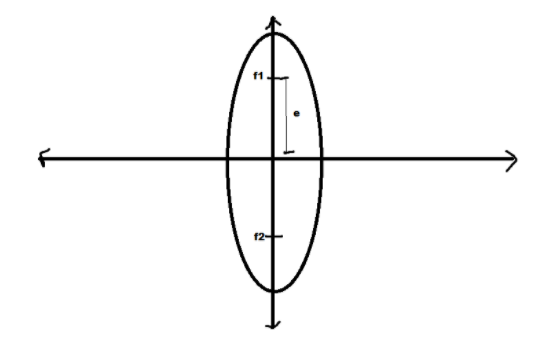
But we are given the equation of the ellipse is $25{x^2} + 9{y^2} - 150x - 90y + 225 = 0$
So at first we need to bring the given equation in the form of the general equation in order to find the value of a and b
First lets group the terms with regard to their co efficient and take the constant to the other side
$ \Rightarrow 25{x^2} - 150x + 9{y^2} - 90y = - 225$
Now let's take 25 common from the first two terms and 9 from the next two terms
$ \Rightarrow 25({x^2} - 6x) + 9({y^2} - 10y) = - 225$
Now let's use the method of completing the square to form two perfect square equations
Add and subtract 9 in the first part and add and subtract 25 in the second part
..$
\Rightarrow 25({x^2} - 6x + 9 - 9) + 9({y^2} - 10y + 25 - 25) = - 225 \\
\Rightarrow 25({x^2} - 6x + 9) - 225 + 9({y^2} - 10y + 25) - 225 = - 225 \\
$..
Taking the constant terms to the other side
\[
\Rightarrow 25({x^2} - 6x + 9) + 9({y^2} - 10y + 25) = - 225 + 225 + 225 \\
\Rightarrow 25{(x - 3)^2} + 9{\left( {y - 5} \right)^2} = 225 \\
\]
According to our general equation the right hand side should be 1.
So let's divide the equation by 225 on both sides.
\[
\Rightarrow \dfrac{{25{{(x - 3)}^2}}}{{225}} + \dfrac{{9{{\left( {y - 5} \right)}^2}}}{{225}} = \dfrac{{225}}{{225}} \\
\Rightarrow \dfrac{{{{(x - 3)}^2}}}{9} + \dfrac{{{{\left( {y - 5} \right)}^2}}}{{25}} = 1 \\
\]
Now our equation is of the form $\dfrac{{{x^2}}}{{{a^2}}} + \dfrac{{{y^2}}}{{{b^2}}} = 1$, a>b
So our ${a^2} = 25$ and ${b^2} = 9$
Now our eccentricity is given by
$
\Rightarrow e = \sqrt {1 - \dfrac{{{b^2}}}{{{a^2}}}} \\
\Rightarrow e = \sqrt {1 - \dfrac{9}{{25}}} \\
\Rightarrow e = \sqrt {\dfrac{{25 - 9}}{{25}}} \\
\Rightarrow e = \sqrt {\dfrac{{16}}{{25}}} = \dfrac{4}{5} \\
$
Therefore the eccentricity is 4/5
The correct option is C.
Note: In mathematics, an ellipse is a plane curve surrounding two focal points, such that for all points on the curve, the sum of the two distances to the focal points is a constant. As such, it generalizes a circle, which is the special type of ellipse in which the two focal points are the same.
All ellipses have two focal points, or foci. The sum of the distances from every point on the ellipse to the two foci is a constant. All ellipses have a center and a major and minor axis. All ellipses have eccentricity values greater than or equal to zero, and less than one.
Complete step-by-step answer:
We know that the general equation of an ellipse is $\dfrac{{{x^2}}}{{{a^2}}} + \dfrac{{{y^2}}}{{{b^2}}} = 1$
And its eccentricity is given by $e = \sqrt {1 - \dfrac{{{b^2}}}{{{a^2}}}} $
The diagram of the ellipse is given below
But we are given the equation of the ellipse is $25{x^2} + 9{y^2} - 150x - 90y + 225 = 0$
So at first we need to bring the given equation in the form of the general equation in order to find the value of a and b
First lets group the terms with regard to their co efficient and take the constant to the other side
$ \Rightarrow 25{x^2} - 150x + 9{y^2} - 90y = - 225$
Now let's take 25 common from the first two terms and 9 from the next two terms
$ \Rightarrow 25({x^2} - 6x) + 9({y^2} - 10y) = - 225$
Now let's use the method of completing the square to form two perfect square equations
Add and subtract 9 in the first part and add and subtract 25 in the second part
..$
\Rightarrow 25({x^2} - 6x + 9 - 9) + 9({y^2} - 10y + 25 - 25) = - 225 \\
\Rightarrow 25({x^2} - 6x + 9) - 225 + 9({y^2} - 10y + 25) - 225 = - 225 \\
$..
Taking the constant terms to the other side
\[
\Rightarrow 25({x^2} - 6x + 9) + 9({y^2} - 10y + 25) = - 225 + 225 + 225 \\
\Rightarrow 25{(x - 3)^2} + 9{\left( {y - 5} \right)^2} = 225 \\
\]
According to our general equation the right hand side should be 1.
So let's divide the equation by 225 on both sides.
\[
\Rightarrow \dfrac{{25{{(x - 3)}^2}}}{{225}} + \dfrac{{9{{\left( {y - 5} \right)}^2}}}{{225}} = \dfrac{{225}}{{225}} \\
\Rightarrow \dfrac{{{{(x - 3)}^2}}}{9} + \dfrac{{{{\left( {y - 5} \right)}^2}}}{{25}} = 1 \\
\]
Now our equation is of the form $\dfrac{{{x^2}}}{{{a^2}}} + \dfrac{{{y^2}}}{{{b^2}}} = 1$, a>b
So our ${a^2} = 25$ and ${b^2} = 9$
Now our eccentricity is given by
$
\Rightarrow e = \sqrt {1 - \dfrac{{{b^2}}}{{{a^2}}}} \\
\Rightarrow e = \sqrt {1 - \dfrac{9}{{25}}} \\
\Rightarrow e = \sqrt {\dfrac{{25 - 9}}{{25}}} \\
\Rightarrow e = \sqrt {\dfrac{{16}}{{25}}} = \dfrac{4}{5} \\
$
Therefore the eccentricity is 4/5
The correct option is C.
Note: In mathematics, an ellipse is a plane curve surrounding two focal points, such that for all points on the curve, the sum of the two distances to the focal points is a constant. As such, it generalizes a circle, which is the special type of ellipse in which the two focal points are the same.
All ellipses have two focal points, or foci. The sum of the distances from every point on the ellipse to the two foci is a constant. All ellipses have a center and a major and minor axis. All ellipses have eccentricity values greater than or equal to zero, and less than one.
Recently Updated Pages
Master Class 11 Social Science: Engaging Questions & Answers for Success

Master Class 11 Physics: Engaging Questions & Answers for Success
Master Class 11 Maths: Engaging Questions & Answers for Success
Master Class 11 Economics: Engaging Questions & Answers for Success
Master Class 11 Computer Science: Engaging Questions & Answers for Success
Master Class 11 Chemistry: Engaging Questions & Answers for Success
Trending doubts
One Metric ton is equal to kg A 10000 B 1000 C 100 class 11 physics CBSE
There are 720 permutations of the digits 1 2 3 4 5 class 11 maths CBSE
1 Quintal is equal to a 110 kg b 10 kg c 100kg d 1000 class 11 physics CBSE
State and prove Bernoullis theorem class 11 physics CBSE
Difference Between Prokaryotic Cells and Eukaryotic Cells
Which among the following are examples of coming together class 11 social science CBSE