




For the curve \[y=b{{e}^{\dfrac{x}{a}}},\]
(a) The subtangent is of constant length and the subnormal varies as the square of the ordinate.
(b) The subtangent is varying and the subnormal varies as the square of the ordinate
(c) The subtangent is of constant length and the subnormal is also constant
(d) None of these
Answer
 Verified
578.4k+ views
Hint: To solve this question, we will first calculate the slope \[\dfrac{dy}{dx}=m\] by the given value of y, \[y=b{{e}^{\dfrac{x}{a}}},\] differentiating gives \[\dfrac{dy}{dx}\]. After that we will assume a point \[P\left( {{x}_{1}},{{y}_{1}} \right)\] on which the normal and tangent are to be drawn, then calculate \[\dfrac{dy}{dx}\] at \[\left( {{x}_{1}},{{y}_{1}} \right).\] The length of the subtangent is given by \[\dfrac{{{y}_{1}}}{m}\] and the length of the subnormal is given by \[{{y}_{1}}m\] where m is the slope.
Complete step by step answer:
We are given the curve as \[y=b{{e}^{\dfrac{x}{a}}}.\] Let us explain the curve. We are given that \[y=b{{e}^{\dfrac{x}{a}}}.\] This is an exponential function. The graph of \[y={{e}^{x}}\] is given as below.
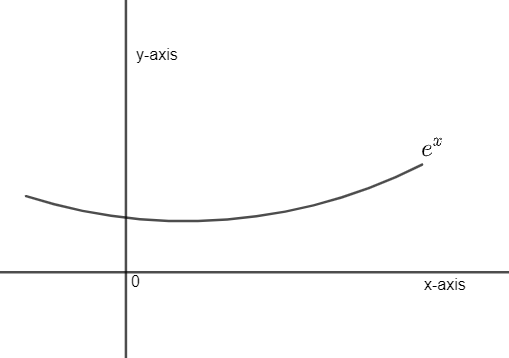
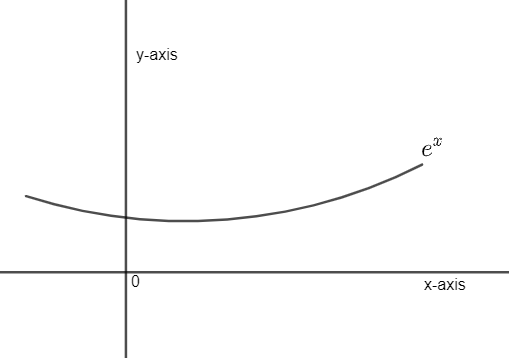
Here, our question has \[y=b{{e}^{\dfrac{x}{a}}}.\] When a = b = 1, then this resembles \[y={{e}^{x}}\] graph. The graph in our situation is also the same.
Let us assume a point \[P\left( {{x}_{1}},{{y}_{1}} \right)\] on the given curve, then \[P\left( {{x}_{1}},{{y}_{1}} \right)\] satisfies the curve \[y=b{{e}^{\dfrac{x}{a}}}.\] Hence, we have,
\[{{y}_{1}}=b{{e}^{\dfrac{{{x}_{1}}}{a}}}\]
Now to compute the subtangent, we will first compute \[\dfrac{dy}{dx}\] of \[y=\left( b{{e}^{\dfrac{x}{a}}} \right).\] \[\dfrac{dy}{dx}\] represents the slope of y. Then differentiate both the sides of \[y=b{{e}^{\dfrac{x}{a}}}\] with respect to x, we get,
\[\dfrac{dy}{dx}=b{{e}^{\dfrac{x}{a}}}\left( \dfrac{d}{dx}\left( \dfrac{x}{a} \right) \right)\]
\[\Rightarrow \dfrac{dy}{dx}=b{{e}^{\dfrac{x}{a}}}\left( \dfrac{1}{a} \right)\]
\[\Rightarrow \dfrac{dy}{dx}=\dfrac{b}{a}{{e}^{\dfrac{x}{a}}}\]
The slope of the tangent to any curve is given by
\[\Rightarrow m=\dfrac{dy}{dx}={{\left( \dfrac{dy}{dx} \right)}_{{{x}_{1}}{{y}_{1}}}}=\dfrac{b}{a}{{e}^{\dfrac{{{x}_{1}}}{a}}}=\dfrac{1}{a}{{y}_{1}}\]
As \[{{y}_{1}}=b{{e}^{\dfrac{{{x}_{1}}}{a}}}.\]
The slope of the subtangent is given by \[\dfrac{{{y}_{1}}}{a}.\] And now because the length of the sub tangents is given by the formula, \[\dfrac{{{y}_{1}}}{m}=\dfrac{{{y}_{1}}}{slope}\] and \[m=\dfrac{{{y}_{1}}}{a}.\] We can write it as \[a=\dfrac{{{y}_{1}}}{m}.\]
Hence, the length of the subtangent is \[\dfrac{{{y}_{1}}}{m}=a\] which is constant. Therefore, the subtangent is of constant length a. And the formula of the length of the subnormal is given by \[\left( {{y}_{1}},m \right)\] as \[m=\dfrac{{{y}_{1}}}{a}.\]
\[\Rightarrow \left| {{y}_{1}}m \right|=\left| {{y}_{1}}\dfrac{\left( {{y}_{1}} \right)}{a} \right|=\dfrac{\left| y_{1}^{2} \right|}{a}\]
This implies that the length of the subnormal is given by \[\dfrac{y_{1}^{2}}{a}.\] Now, this is not a constant, hence the length of the subnormal varies as y varies. Therefore, the length of the subnormal varies as the square of the ordinate varies. Therefore, the subtangent is of constant length and the subnormal varies as the square of the ordinate.
So, the correct answer is “Option a”.
Note: The length of the subnormal \[\dfrac{\left| {{y}^{2}} \right|}{a}\] and \[\dfrac{{{y}^{2}}}{a}\] because the square of any number ‘y’ always gives a positive value, so \[\left| {{y}^{2}} \right|\] and \[{{y}^{2}}\] doesn’t make any difference here. You can also go for applying a mod in the length of the subtangent as well. The mod is applied in such cases because the length can’t be negative (whether of subtangent or subnormal).
Complete step by step answer:
We are given the curve as \[y=b{{e}^{\dfrac{x}{a}}}.\] Let us explain the curve. We are given that \[y=b{{e}^{\dfrac{x}{a}}}.\] This is an exponential function. The graph of \[y={{e}^{x}}\] is given as below.
Here, our question has \[y=b{{e}^{\dfrac{x}{a}}}.\] When a = b = 1, then this resembles \[y={{e}^{x}}\] graph. The graph in our situation is also the same.
Let us assume a point \[P\left( {{x}_{1}},{{y}_{1}} \right)\] on the given curve, then \[P\left( {{x}_{1}},{{y}_{1}} \right)\] satisfies the curve \[y=b{{e}^{\dfrac{x}{a}}}.\] Hence, we have,
\[{{y}_{1}}=b{{e}^{\dfrac{{{x}_{1}}}{a}}}\]
Now to compute the subtangent, we will first compute \[\dfrac{dy}{dx}\] of \[y=\left( b{{e}^{\dfrac{x}{a}}} \right).\] \[\dfrac{dy}{dx}\] represents the slope of y. Then differentiate both the sides of \[y=b{{e}^{\dfrac{x}{a}}}\] with respect to x, we get,
\[\dfrac{dy}{dx}=b{{e}^{\dfrac{x}{a}}}\left( \dfrac{d}{dx}\left( \dfrac{x}{a} \right) \right)\]
\[\Rightarrow \dfrac{dy}{dx}=b{{e}^{\dfrac{x}{a}}}\left( \dfrac{1}{a} \right)\]
\[\Rightarrow \dfrac{dy}{dx}=\dfrac{b}{a}{{e}^{\dfrac{x}{a}}}\]
The slope of the tangent to any curve is given by
\[\Rightarrow m=\dfrac{dy}{dx}={{\left( \dfrac{dy}{dx} \right)}_{{{x}_{1}}{{y}_{1}}}}=\dfrac{b}{a}{{e}^{\dfrac{{{x}_{1}}}{a}}}=\dfrac{1}{a}{{y}_{1}}\]
As \[{{y}_{1}}=b{{e}^{\dfrac{{{x}_{1}}}{a}}}.\]
The slope of the subtangent is given by \[\dfrac{{{y}_{1}}}{a}.\] And now because the length of the sub tangents is given by the formula, \[\dfrac{{{y}_{1}}}{m}=\dfrac{{{y}_{1}}}{slope}\] and \[m=\dfrac{{{y}_{1}}}{a}.\] We can write it as \[a=\dfrac{{{y}_{1}}}{m}.\]
Hence, the length of the subtangent is \[\dfrac{{{y}_{1}}}{m}=a\] which is constant. Therefore, the subtangent is of constant length a. And the formula of the length of the subnormal is given by \[\left( {{y}_{1}},m \right)\] as \[m=\dfrac{{{y}_{1}}}{a}.\]
\[\Rightarrow \left| {{y}_{1}}m \right|=\left| {{y}_{1}}\dfrac{\left( {{y}_{1}} \right)}{a} \right|=\dfrac{\left| y_{1}^{2} \right|}{a}\]
This implies that the length of the subnormal is given by \[\dfrac{y_{1}^{2}}{a}.\] Now, this is not a constant, hence the length of the subnormal varies as y varies. Therefore, the length of the subnormal varies as the square of the ordinate varies. Therefore, the subtangent is of constant length and the subnormal varies as the square of the ordinate.
So, the correct answer is “Option a”.
Note: The length of the subnormal \[\dfrac{\left| {{y}^{2}} \right|}{a}\] and \[\dfrac{{{y}^{2}}}{a}\] because the square of any number ‘y’ always gives a positive value, so \[\left| {{y}^{2}} \right|\] and \[{{y}^{2}}\] doesn’t make any difference here. You can also go for applying a mod in the length of the subtangent as well. The mod is applied in such cases because the length can’t be negative (whether of subtangent or subnormal).
Recently Updated Pages
Master Class 11 Computer Science: Engaging Questions & Answers for Success

Master Class 11 Business Studies: Engaging Questions & Answers for Success
Master Class 11 Economics: Engaging Questions & Answers for Success
Master Class 11 English: Engaging Questions & Answers for Success
Master Class 11 Maths: Engaging Questions & Answers for Success
Master Class 11 Biology: Engaging Questions & Answers for Success
Trending doubts
One Metric ton is equal to kg A 10000 B 1000 C 100 class 11 physics CBSE
There are 720 permutations of the digits 1 2 3 4 5 class 11 maths CBSE
Discuss the various forms of bacteria class 11 biology CBSE
Draw a diagram of a plant cell and label at least eight class 11 biology CBSE
State the laws of reflection of light
Explain zero factorial class 11 maths CBSE