




For the circle \[{x^2} + {y^2} = {r^2}\], find the value of r for which the area enclosed by the tangents drawn from the point P (6,8) to the circle and the chord of contact is maximum.
A. 5
B. 6
C. 8
D. 4
Answer
 Verified
638.4k+ views
Hint: Area of triangle is maximum when the triangle is a symmetrical and equilateral triangle and all the angles of an equilateral triangle is \[60^\circ \]. Chord of a circle is a straight - line segment whose endpoints both lie on the circle.
Complete step by step solution:
Now let us first of all draw a diagram according to the statement given in the question.
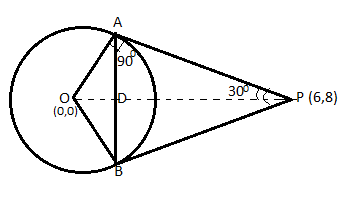
So, AP and BP are the tangents drawn with the radius ‘r’, AB is the chord of the circle and \[\vartriangle APB\]is the area enclosed by tangents and chord of the circle.
Now as given in question the area enclosed is the maximum area and the area of triangle is maximum when the triangle is a symmetrical equilateral triangle.
So, now we can say that the \[\vartriangle APB\] is an equilateral triangle.
Now if \[\vartriangle APB\]is an equilateral triangle then we must say that \[\angle APB = \angle PBA = \angle BAP = 60^\circ \]
And PD is the line which divides \[\vartriangle APB\]in two equal parts so we can say that PD also divides \[\angle APB\]in two equal angles.
Now in \[\vartriangle APO\]
Square of Base = \[{x^2} + {y^2} - {r^2}\]
( As square of the tangents of circle is equal to the \[{x^2} + {y^2} - {r^2}\] and here ( x , y ) = ( 6 , 8 ) )
And the perpendicular = r
( as the radius and tangents are perpendicular to each other )
So, by the Pythagoras theorem we get the PO ( i.e. hypotenuse ) of \[\vartriangle APO\].
\[ \Rightarrow \;P{O^2} = A{O^2} + A{P^2}\]
\[ \Rightarrow \;P{O^2} = ({r^2}) + ({x^2} + {y^2} - {r^2})\]
Putting the values of x and y in above equation
\[ \Rightarrow \;P{O^2} = ({r^2} + {6^2} + {8^2} - {r^2})\]
\[ \Rightarrow PO = \sqrt {100} = 10\]
Now applying \[\sin \theta \]in \[\vartriangle APO\]
As we know that, \[\sin \theta = \dfrac{{perpendicular}}{{hypotenuse}} = \dfrac{{OA}}{{10}}\] ( \[\theta = 30^\circ \])
\[ \Rightarrow \sin 30^\circ = \,\;\dfrac{r}{{10}}\]
\[ \Rightarrow \dfrac{1}{2} = \dfrac{r}{{10}}\] ( as \[\sin 30^\circ = \,\;\dfrac{1}{2}\] )
\[ \Rightarrow r = \,\,\,\dfrac{{10}}{2}\;\; = 5\]
So, the area enclosed with the chord and tangents is maximum when the radius of circle ‘r’ is 5.
Hence, A is the correct option.
Note: Whenever we come up with this type of problem we can also solve this question by applying \[\tan \theta = \dfrac{{perpendicular}}{{base}}\] in \[\vartriangle APO\] and by this we will get the value of base in terms of r and by further putting the value of base in Pythagoras theorem we can solve this question.
Complete step by step solution:
Now let us first of all draw a diagram according to the statement given in the question.
So, AP and BP are the tangents drawn with the radius ‘r’, AB is the chord of the circle and \[\vartriangle APB\]is the area enclosed by tangents and chord of the circle.
Now as given in question the area enclosed is the maximum area and the area of triangle is maximum when the triangle is a symmetrical equilateral triangle.
So, now we can say that the \[\vartriangle APB\] is an equilateral triangle.
Now if \[\vartriangle APB\]is an equilateral triangle then we must say that \[\angle APB = \angle PBA = \angle BAP = 60^\circ \]
And PD is the line which divides \[\vartriangle APB\]in two equal parts so we can say that PD also divides \[\angle APB\]in two equal angles.
Now in \[\vartriangle APO\]
Square of Base = \[{x^2} + {y^2} - {r^2}\]
( As square of the tangents of circle is equal to the \[{x^2} + {y^2} - {r^2}\] and here ( x , y ) = ( 6 , 8 ) )
And the perpendicular = r
( as the radius and tangents are perpendicular to each other )
So, by the Pythagoras theorem we get the PO ( i.e. hypotenuse ) of \[\vartriangle APO\].
\[ \Rightarrow \;P{O^2} = A{O^2} + A{P^2}\]
\[ \Rightarrow \;P{O^2} = ({r^2}) + ({x^2} + {y^2} - {r^2})\]
Putting the values of x and y in above equation
\[ \Rightarrow \;P{O^2} = ({r^2} + {6^2} + {8^2} - {r^2})\]
\[ \Rightarrow PO = \sqrt {100} = 10\]
Now applying \[\sin \theta \]in \[\vartriangle APO\]
As we know that, \[\sin \theta = \dfrac{{perpendicular}}{{hypotenuse}} = \dfrac{{OA}}{{10}}\] ( \[\theta = 30^\circ \])
\[ \Rightarrow \sin 30^\circ = \,\;\dfrac{r}{{10}}\]
\[ \Rightarrow \dfrac{1}{2} = \dfrac{r}{{10}}\] ( as \[\sin 30^\circ = \,\;\dfrac{1}{2}\] )
\[ \Rightarrow r = \,\,\,\dfrac{{10}}{2}\;\; = 5\]
So, the area enclosed with the chord and tangents is maximum when the radius of circle ‘r’ is 5.
Hence, A is the correct option.
Note: Whenever we come up with this type of problem we can also solve this question by applying \[\tan \theta = \dfrac{{perpendicular}}{{base}}\] in \[\vartriangle APO\] and by this we will get the value of base in terms of r and by further putting the value of base in Pythagoras theorem we can solve this question.
Recently Updated Pages
Master Class 11 English: Engaging Questions & Answers for Success

Master Class 11 Social Science: Engaging Questions & Answers for Success
Master Class 11 Maths: Engaging Questions & Answers for Success
Master Class 11 Biology: Engaging Questions & Answers for Success
Master Class 11 Physics: Engaging Questions & Answers for Success
Master Class 11 Chemistry: Engaging Questions & Answers for Success